

446
K. Imato and Y. Ooyama
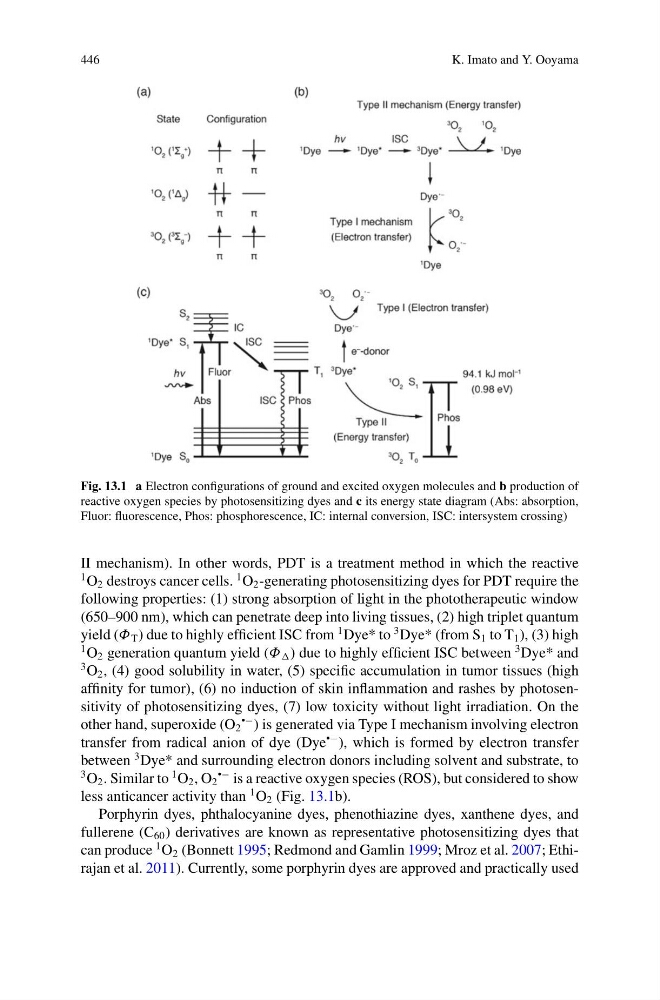
Fig. 13.1 a Electron configurations of ground and excited oxygen molecules and b production of
reactive oxygen species by photosensitizing dyes and c its energy state diagram (Abs: absorption,
Fluor: fluorescence, Phos: phosphorescence, IC: internal conversion, ISC: intersystem crossing)
II mechanism). In other words, PDT is a treatment method in which the reactive
1 O 2 destroys cancer cells.
1 O 2 -generating photosensitizing dyes for PDT require the
following properties: (1) strong absorption of light in the phototherapeutic window
(650–900 nm), which can penetrate deep into living tissues, (2) high triplet quantum
yield (Φ T ) due to highly efficient ISC from
1 Dye* to
3 Dye* (from S 1 to T 1 ), (3) high
1 O 2 generation quantum yield (Φ ) due to highly efficient ISC between
3 Dye* and
3 O 2 , (4) good solubility in water, (5) specific accumulation in tumor tissues (high
affinity for tumor), (6) no induction of skin inflammation and rashes by photosensitivity of photosensitizing dyes, (7) low toxicity without light irradiation. On the
other hand, superoxide (O 2
•− ) is generated via Type I mechanism involving electron
transfer from radical anion of dye (Dye
•− ), which is formed by electron transfer
between
3 Dye* and surrounding electron donors including solvent and substrate, to
3 O 2 . Similar to
1 O 2 , O 2
•− is a reactive oxygen species (ROS), but considered to show
less anticancer activity than
1 O 2 (Fig. 13.1b).
Porphyrin dyes, phthalocyanine dyes, phenothiazine dyes, xanthene dyes, and
fullerene (C 60 ) derivatives are known as representative photosensitizing dyes that
can produce
1 O 2 (Bonnett 1995; Redmond and Gamlin 1999; Mroz et al. 2007; Ethirajan et al. 2011). Currently, some porphyrin dyes are approved and practically used
K. Imato and Y. Ooyama
Fig. 13.1 a Electron configurations of ground and excited oxygen molecules and b production of
reactive oxygen species by photosensitizing dyes and c its energy state diagram (Abs: absorption,
Fluor: fluorescence, Phos: phosphorescence, IC: internal conversion, ISC: intersystem crossing)
II mechanism). In other words, PDT is a treatment method in which the reactive
1 O 2 destroys cancer cells.
1 O 2 -generating photosensitizing dyes for PDT require the
following properties: (1) strong absorption of light in the phototherapeutic window
(650–900 nm), which can penetrate deep into living tissues, (2) high triplet quantum
yield (Φ T ) due to highly efficient ISC from
1 Dye* to
3 Dye* (from S 1 to T 1 ), (3) high
1 O 2 generation quantum yield (Φ ) due to highly efficient ISC between
3 Dye* and
3 O 2 , (4) good solubility in water, (5) specific accumulation in tumor tissues (high
affinity for tumor), (6) no induction of skin inflammation and rashes by photosensitivity of photosensitizing dyes, (7) low toxicity without light irradiation. On the
other hand, superoxide (O 2
•− ) is generated via Type I mechanism involving electron
transfer from radical anion of dye (Dye
•− ), which is formed by electron transfer
between
3 Dye* and surrounding electron donors including solvent and substrate, to
3 O 2 . Similar to
1 O 2 , O 2
•− is a reactive oxygen species (ROS), but considered to show
less anticancer activity than
1 O 2 (Fig. 13.1b).
Porphyrin dyes, phthalocyanine dyes, phenothiazine dyes, xanthene dyes, and
fullerene (C 60 ) derivatives are known as representative photosensitizing dyes that
can produce
1 O 2 (Bonnett 1995; Redmond and Gamlin 1999; Mroz et al. 2007; Ethirajan et al. 2011). Currently, some porphyrin dyes are approved and practically used