

412
Y. Kubo
12.2 Hydrogen Bonding
Hydrogen bonding has been greatly used for the construction of supramolecules
(Jeffry 1997), which is essential in the formation of double strand DNA and protein
folding. A fascinating feature of interaction mode is the directionality of the hydrogen
bond, allowing for precise design of the targeted complexes and control of the geometry of supramolecules. The pioneering work for the production of supramoleculebased WLE materials was conducted by Meijer, Schenning, and co-workers (Abbel
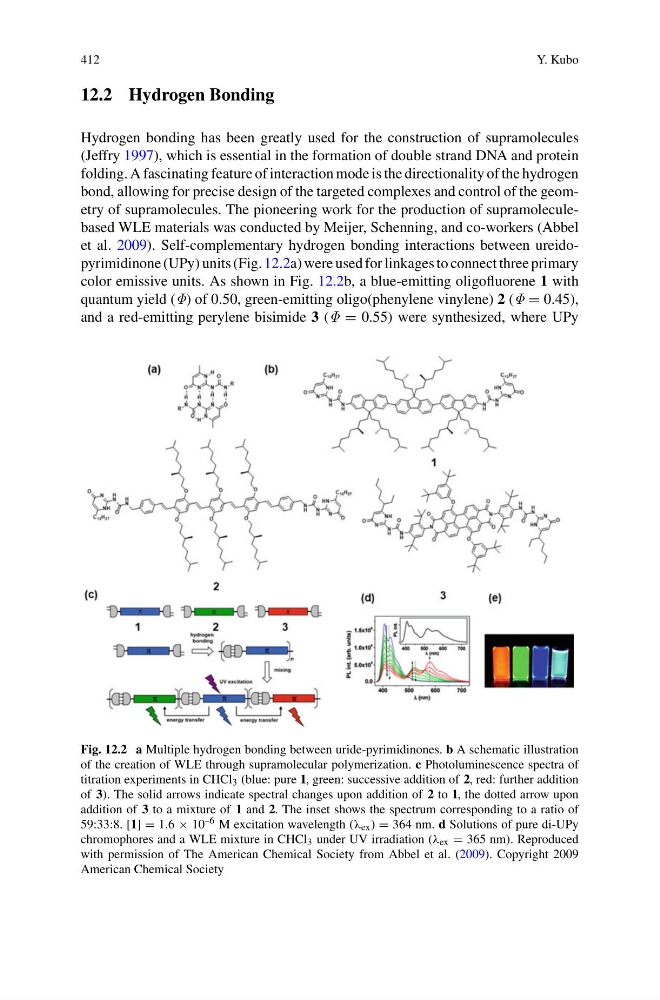
et al. 2009). Self-complementary hydrogen bonding interactions between ureidopyrimidinone (UPy) units (Fig. 12.2a) were used for linkages to connect three primary
color emissive units. As shown in Fig. 12.2b, a blue-emitting oligofluorene 1 with
quantum yield (F) of 0.50, green-emitting oligo(phenylene vinylene) 2 (F = 0.45),
and a red-emitting perylene bisimide 3 (F = 0.55) were synthesized, where UPy
Fig. 12.2 a Multiple hydrogen bonding between uride-pyrimidinones. b A schematic illustration
of the creation of WLE through supramolecular polymerization. c Photoluminescence spectra of
titration experiments in CHCl 3 (blue: pure 1, green: successive addition of 2, red: further addition
of 3). The solid arrows indicate spectral changes upon addition of 2 to 1, the dotted arrow upon
addition of 3 to a mixture of 1 and 2. The inset shows the spectrum corresponding to a ratio of
59:33:8. [1] = 1.6 × 10 –6 M excitation wavelength (λ ex ) = 364 nm. d Solutions of pure di-UPy
chromophores and a WLE mixture in CHCl 3 under UV irradiation (λ ex = 365 nm). Reproduced
with permission of The American Chemical Society from Abbel et al. (2009). Copyright 2009
American Chemical Society
Y. Kubo
12.2 Hydrogen Bonding
Hydrogen bonding has been greatly used for the construction of supramolecules
(Jeffry 1997), which is essential in the formation of double strand DNA and protein
folding. A fascinating feature of interaction mode is the directionality of the hydrogen
bond, allowing for precise design of the targeted complexes and control of the geometry of supramolecules. The pioneering work for the production of supramoleculebased WLE materials was conducted by Meijer, Schenning, and co-workers (Abbel
et al. 2009). Self-complementary hydrogen bonding interactions between ureidopyrimidinone (UPy) units (Fig. 12.2a) were used for linkages to connect three primary
color emissive units. As shown in Fig. 12.2b, a blue-emitting oligofluorene 1 with
quantum yield (F) of 0.50, green-emitting oligo(phenylene vinylene) 2 (F = 0.45),
and a red-emitting perylene bisimide 3 (F = 0.55) were synthesized, where UPy
Fig. 12.2 a Multiple hydrogen bonding between uride-pyrimidinones. b A schematic illustration
of the creation of WLE through supramolecular polymerization. c Photoluminescence spectra of
titration experiments in CHCl 3 (blue: pure 1, green: successive addition of 2, red: further addition
of 3). The solid arrows indicate spectral changes upon addition of 2 to 1, the dotted arrow upon
addition of 3 to a mixture of 1 and 2. The inset shows the spectrum corresponding to a ratio of
59:33:8. [1] = 1.6 × 10 –6 M excitation wavelength (λ ex ) = 364 nm. d Solutions of pure di-UPy
chromophores and a WLE mixture in CHCl 3 under UV irradiation (λ ex = 365 nm). Reproduced
with permission of The American Chemical Society from Abbel et al. (2009). Copyright 2009
American Chemical Society