

12 White-Light Emissive Materials Based on Supramolecular …
411
a well-organized microenvironment, which makes chemists fabricate plural dyecontaining systems. Subsequently, supramolecular self-assembly has great promise
for the generation of WLE materials. Efficacy of the energy transfer (E) is defined
by the following Eq. (12.1) (Lakowicz 2006):
E =
k ET
k ET + τ
−1
D
(12.1)
where k ET is the rate constant for the energy transfer process, being given by Eq. (12.2)
k ET = τ
−1
D A − τ
−1
D
(12.2)
in which τ DA and τ D are averaged lifetime values of the donor in the presence and
absence of the acceptor, respectively. The E value is also given by using the Förster
distance (R 0 ) and donor/acceptor distance (r). Accordingly, the donor/acceptor
distance can be experimentally evaluated using the following Eq. (12.3) when FRET
efficiency and the Förster distance are obtained. In this context, we should consider
the FRET efficiency affected by the acceptor concentration (Gartzia-Rivero et al.
2014).
E =
R
6
0
R
6
0 + r 6
(12.3)
In principle, the donor-to-acceptor energy transfer significantly depends on the
following parameters: distance, orientation factor, and overlap integral of donor and
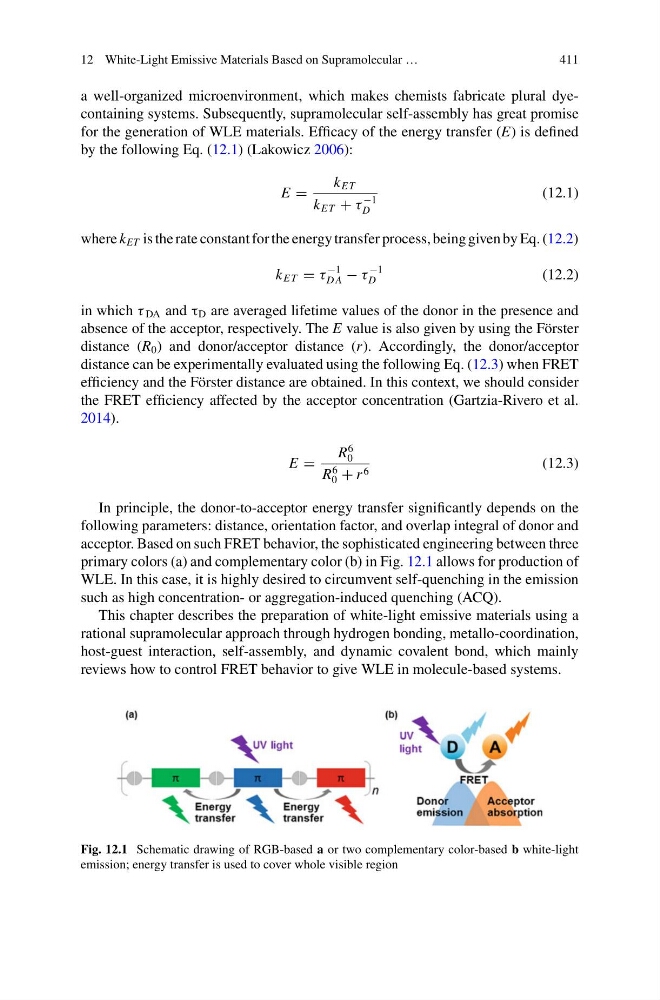
acceptor. Based on such FRET behavior, the sophisticated engineering between three
primary colors (a) and complementary color (b) in Fig. 12.1 allows for production of
WLE. In this case, it is highly desired to circumvent self-quenching in the emission
such as high concentration- or aggregation-induced quenching (ACQ).
This chapter describes the preparation of white-light emissive materials using a
rational supramolecular approach through hydrogen bonding, metallo-coordination,
host-guest interaction, self-assembly, and dynamic covalent bond, which mainly
reviews how to control FRET behavior to give WLE in molecule-based systems.
Fig. 12.1 Schematic drawing of RGB-based a or two complementary color-based b white-light
emission; energy transfer is used to cover whole visible region
411
a well-organized microenvironment, which makes chemists fabricate plural dyecontaining systems. Subsequently, supramolecular self-assembly has great promise
for the generation of WLE materials. Efficacy of the energy transfer (E) is defined
by the following Eq. (12.1) (Lakowicz 2006):
E =
k ET
k ET + τ
−1
D
(12.1)
where k ET is the rate constant for the energy transfer process, being given by Eq. (12.2)
k ET = τ
−1
D A − τ
−1
D
(12.2)
in which τ DA and τ D are averaged lifetime values of the donor in the presence and
absence of the acceptor, respectively. The E value is also given by using the Förster
distance (R 0 ) and donor/acceptor distance (r). Accordingly, the donor/acceptor
distance can be experimentally evaluated using the following Eq. (12.3) when FRET
efficiency and the Förster distance are obtained. In this context, we should consider
the FRET efficiency affected by the acceptor concentration (Gartzia-Rivero et al.
2014).
E =
R
6
0
R
6
0 + r 6
(12.3)
In principle, the donor-to-acceptor energy transfer significantly depends on the
following parameters: distance, orientation factor, and overlap integral of donor and
acceptor. Based on such FRET behavior, the sophisticated engineering between three
primary colors (a) and complementary color (b) in Fig. 12.1 allows for production of
WLE. In this case, it is highly desired to circumvent self-quenching in the emission
such as high concentration- or aggregation-induced quenching (ACQ).
This chapter describes the preparation of white-light emissive materials using a
rational supramolecular approach through hydrogen bonding, metallo-coordination,
host-guest interaction, self-assembly, and dynamic covalent bond, which mainly
reviews how to control FRET behavior to give WLE in molecule-based systems.
Fig. 12.1 Schematic drawing of RGB-based a or two complementary color-based b white-light
emission; energy transfer is used to cover whole visible region