

404
Y. Niko and S. Watanabe
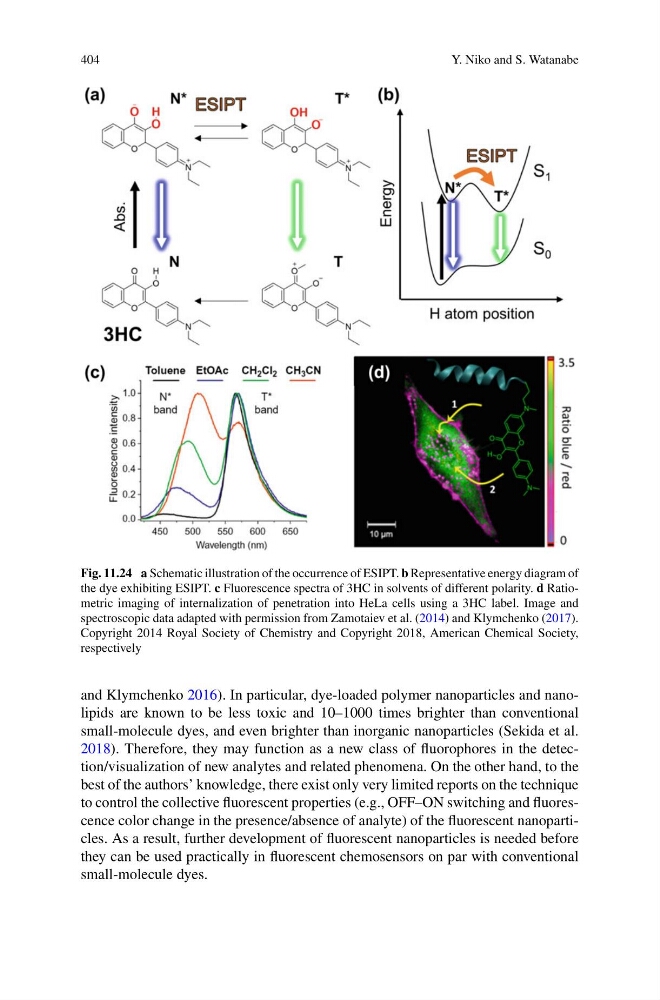
Fig. 11.24 a Schematic illustration of the occurrence of ESIPT. b Representative energy diagram of
the dye exhibiting ESIPT. c Fluorescence spectra of 3HC in solvents of different polarity. d Ratiometric imaging of internalization of penetration into HeLa cells using a 3HC label. Image and
spectroscopic data adapted with permission from Zamotaiev et al. (2014) and Klymchenko (2017).
Copyright 2014 Royal Society of Chemistry and Copyright 2018, American Chemical Society,
respectively
and Klymchenko 2016). In particular, dye-loaded polymer nanoparticles and nanolipids are known to be less toxic and 10–1000 times brighter than conventional
small-molecule dyes, and even brighter than inorganic nanoparticles (Sekida et al.
2018). Therefore, they may function as a new class of fluorophores in the detection/visualization of new analytes and related phenomena. On the other hand, to the
best of the authors’ knowledge, there exist only very limited reports on the technique
to control the collective fluorescent properties (e.g., OFF–ON switching and fluorescence color change in the presence/absence of analyte) of the fluorescent nanoparticles. As a result, further development of fluorescent nanoparticles is needed before
they can be used practically in fluorescent chemosensors on par with conventional
small-molecule dyes.
Y. Niko and S. Watanabe
Fig. 11.24 a Schematic illustration of the occurrence of ESIPT. b Representative energy diagram of
the dye exhibiting ESIPT. c Fluorescence spectra of 3HC in solvents of different polarity. d Ratiometric imaging of internalization of penetration into HeLa cells using a 3HC label. Image and
spectroscopic data adapted with permission from Zamotaiev et al. (2014) and Klymchenko (2017).
Copyright 2014 Royal Society of Chemistry and Copyright 2018, American Chemical Society,
respectively
and Klymchenko 2016). In particular, dye-loaded polymer nanoparticles and nanolipids are known to be less toxic and 10–1000 times brighter than conventional
small-molecule dyes, and even brighter than inorganic nanoparticles (Sekida et al.
2018). Therefore, they may function as a new class of fluorophores in the detection/visualization of new analytes and related phenomena. On the other hand, to the
best of the authors’ knowledge, there exist only very limited reports on the technique
to control the collective fluorescent properties (e.g., OFF–ON switching and fluorescence color change in the presence/absence of analyte) of the fluorescent nanoparticles. As a result, further development of fluorescent nanoparticles is needed before
they can be used practically in fluorescent chemosensors on par with conventional
small-molecule dyes.