

10 Circularly Polarized Luminescence (CPL) Based on Planar …
351
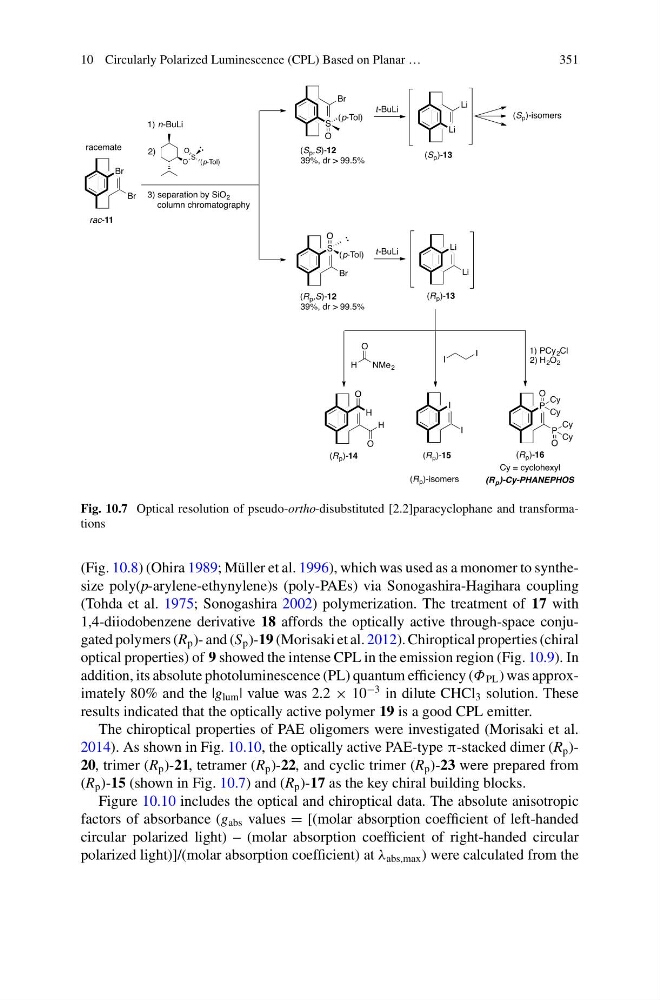
Fig. 10.7 Optical resolution of pseudo-ortho-disubstituted [2.2]paracyclophane and transformations
(Fig. 10.8) (Ohira 1989; Müller et al. 1996), which was used as a monomer to synthesize poly(p-arylene-ethynylene)s (poly-PAEs) via Sonogashira-Hagihara coupling
(Tohda et al. 1975; Sonogashira 2002) polymerization. The treatment of 17 with
1,4-diiodobenzene derivative 18 affords the optically active through-space conjugated polymers (R p )- and (S p )-19 (Morisaki et al. 2012). Chiroptical properties (chiral
optical properties) of 9 showed the intense CPL in the emission region (Fig. 10.9). In
addition, its absolute photoluminescence (PL) quantum efficiency (Φ PL ) was approximately 80% and the |g lum | value was 2.2 × 10
−3 in dilute CHCl 3 solution. These
results indicated that the optically active polymer 19 is a good CPL emitter.
The chiroptical properties of PAE oligomers were investigated (Morisaki et al.
2014). As shown in Fig. 10.10, the optically active PAE-type π-stacked dimer (R p )20, trimer (R p )-21, tetramer (R p )-22, and cyclic trimer (R p )-23 were prepared from
(R p )-15 (shown in Fig. 10.7) and (R p )-17 as the key chiral building blocks.
Figure 10.10 includes the optical and chiroptical data. The absolute anisotropic
factors of absorbance (g abs values = [(molar absorption coefficient of left-handed
circular polarized light) – (molar absorption coefficient of right-handed circular
polarized light)]/(molar absorption coefficient) at λ abs,max ) were calculated from the
351
Fig. 10.7 Optical resolution of pseudo-ortho-disubstituted [2.2]paracyclophane and transformations
(Fig. 10.8) (Ohira 1989; Müller et al. 1996), which was used as a monomer to synthesize poly(p-arylene-ethynylene)s (poly-PAEs) via Sonogashira-Hagihara coupling
(Tohda et al. 1975; Sonogashira 2002) polymerization. The treatment of 17 with
1,4-diiodobenzene derivative 18 affords the optically active through-space conjugated polymers (R p )- and (S p )-19 (Morisaki et al. 2012). Chiroptical properties (chiral
optical properties) of 9 showed the intense CPL in the emission region (Fig. 10.9). In
addition, its absolute photoluminescence (PL) quantum efficiency (Φ PL ) was approximately 80% and the |g lum | value was 2.2 × 10
−3 in dilute CHCl 3 solution. These
results indicated that the optically active polymer 19 is a good CPL emitter.
The chiroptical properties of PAE oligomers were investigated (Morisaki et al.
2014). As shown in Fig. 10.10, the optically active PAE-type π-stacked dimer (R p )20, trimer (R p )-21, tetramer (R p )-22, and cyclic trimer (R p )-23 were prepared from
(R p )-15 (shown in Fig. 10.7) and (R p )-17 as the key chiral building blocks.
Figure 10.10 includes the optical and chiroptical data. The absolute anisotropic
factors of absorbance (g abs values = [(molar absorption coefficient of left-handed
circular polarized light) – (molar absorption coefficient of right-handed circular
polarized light)]/(molar absorption coefficient) at λ abs,max ) were calculated from the