

350
Y. Morisaki
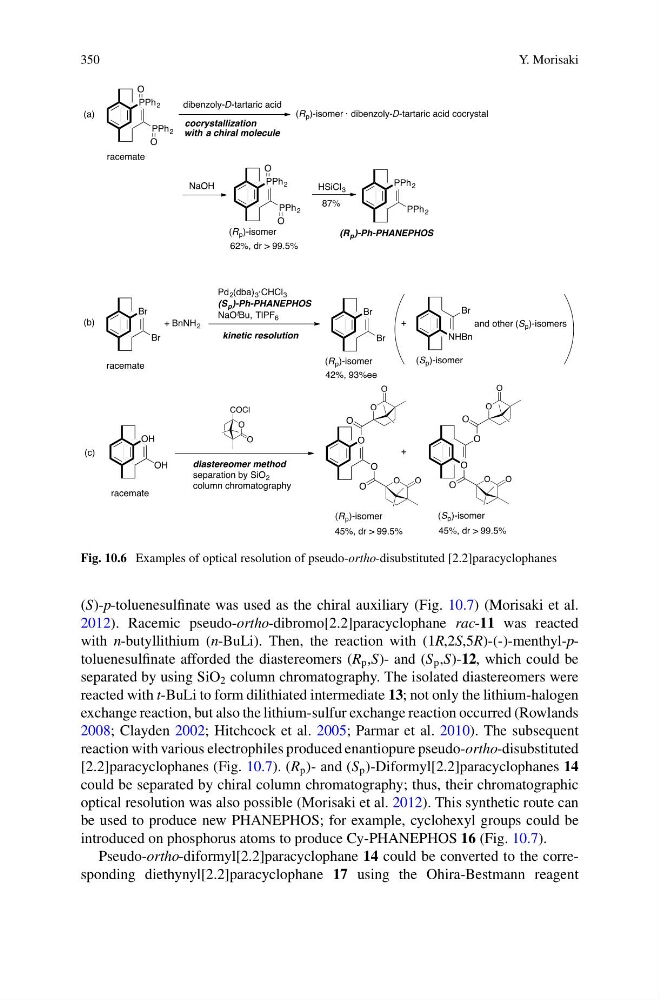
Fig. 10.6 Examples of optical resolution of pseudo-ortho-disubstituted [2.2]paracyclophanes
(S)-p-toluenesulfinate was used as the chiral auxiliary (Fig. 10.7) (Morisaki et al.
2012). Racemic pseudo-ortho-dibromo[2.2]paracyclophane rac-11 was reacted
with n-butyllithium (n-BuLi). Then, the reaction with (1R,2S,5R)-(-)-menthyl-ptoluenesulfinate afforded the diastereomers (R p ,S)- and (S p ,S)-12, which could be
separated by using SiO 2 column chromatography. The isolated diastereomers were
reacted with t-BuLi to form dilithiated intermediate 13; not only the lithium-halogen
exchange reaction, but also the lithium-sulfur exchange reaction occurred (Rowlands
2008; Clayden 2002; Hitchcock et al. 2005; Parmar et al. 2010). The subsequent
reaction with various electrophiles produced enantiopure pseudo-ortho-disubstituted
[2.2]paracyclophanes (Fig. 10.7). (R p )- and (S p )-Diformyl[2.2]paracyclophanes 14
could be separated by chiral column chromatography; thus, their chromatographic
optical resolution was also possible (Morisaki et al. 2012). This synthetic route can
be used to produce new PHANEPHOS; for example, cyclohexyl groups could be
introduced on phosphorus atoms to produce Cy-PHANEPHOS 16 (Fig. 10.7).
Pseudo-ortho-diformyl[2.2]paracyclophane 14 could be converted to the corresponding diethynyl[2.2]paracyclophane 17 using the Ohira-Bestmann reagent
Y. Morisaki
Fig. 10.6 Examples of optical resolution of pseudo-ortho-disubstituted [2.2]paracyclophanes
(S)-p-toluenesulfinate was used as the chiral auxiliary (Fig. 10.7) (Morisaki et al.
2012). Racemic pseudo-ortho-dibromo[2.2]paracyclophane rac-11 was reacted
with n-butyllithium (n-BuLi). Then, the reaction with (1R,2S,5R)-(-)-menthyl-ptoluenesulfinate afforded the diastereomers (R p ,S)- and (S p ,S)-12, which could be
separated by using SiO 2 column chromatography. The isolated diastereomers were
reacted with t-BuLi to form dilithiated intermediate 13; not only the lithium-halogen
exchange reaction, but also the lithium-sulfur exchange reaction occurred (Rowlands
2008; Clayden 2002; Hitchcock et al. 2005; Parmar et al. 2010). The subsequent
reaction with various electrophiles produced enantiopure pseudo-ortho-disubstituted
[2.2]paracyclophanes (Fig. 10.7). (R p )- and (S p )-Diformyl[2.2]paracyclophanes 14
could be separated by chiral column chromatography; thus, their chromatographic
optical resolution was also possible (Morisaki et al. 2012). This synthetic route can
be used to produce new PHANEPHOS; for example, cyclohexyl groups could be
introduced on phosphorus atoms to produce Cy-PHANEPHOS 16 (Fig. 10.7).
Pseudo-ortho-diformyl[2.2]paracyclophane 14 could be converted to the corresponding diethynyl[2.2]paracyclophane 17 using the Ohira-Bestmann reagent