

2 Squaraine Dyes
29
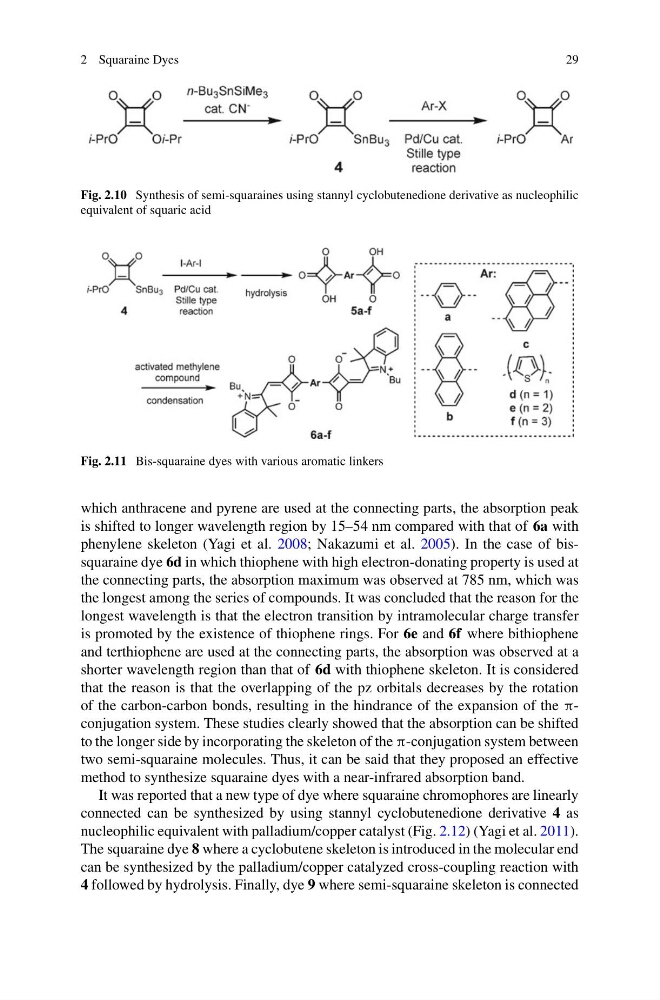
Fig. 2.10 Synthesis of semi-squaraines using stannyl cyclobutenedione derivative as nucleophilic
equivalent of squaric acid
Fig. 2.11 Bis-squaraine dyes with various aromatic linkers
which anthracene and pyrene are used at the connecting parts, the absorption peak
is shifted to longer wavelength region by 15–54 nm compared with that of 6a with
phenylene skeleton (Yagi et al. 2008; Nakazumi et al. 2005). In the case of bissquaraine dye 6d in which thiophene with high electron-donating property is used at
the connecting parts, the absorption maximum was observed at 785 nm, which was
the longest among the series of compounds. It was concluded that the reason for the
longest wavelength is that the electron transition by intramolecular charge transfer
is promoted by the existence of thiophene rings. For 6e and 6f where bithiophene
and terthiophene are used at the connecting parts, the absorption was observed at a
shorter wavelength region than that of 6d with thiophene skeleton. It is considered
that the reason is that the overlapping of the pz orbitals decreases by the rotation
of the carbon-carbon bonds, resulting in the hindrance of the expansion of the πconjugation system. These studies clearly showed that the absorption can be shifted
to the longer side by incorporating the skeleton of the π-conjugation system between
two semi-squaraine molecules. Thus, it can be said that they proposed an effective
method to synthesize squaraine dyes with a near-infrared absorption band.
It was reported that a new type of dye where squaraine chromophores are linearly
connected can be synthesized by using stannyl cyclobutenedione derivative 4 as
nucleophilic equivalent with palladium/copper catalyst (Fig. 2.12) (Yagi et al. 2011).
The squaraine dye 8 where a cyclobutene skeleton is introduced in the molecular end
can be synthesized by the palladium/copper catalyzed cross-coupling reaction with
4 followed by hydrolysis. Finally, dye 9 where semi-squaraine skeleton is connected
29
Fig. 2.10 Synthesis of semi-squaraines using stannyl cyclobutenedione derivative as nucleophilic
equivalent of squaric acid
Fig. 2.11 Bis-squaraine dyes with various aromatic linkers
which anthracene and pyrene are used at the connecting parts, the absorption peak
is shifted to longer wavelength region by 15–54 nm compared with that of 6a with
phenylene skeleton (Yagi et al. 2008; Nakazumi et al. 2005). In the case of bissquaraine dye 6d in which thiophene with high electron-donating property is used at
the connecting parts, the absorption maximum was observed at 785 nm, which was
the longest among the series of compounds. It was concluded that the reason for the
longest wavelength is that the electron transition by intramolecular charge transfer
is promoted by the existence of thiophene rings. For 6e and 6f where bithiophene
and terthiophene are used at the connecting parts, the absorption was observed at a
shorter wavelength region than that of 6d with thiophene skeleton. It is considered
that the reason is that the overlapping of the pz orbitals decreases by the rotation
of the carbon-carbon bonds, resulting in the hindrance of the expansion of the πconjugation system. These studies clearly showed that the absorption can be shifted
to the longer side by incorporating the skeleton of the π-conjugation system between
two semi-squaraine molecules. Thus, it can be said that they proposed an effective
method to synthesize squaraine dyes with a near-infrared absorption band.
It was reported that a new type of dye where squaraine chromophores are linearly
connected can be synthesized by using stannyl cyclobutenedione derivative 4 as
nucleophilic equivalent with palladium/copper catalyst (Fig. 2.12) (Yagi et al. 2011).
The squaraine dye 8 where a cyclobutene skeleton is introduced in the molecular end
can be synthesized by the palladium/copper catalyzed cross-coupling reaction with
4 followed by hydrolysis. Finally, dye 9 where semi-squaraine skeleton is connected