

348
Y. Morisaki
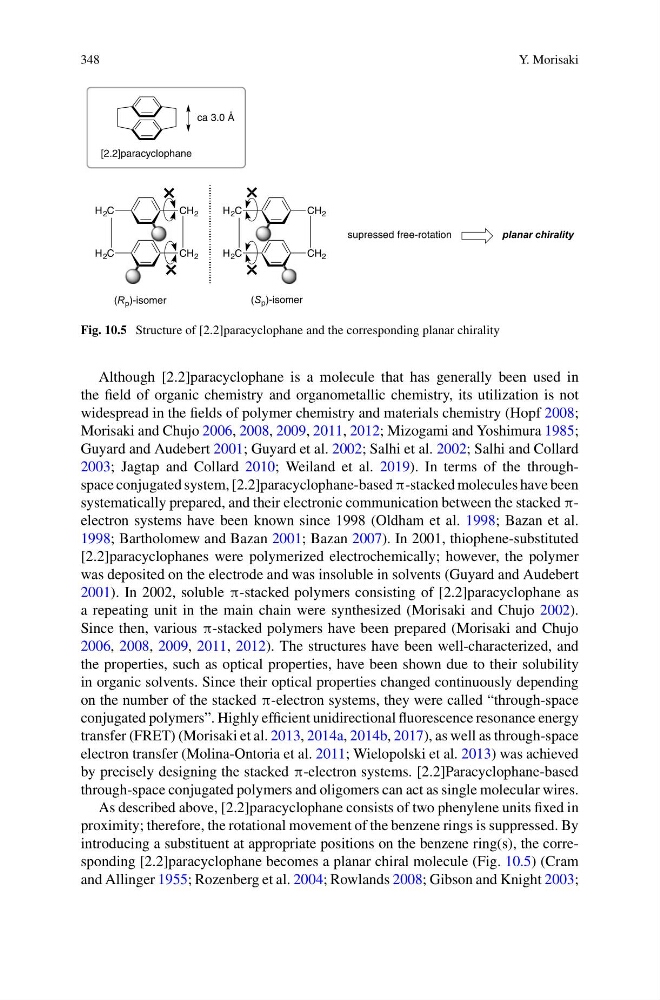
Fig. 10.5 Structure of [2.2]paracyclophane and the corresponding planar chirality
Although [2.2]paracyclophane is a molecule that has generally been used in
the field of organic chemistry and organometallic chemistry, its utilization is not
widespread in the fields of polymer chemistry and materials chemistry (Hopf 2008;
Morisaki and Chujo 2006, 2008, 2009, 2011, 2012; Mizogami and Yoshimura 1985;
Guyard and Audebert 2001; Guyard et al. 2002; Salhi et al. 2002; Salhi and Collard
2003; Jagtap and Collard 2010; Weiland et al. 2019). In terms of the throughspace conjugated system, [2.2]paracyclophane-based π-stacked molecules have been
systematically prepared, and their electronic communication between the stacked πelectron systems have been known since 1998 (Oldham et al. 1998; Bazan et al.
1998; Bartholomew and Bazan 2001; Bazan 2007). In 2001, thiophene-substituted
[2.2]paracyclophanes were polymerized electrochemically; however, the polymer
was deposited on the electrode and was insoluble in solvents (Guyard and Audebert
2001). In 2002, soluble π-stacked polymers consisting of [2.2]paracyclophane as
a repeating unit in the main chain were synthesized (Morisaki and Chujo 2002).
Since then, various π-stacked polymers have been prepared (Morisaki and Chujo
2006, 2008, 2009, 2011, 2012). The structures have been well-characterized, and
the properties, such as optical properties, have been shown due to their solubility
in organic solvents. Since their optical properties changed continuously depending
on the number of the stacked π-electron systems, they were called “through-space
conjugated polymers”. Highly efficient unidirectional fluorescence resonance energy
transfer (FRET) (Morisaki et al. 2013, 2014a, 2014b, 2017), as well as through-space
electron transfer (Molina-Ontoria et al. 2011; Wielopolski et al. 2013) was achieved
by precisely designing the stacked π-electron systems. [2.2]Paracyclophane-based
through-space conjugated polymers and oligomers can act as single molecular wires.
As described above, [2.2]paracyclophane consists of two phenylene units fixed in
proximity; therefore, the rotational movement of the benzene rings is suppressed. By
introducing a substituent at appropriate positions on the benzene ring(s), the corresponding [2.2]paracyclophane becomes a planar chiral molecule (Fig. 10.5) (Cram
and Allinger 1955; Rozenberg et al. 2004; Rowlands 2008; Gibson and Knight 2003;
Y. Morisaki
Fig. 10.5 Structure of [2.2]paracyclophane and the corresponding planar chirality
Although [2.2]paracyclophane is a molecule that has generally been used in
the field of organic chemistry and organometallic chemistry, its utilization is not
widespread in the fields of polymer chemistry and materials chemistry (Hopf 2008;
Morisaki and Chujo 2006, 2008, 2009, 2011, 2012; Mizogami and Yoshimura 1985;
Guyard and Audebert 2001; Guyard et al. 2002; Salhi et al. 2002; Salhi and Collard
2003; Jagtap and Collard 2010; Weiland et al. 2019). In terms of the throughspace conjugated system, [2.2]paracyclophane-based π-stacked molecules have been
systematically prepared, and their electronic communication between the stacked πelectron systems have been known since 1998 (Oldham et al. 1998; Bazan et al.
1998; Bartholomew and Bazan 2001; Bazan 2007). In 2001, thiophene-substituted
[2.2]paracyclophanes were polymerized electrochemically; however, the polymer
was deposited on the electrode and was insoluble in solvents (Guyard and Audebert
2001). In 2002, soluble π-stacked polymers consisting of [2.2]paracyclophane as
a repeating unit in the main chain were synthesized (Morisaki and Chujo 2002).
Since then, various π-stacked polymers have been prepared (Morisaki and Chujo
2006, 2008, 2009, 2011, 2012). The structures have been well-characterized, and
the properties, such as optical properties, have been shown due to their solubility
in organic solvents. Since their optical properties changed continuously depending
on the number of the stacked π-electron systems, they were called “through-space
conjugated polymers”. Highly efficient unidirectional fluorescence resonance energy
transfer (FRET) (Morisaki et al. 2013, 2014a, 2014b, 2017), as well as through-space
electron transfer (Molina-Ontoria et al. 2011; Wielopolski et al. 2013) was achieved
by precisely designing the stacked π-electron systems. [2.2]Paracyclophane-based
through-space conjugated polymers and oligomers can act as single molecular wires.
As described above, [2.2]paracyclophane consists of two phenylene units fixed in
proximity; therefore, the rotational movement of the benzene rings is suppressed. By
introducing a substituent at appropriate positions on the benzene ring(s), the corresponding [2.2]paracyclophane becomes a planar chiral molecule (Fig. 10.5) (Cram
and Allinger 1955; Rozenberg et al. 2004; Rowlands 2008; Gibson and Knight 2003;