

10 Circularly Polarized Luminescence (CPL) Based on Planar …
347
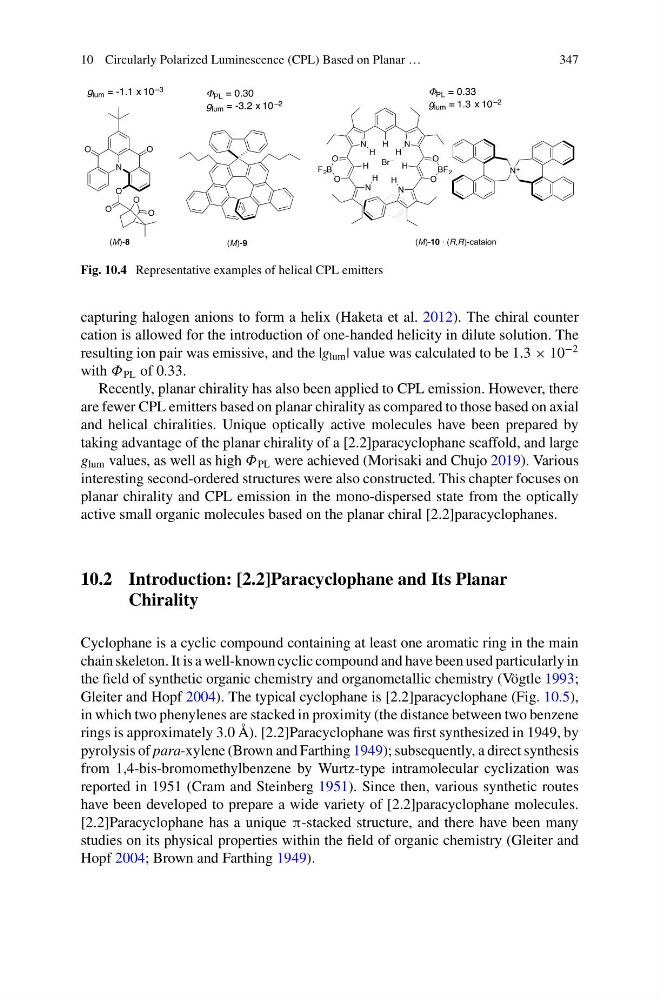
Fig. 10.4 Representative examples of helical CPL emitters
capturing halogen anions to form a helix (Haketa et al. 2012). The chiral counter
cation is allowed for the introduction of one-handed helicity in dilute solution. The
resulting ion pair was emissive, and the |g lum | value was calculated to be 1.3 × 10
−2
with Φ PL of 0.33.
Recently, planar chirality has also been applied to CPL emission. However, there
are fewer CPL emitters based on planar chirality as compared to those based on axial
and helical chiralities. Unique optically active molecules have been prepared by
taking advantage of the planar chirality of a [2.2]paracyclophane scaffold, and large
g lum values, as well as high Φ PL were achieved (Morisaki and Chujo 2019). Various
interesting second-ordered structures were also constructed. This chapter focuses on
planar chirality and CPL emission in the mono-dispersed state from the optically
active small organic molecules based on the planar chiral [2.2]paracyclophanes.
10.2 Introduction: [2.2]Paracyclophane and Its Planar
Chirality
Cyclophane is a cyclic compound containing at least one aromatic ring in the main
chain skeleton. It is a well-known cyclic compound and have been used particularly in
the field of synthetic organic chemistry and organometallic chemistry (Vögtle 1993;
Gleiter and Hopf 2004). The typical cyclophane is [2.2]paracyclophane (Fig. 10.5),
in which two phenylenes are stacked in proximity (the distance between two benzene
rings is approximately 3.0 Å). [2.2]Paracyclophane was first synthesized in 1949, by
pyrolysis of para-xylene (Brown and Farthing 1949); subsequently, a direct synthesis
from 1,4-bis-bromomethylbenzene by Wurtz-type intramolecular cyclization was
reported in 1951 (Cram and Steinberg 1951). Since then, various synthetic routes
have been developed to prepare a wide variety of [2.2]paracyclophane molecules.
[2.2]Paracyclophane has a unique π-stacked structure, and there have been many
studies on its physical properties within the field of organic chemistry (Gleiter and
Hopf 2004; Brown and Farthing 1949).
347
Fig. 10.4 Representative examples of helical CPL emitters
capturing halogen anions to form a helix (Haketa et al. 2012). The chiral counter
cation is allowed for the introduction of one-handed helicity in dilute solution. The
resulting ion pair was emissive, and the |g lum | value was calculated to be 1.3 × 10
−2
with Φ PL of 0.33.
Recently, planar chirality has also been applied to CPL emission. However, there
are fewer CPL emitters based on planar chirality as compared to those based on axial
and helical chiralities. Unique optically active molecules have been prepared by
taking advantage of the planar chirality of a [2.2]paracyclophane scaffold, and large
g lum values, as well as high Φ PL were achieved (Morisaki and Chujo 2019). Various
interesting second-ordered structures were also constructed. This chapter focuses on
planar chirality and CPL emission in the mono-dispersed state from the optically
active small organic molecules based on the planar chiral [2.2]paracyclophanes.
10.2 Introduction: [2.2]Paracyclophane and Its Planar
Chirality
Cyclophane is a cyclic compound containing at least one aromatic ring in the main
chain skeleton. It is a well-known cyclic compound and have been used particularly in
the field of synthetic organic chemistry and organometallic chemistry (Vögtle 1993;
Gleiter and Hopf 2004). The typical cyclophane is [2.2]paracyclophane (Fig. 10.5),
in which two phenylenes are stacked in proximity (the distance between two benzene
rings is approximately 3.0 Å). [2.2]Paracyclophane was first synthesized in 1949, by
pyrolysis of para-xylene (Brown and Farthing 1949); subsequently, a direct synthesis
from 1,4-bis-bromomethylbenzene by Wurtz-type intramolecular cyclization was
reported in 1951 (Cram and Steinberg 1951). Since then, various synthetic routes
have been developed to prepare a wide variety of [2.2]paracyclophane molecules.
[2.2]Paracyclophane has a unique π-stacked structure, and there have been many
studies on its physical properties within the field of organic chemistry (Gleiter and
Hopf 2004; Brown and Farthing 1949).