

26
T. Maeda
between squaric acid and thionyl chloride (or oxalyl chloride), squaraine dyes of
1,2-substitution are selectively obtained (Fig. 2.6b) (Ried and Vogl 1977). Further,
squaraine dyes of 1,2-substitution have been recently synthesized by the LiebeskindSrogl cross-coupling reaction using palladium catalyst (Fig. 2.6c) (Aguilar-Aguilar
and Pena-Cabrera 2007).
When activated methylene compounds and squaric acid are reacted under the
azeotropic condition, 1,3-substituted squaraine dyes are selectively obtained like
arene. However, 1,2-substitution that is the regioisomer seems to be also produced
by this reaction. Beverina et al. have clarified that the squaraine of 1,2-substitution
is regioselectively produced by the condensation reaction between ethyl ester of
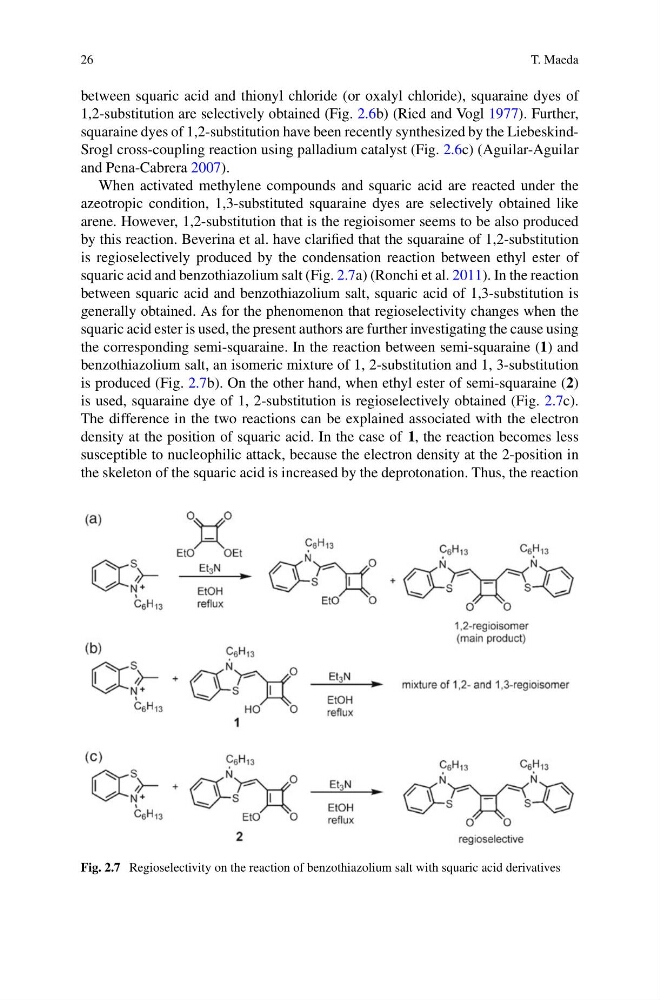
squaric acid and benzothiazolium salt (Fig. 2.7a) (Ronchi et al. 2011). In the reaction
between squaric acid and benzothiazolium salt, squaric acid of 1,3-substitution is
generally obtained. As for the phenomenon that regioselectivity changes when the
squaric acid ester is used, the present authors are further investigating the cause using
the corresponding semi-squaraine. In the reaction between semi-squaraine (1) and
benzothiazolium salt, an isomeric mixture of 1, 2-substitution and 1, 3-substitution
is produced (Fig. 2.7b). On the other hand, when ethyl ester of semi-squaraine (2)
is used, squaraine dye of 1, 2-substitution is regioselectively obtained (Fig. 2.7c).
The difference in the two reactions can be explained associated with the electron
density at the position of squaric acid. In the case of 1, the reaction becomes less
susceptible to nucleophilic attack, because the electron density at the 2-position in
the skeleton of the squaric acid is increased by the deprotonation. Thus, the reaction
Fig. 2.7 Regioselectivity on the reaction of benzothiazolium salt with squaric acid derivatives
T. Maeda
between squaric acid and thionyl chloride (or oxalyl chloride), squaraine dyes of
1,2-substitution are selectively obtained (Fig. 2.6b) (Ried and Vogl 1977). Further,
squaraine dyes of 1,2-substitution have been recently synthesized by the LiebeskindSrogl cross-coupling reaction using palladium catalyst (Fig. 2.6c) (Aguilar-Aguilar
and Pena-Cabrera 2007).
When activated methylene compounds and squaric acid are reacted under the
azeotropic condition, 1,3-substituted squaraine dyes are selectively obtained like
arene. However, 1,2-substitution that is the regioisomer seems to be also produced
by this reaction. Beverina et al. have clarified that the squaraine of 1,2-substitution
is regioselectively produced by the condensation reaction between ethyl ester of
squaric acid and benzothiazolium salt (Fig. 2.7a) (Ronchi et al. 2011). In the reaction
between squaric acid and benzothiazolium salt, squaric acid of 1,3-substitution is
generally obtained. As for the phenomenon that regioselectivity changes when the
squaric acid ester is used, the present authors are further investigating the cause using
the corresponding semi-squaraine. In the reaction between semi-squaraine (1) and
benzothiazolium salt, an isomeric mixture of 1, 2-substitution and 1, 3-substitution
is produced (Fig. 2.7b). On the other hand, when ethyl ester of semi-squaraine (2)
is used, squaraine dye of 1, 2-substitution is regioselectively obtained (Fig. 2.7c).
The difference in the two reactions can be explained associated with the electron
density at the position of squaric acid. In the case of 1, the reaction becomes less
susceptible to nucleophilic attack, because the electron density at the 2-position in
the skeleton of the squaric acid is increased by the deprotonation. Thus, the reaction
Fig. 2.7 Regioselectivity on the reaction of benzothiazolium salt with squaric acid derivatives