

8 Red and Near-IR Fluorescent Two-Photon Absorption Dyes
297
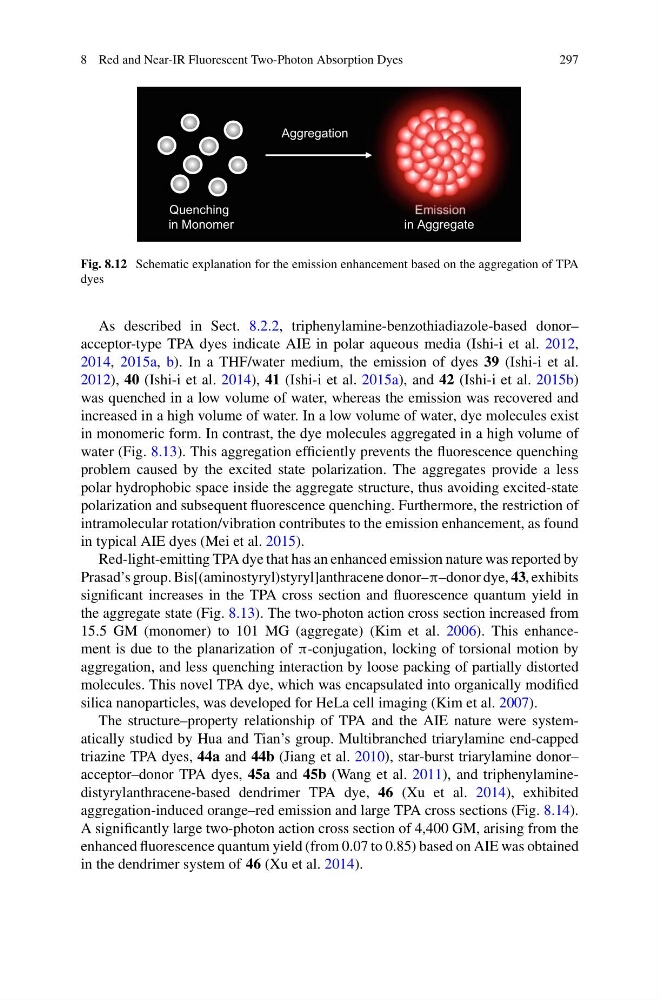
in Aggregate
Aggregation
Quenching
in Monomer
Fig. 8.12 Schematic explanation for the emission enhancement based on the aggregation of TPA
dyes
As described in Sect. 8.2.2, triphenylamine-benzothiadiazole-based donor–
acceptor-type TPA dyes indicate AIE in polar aqueous media (Ishi-i et al. 2012,
2014, 2015a, b). In a THF/water medium, the emission of dyes 39 (Ishi-i et al.
2012), 40 (Ishi-i et al. 2014), 41 (Ishi-i et al. 2015a), and 42 (Ishi-i et al. 2015b)
was quenched in a low volume of water, whereas the emission was recovered and
increased in a high volume of water. In a low volume of water, dye molecules exist
in monomeric form. In contrast, the dye molecules aggregated in a high volume of
water (Fig. 8.13). This aggregation efficiently prevents the fluorescence quenching
problem caused by the excited state polarization. The aggregates provide a less
polar hydrophobic space inside the aggregate structure, thus avoiding excited-state
polarization and subsequent fluorescence quenching. Furthermore, the restriction of
intramolecular rotation/vibration contributes to the emission enhancement, as found
in typical AIE dyes (Mei et al. 2015).
Red-light-emitting TPA dye that has an enhanced emission nature was reported by
Prasad’s group. Bis[(aminostyryl)styryl]anthracene donor–π–donor dye, 43, exhibits
significant increases in the TPA cross section and fluorescence quantum yield in
the aggregate state (Fig. 8.13). The two-photon action cross section increased from
15.5 GM (monomer) to 101 MG (aggregate) (Kim et al. 2006). This enhancement is due to the planarization of π-conjugation, locking of torsional motion by
aggregation, and less quenching interaction by loose packing of partially distorted
molecules. This novel TPA dye, which was encapsulated into organically modified
silica nanoparticles, was developed for HeLa cell imaging (Kim et al. 2007).
The structure–property relationship of TPA and the AIE nature were systematically studied by Hua and Tian’s group. Multibranched triarylamine end-capped
triazine TPA dyes, 44a and 44b (Jiang et al. 2010), star-burst triarylamine donor–
acceptor–donor TPA dyes, 45a and 45b (Wang et al. 2011), and triphenylaminedistyrylanthracene-based dendrimer TPA dye, 46 (Xu et al. 2014), exhibited
aggregation-induced orange–red emission and large TPA cross sections (Fig. 8.14).
A significantly large two-photon action cross section of 4,400 GM, arising from the
enhanced fluorescence quantum yield (from 0.07 to 0.85) based on AIE was obtained
in the dendrimer system of 46 (Xu et al. 2014).
297
in Aggregate
Aggregation
Quenching
in Monomer
Fig. 8.12 Schematic explanation for the emission enhancement based on the aggregation of TPA
dyes
As described in Sect. 8.2.2, triphenylamine-benzothiadiazole-based donor–
acceptor-type TPA dyes indicate AIE in polar aqueous media (Ishi-i et al. 2012,
2014, 2015a, b). In a THF/water medium, the emission of dyes 39 (Ishi-i et al.
2012), 40 (Ishi-i et al. 2014), 41 (Ishi-i et al. 2015a), and 42 (Ishi-i et al. 2015b)
was quenched in a low volume of water, whereas the emission was recovered and
increased in a high volume of water. In a low volume of water, dye molecules exist
in monomeric form. In contrast, the dye molecules aggregated in a high volume of
water (Fig. 8.13). This aggregation efficiently prevents the fluorescence quenching
problem caused by the excited state polarization. The aggregates provide a less
polar hydrophobic space inside the aggregate structure, thus avoiding excited-state
polarization and subsequent fluorescence quenching. Furthermore, the restriction of
intramolecular rotation/vibration contributes to the emission enhancement, as found
in typical AIE dyes (Mei et al. 2015).
Red-light-emitting TPA dye that has an enhanced emission nature was reported by
Prasad’s group. Bis[(aminostyryl)styryl]anthracene donor–π–donor dye, 43, exhibits
significant increases in the TPA cross section and fluorescence quantum yield in
the aggregate state (Fig. 8.13). The two-photon action cross section increased from
15.5 GM (monomer) to 101 MG (aggregate) (Kim et al. 2006). This enhancement is due to the planarization of π-conjugation, locking of torsional motion by
aggregation, and less quenching interaction by loose packing of partially distorted
molecules. This novel TPA dye, which was encapsulated into organically modified
silica nanoparticles, was developed for HeLa cell imaging (Kim et al. 2007).
The structure–property relationship of TPA and the AIE nature were systematically studied by Hua and Tian’s group. Multibranched triarylamine end-capped
triazine TPA dyes, 44a and 44b (Jiang et al. 2010), star-burst triarylamine donor–
acceptor–donor TPA dyes, 45a and 45b (Wang et al. 2011), and triphenylaminedistyrylanthracene-based dendrimer TPA dye, 46 (Xu et al. 2014), exhibited
aggregation-induced orange–red emission and large TPA cross sections (Fig. 8.14).
A significantly large two-photon action cross section of 4,400 GM, arising from the
enhanced fluorescence quantum yield (from 0.07 to 0.85) based on AIE was obtained
in the dendrimer system of 46 (Xu et al. 2014).