

8 Red and Near-IR Fluorescent Two-Photon Absorption Dyes
295
Bu 2 N
37
420 GM at 960 nm (toluene),
em 690 nm, F 0.02 (PBS, pH 7),
em 617 nm, F 0.33 (PBS, pH 7, with Cremophor EL)
O
B
N
F
F
F
36
F 100 GM, 160 GM at 1,552 nm, em 800 nm, F 0.64 (DMSO),
F 38 GM, 74 GM at 1,552 nm (MeOH)
N
+
S
N
S
I
-
O
Et 2 N
38a: R = NH 2
38b: R = NMe 2
38c: R = N 3
38a: F 180 GM at 820 nm, em 725 nm, F 0.13 (PBS, pH 7.4)
38b: F 190 GM at 820 nm, em 750 nm, F 0.11 (PBS, pH 7.4)
R
+
33
F 880 GM at 950 nm and 304 GM at 1050 nm (DMSO),
em 650 nm, F 0.80 (DMSO)
N
+
N
+
I
-
I
-
34
1,454 GM at 890 nm, em 600 nm (MeOH),
814 GM at 890 nm, em 600 nm (MeCN)
N
N
+
+ N (CH 2 ) 11 CH 3
CH 3 (CH 2 ) 11
I
-
I
-
N
O
N
+
(CH 2 ) 5 CH 3
+ N
CH 3 (CH 2 ) 5
I
-
I
-
em 570 nm, F 0.12 (DMF, monomer),
em 610 nm, F 0.01 (water, aggregate)
35
RNA
Nonfluorescence
Strong Fluorescence
(25-fold enhancement)
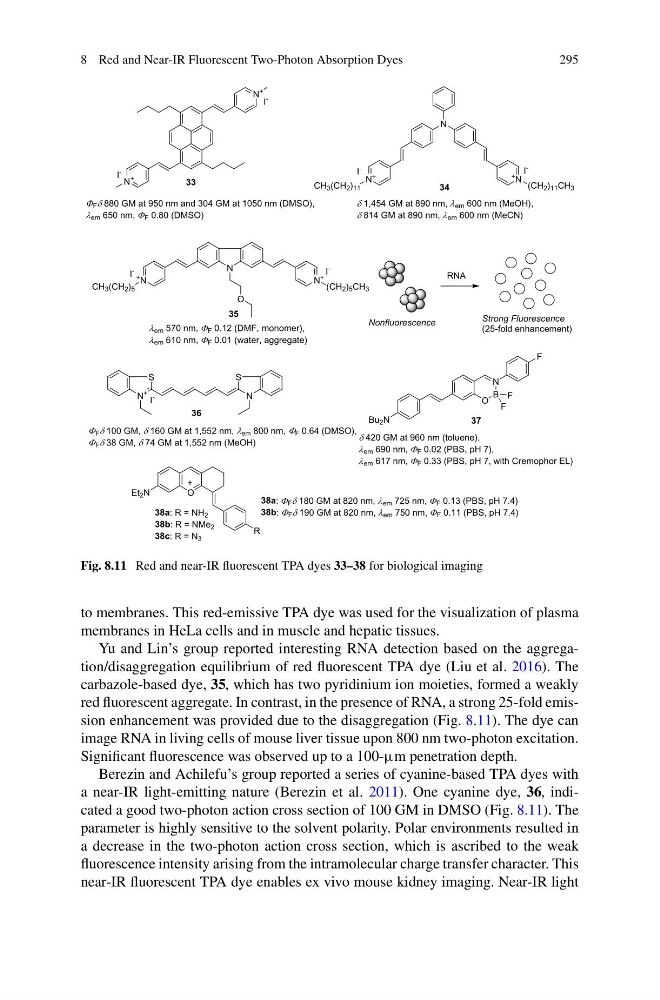
Fig. 8.11 Red and near-IR fluorescent TPA dyes 33–38 for biological imaging
to membranes. This red-emissive TPA dye was used for the visualization of plasma
membranes in HeLa cells and in muscle and hepatic tissues.
Yu and Lin’s group reported interesting RNA detection based on the aggregation/disaggregation equilibrium of red fluorescent TPA dye (Liu et al. 2016). The
carbazole-based dye, 35, which has two pyridinium ion moieties, formed a weakly
red fluorescent aggregate. In contrast, in the presence of RNA, a strong 25-fold emission enhancement was provided due to the disaggregation (Fig. 8.11). The dye can
image RNA in living cells of mouse liver tissue upon 800 nm two-photon excitation.
Significant fluorescence was observed up to a 100-μm penetration depth.
Berezin and Achilefu’s group reported a series of cyanine-based TPA dyes with
a near-IR light-emitting nature (Berezin et al. 2011). One cyanine dye, 36, indicated a good two-photon action cross section of 100 GM in DMSO (Fig. 8.11). The
parameter is highly sensitive to the solvent polarity. Polar environments resulted in
a decrease in the two-photon action cross section, which is ascribed to the weak
fluorescence intensity arising from the intramolecular charge transfer character. This
near-IR fluorescent TPA dye enables ex vivo mouse kidney imaging. Near-IR light
295
Bu 2 N
37
420 GM at 960 nm (toluene),
em 690 nm, F 0.02 (PBS, pH 7),
em 617 nm, F 0.33 (PBS, pH 7, with Cremophor EL)
O
B
N
F
F
F
36
F 100 GM, 160 GM at 1,552 nm, em 800 nm, F 0.64 (DMSO),
F 38 GM, 74 GM at 1,552 nm (MeOH)
N
+
S
N
S
I
-
O
Et 2 N
38a: R = NH 2
38b: R = NMe 2
38c: R = N 3
38a: F 180 GM at 820 nm, em 725 nm, F 0.13 (PBS, pH 7.4)
38b: F 190 GM at 820 nm, em 750 nm, F 0.11 (PBS, pH 7.4)
R
+
33
F 880 GM at 950 nm and 304 GM at 1050 nm (DMSO),
em 650 nm, F 0.80 (DMSO)
N
+
N
+
I
-
I
-
34
1,454 GM at 890 nm, em 600 nm (MeOH),
814 GM at 890 nm, em 600 nm (MeCN)
N
N
+
+ N (CH 2 ) 11 CH 3
CH 3 (CH 2 ) 11
I
-
I
-
N
O
N
+
(CH 2 ) 5 CH 3
+ N
CH 3 (CH 2 ) 5
I
-
I
-
em 570 nm, F 0.12 (DMF, monomer),
em 610 nm, F 0.01 (water, aggregate)
35
RNA
Nonfluorescence
Strong Fluorescence
(25-fold enhancement)
Fig. 8.11 Red and near-IR fluorescent TPA dyes 33–38 for biological imaging
to membranes. This red-emissive TPA dye was used for the visualization of plasma
membranes in HeLa cells and in muscle and hepatic tissues.
Yu and Lin’s group reported interesting RNA detection based on the aggregation/disaggregation equilibrium of red fluorescent TPA dye (Liu et al. 2016). The
carbazole-based dye, 35, which has two pyridinium ion moieties, formed a weakly
red fluorescent aggregate. In contrast, in the presence of RNA, a strong 25-fold emission enhancement was provided due to the disaggregation (Fig. 8.11). The dye can
image RNA in living cells of mouse liver tissue upon 800 nm two-photon excitation.
Significant fluorescence was observed up to a 100-μm penetration depth.
Berezin and Achilefu’s group reported a series of cyanine-based TPA dyes with
a near-IR light-emitting nature (Berezin et al. 2011). One cyanine dye, 36, indicated a good two-photon action cross section of 100 GM in DMSO (Fig. 8.11). The
parameter is highly sensitive to the solvent polarity. Polar environments resulted in
a decrease in the two-photon action cross section, which is ascribed to the weak
fluorescence intensity arising from the intramolecular charge transfer character. This
near-IR fluorescent TPA dye enables ex vivo mouse kidney imaging. Near-IR light