

292
T. Ishi-i
The detection of biological chemical species, such as sulfur dioxide (SO 2 ),
hydrogen sulfide (H 2 S), carbon monoxide (CO), and nitric oxide (NO), is important to
elucidate physiological and pathological processes (Xu et al. 2016; Chen et al. 2016).
Red-emissive TPA dyes have been developed for the detection of chemical species.
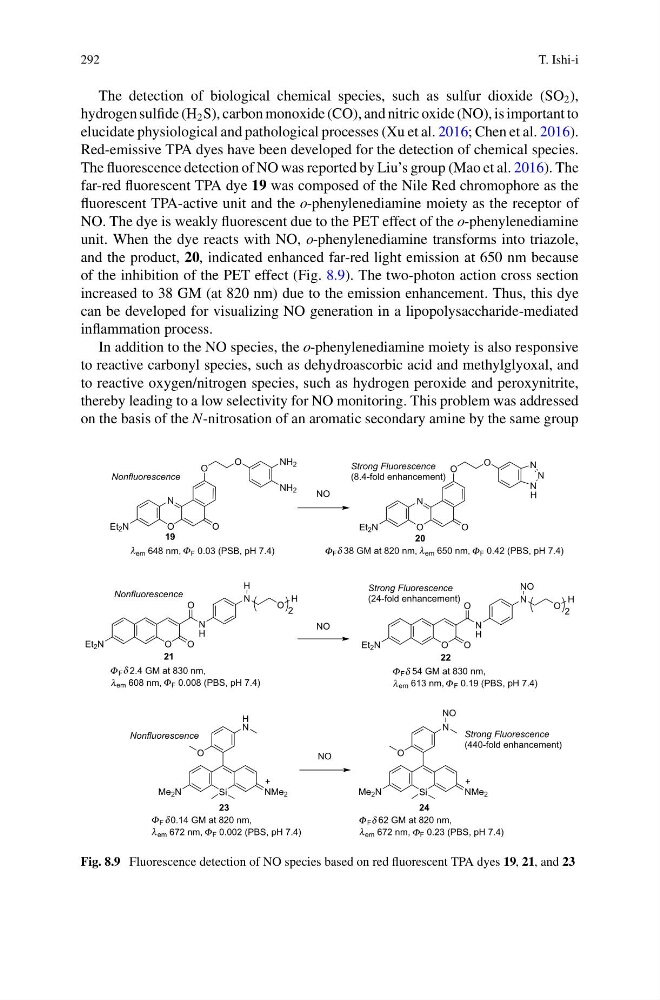
The fluorescence detection of NO was reported by Liu’s group (Mao et al. 2016). The
far-red fluorescent TPA dye 19 was composed of the Nile Red chromophore as the
fluorescent TPA-active unit and the o-phenylenediamine moiety as the receptor of
NO. The dye is weakly fluorescent due to the PET effect of the o-phenylenediamine
unit. When the dye reacts with NO, o-phenylenediamine transforms into triazole,
and the product, 20, indicated enhanced far-red light emission at 650 nm because
of the inhibition of the PET effect (Fig. 8.9). The two-photon action cross section
increased to 38 GM (at 820 nm) due to the emission enhancement. Thus, this dye
can be developed for visualizing NO generation in a lipopolysaccharide-mediated
inflammation process.
In addition to the NO species, the o-phenylenediamine moiety is also responsive
to reactive carbonyl species, such as dehydroascorbic acid and methylglyoxal, and
to reactive oxygen/nitrogen species, such as hydrogen peroxide and peroxynitrite,
thereby leading to a low selectivity for NO monitoring. This problem was addressed
on the basis of the N-nitrosation of an aromatic secondary amine by the same group
N
O
Et 2 N
19
F 38 GM at 820 nm, em 650 nm, F 0.42 (PBS, pH 7.4)
O
O
O
NH 2
NH 2
N
O
Et 2 N
20
O
O
O
N
N
N
H
NO
Nonfluorescence
Strong Fluorescence
(8.4-fold enhancement)
em 648 nm, F 0.03 (PSB, pH 7.4)
F 54 GM at 830 nm,
em 613 nm, F 0.19 (PBS, pH 7.4)
O
Et 2 N
22
O
NO
Nonfluorescence
Strong Fluorescence
(24-fold enhancement)
F 2.4 GM at 830 nm,
em 608 nm, F 0.008 (PBS, pH 7.4)
O
N
N
NO
H
O
H
2
O
Et 2 N
O
O
N
N
H
H
O
H
2
21
Si
23
O
N
Me 2 N
NMe 2
H
+
Si
24
O
N
Me 2 N
NMe 2
NO
+
NO
F 0.14 GM at 820 nm,
em 672 nm, F 0.002 (PBS, pH 7.4)
Nonfluorescence
Strong Fluorescence
(440-fold enhancement)
F 62 GM at 820 nm,
em 672 nm, F 0.23 (PBS, pH 7.4)
δ
δ
δ
δ
δ
λ
λ
λ
λ
Φ
Φ
Φ
Φ
λ
λ
Φ
Φ
Φ
Φ
Φ
Φ
Φ
Fig. 8.9 Fluorescence detection of NO species based on red fluorescent TPA dyes 19, 21, and 23
T. Ishi-i
The detection of biological chemical species, such as sulfur dioxide (SO 2 ),
hydrogen sulfide (H 2 S), carbon monoxide (CO), and nitric oxide (NO), is important to
elucidate physiological and pathological processes (Xu et al. 2016; Chen et al. 2016).
Red-emissive TPA dyes have been developed for the detection of chemical species.
The fluorescence detection of NO was reported by Liu’s group (Mao et al. 2016). The
far-red fluorescent TPA dye 19 was composed of the Nile Red chromophore as the
fluorescent TPA-active unit and the o-phenylenediamine moiety as the receptor of
NO. The dye is weakly fluorescent due to the PET effect of the o-phenylenediamine
unit. When the dye reacts with NO, o-phenylenediamine transforms into triazole,
and the product, 20, indicated enhanced far-red light emission at 650 nm because
of the inhibition of the PET effect (Fig. 8.9). The two-photon action cross section
increased to 38 GM (at 820 nm) due to the emission enhancement. Thus, this dye
can be developed for visualizing NO generation in a lipopolysaccharide-mediated
inflammation process.
In addition to the NO species, the o-phenylenediamine moiety is also responsive
to reactive carbonyl species, such as dehydroascorbic acid and methylglyoxal, and
to reactive oxygen/nitrogen species, such as hydrogen peroxide and peroxynitrite,
thereby leading to a low selectivity for NO monitoring. This problem was addressed
on the basis of the N-nitrosation of an aromatic secondary amine by the same group
N
O
Et 2 N
19
F 38 GM at 820 nm, em 650 nm, F 0.42 (PBS, pH 7.4)
O
O
O
NH 2
NH 2
N
O
Et 2 N
20
O
O
O
N
N
N
H
NO
Nonfluorescence
Strong Fluorescence
(8.4-fold enhancement)
em 648 nm, F 0.03 (PSB, pH 7.4)
F 54 GM at 830 nm,
em 613 nm, F 0.19 (PBS, pH 7.4)
O
Et 2 N
22
O
NO
Nonfluorescence
Strong Fluorescence
(24-fold enhancement)
F 2.4 GM at 830 nm,
em 608 nm, F 0.008 (PBS, pH 7.4)
O
N
N
NO
H
O
H
2
O
Et 2 N
O
O
N
N
H
H
O
H
2
21
Si
23
O
N
Me 2 N
NMe 2
H
+
Si
24
O
N
Me 2 N
NMe 2
NO
+
NO
F 0.14 GM at 820 nm,
em 672 nm, F 0.002 (PBS, pH 7.4)
Nonfluorescence
Strong Fluorescence
(440-fold enhancement)
F 62 GM at 820 nm,
em 672 nm, F 0.23 (PBS, pH 7.4)
δ
δ
δ
δ
δ
λ
λ
λ
λ
Φ
Φ
Φ
Φ
λ
λ
Φ
Φ
Φ
Φ
Φ
Φ
Φ
Fig. 8.9 Fluorescence detection of NO species based on red fluorescent TPA dyes 19, 21, and 23