

2 Squaraine Dyes
23
extinction coefficients reaching−10
5 L mol
−1 cm
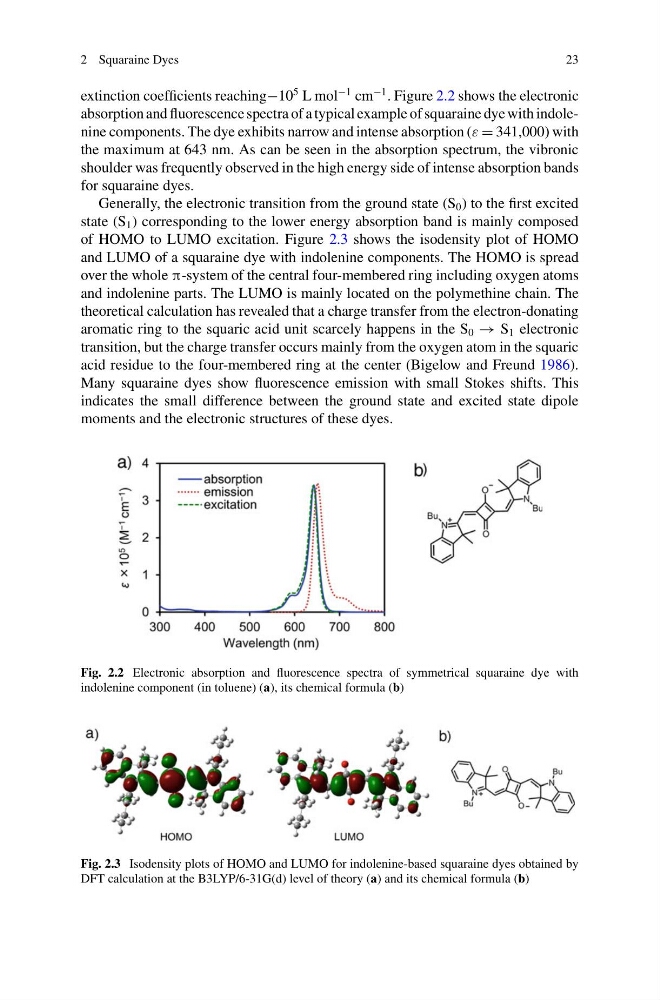
−1 . Figure 2.2 shows the electronic
absorption and fluorescence spectra of a typical example of squaraine dye with indolenine components. The dye exhibits narrow and intense absorption (ε = 341,000) with
the maximum at 643 nm. As can be seen in the absorption spectrum, the vibronic
shoulder was frequently observed in the high energy side of intense absorption bands
for squaraine dyes.
Generally, the electronic transition from the ground state (S 0 ) to the first excited
state (S 1 ) corresponding to the lower energy absorption band is mainly composed
of HOMO to LUMO excitation. Figure 2.3 shows the isodensity plot of HOMO
and LUMO of a squaraine dye with indolenine components. The HOMO is spread
over the whole π-system of the central four-membered ring including oxygen atoms
and indolenine parts. The LUMO is mainly located on the polymethine chain. The
theoretical calculation has revealed that a charge transfer from the electron-donating
aromatic ring to the squaric acid unit scarcely happens in the S 0 → S 1 electronic
transition, but the charge transfer occurs mainly from the oxygen atom in the squaric
acid residue to the four-membered ring at the center (Bigelow and Freund 1986).
Many squaraine dyes show fluorescence emission with small Stokes shifts. This
indicates the small difference between the ground state and excited state dipole
moments and the electronic structures of these dyes.
Fig. 2.2 Electronic absorption and fluorescence spectra of symmetrical squaraine dye with
indolenine component (in toluene) (a), its chemical formula (b)
Fig. 2.3 Isodensity plots of HOMO and LUMO for indolenine-based squaraine dyes obtained by
DFT calculation at the B3LYP/6-31G(d) level of theory (a) and its chemical formula (b)
23
extinction coefficients reaching−10
5 L mol
−1 cm
−1 . Figure 2.2 shows the electronic
absorption and fluorescence spectra of a typical example of squaraine dye with indolenine components. The dye exhibits narrow and intense absorption (ε = 341,000) with
the maximum at 643 nm. As can be seen in the absorption spectrum, the vibronic
shoulder was frequently observed in the high energy side of intense absorption bands
for squaraine dyes.
Generally, the electronic transition from the ground state (S 0 ) to the first excited
state (S 1 ) corresponding to the lower energy absorption band is mainly composed
of HOMO to LUMO excitation. Figure 2.3 shows the isodensity plot of HOMO
and LUMO of a squaraine dye with indolenine components. The HOMO is spread
over the whole π-system of the central four-membered ring including oxygen atoms
and indolenine parts. The LUMO is mainly located on the polymethine chain. The
theoretical calculation has revealed that a charge transfer from the electron-donating
aromatic ring to the squaric acid unit scarcely happens in the S 0 → S 1 electronic
transition, but the charge transfer occurs mainly from the oxygen atom in the squaric
acid residue to the four-membered ring at the center (Bigelow and Freund 1986).
Many squaraine dyes show fluorescence emission with small Stokes shifts. This
indicates the small difference between the ground state and excited state dipole
moments and the electronic structures of these dyes.
Fig. 2.2 Electronic absorption and fluorescence spectra of symmetrical squaraine dye with
indolenine component (in toluene) (a), its chemical formula (b)
Fig. 2.3 Isodensity plots of HOMO and LUMO for indolenine-based squaraine dyes obtained by
DFT calculation at the B3LYP/6-31G(d) level of theory (a) and its chemical formula (b)