

22
T. Maeda
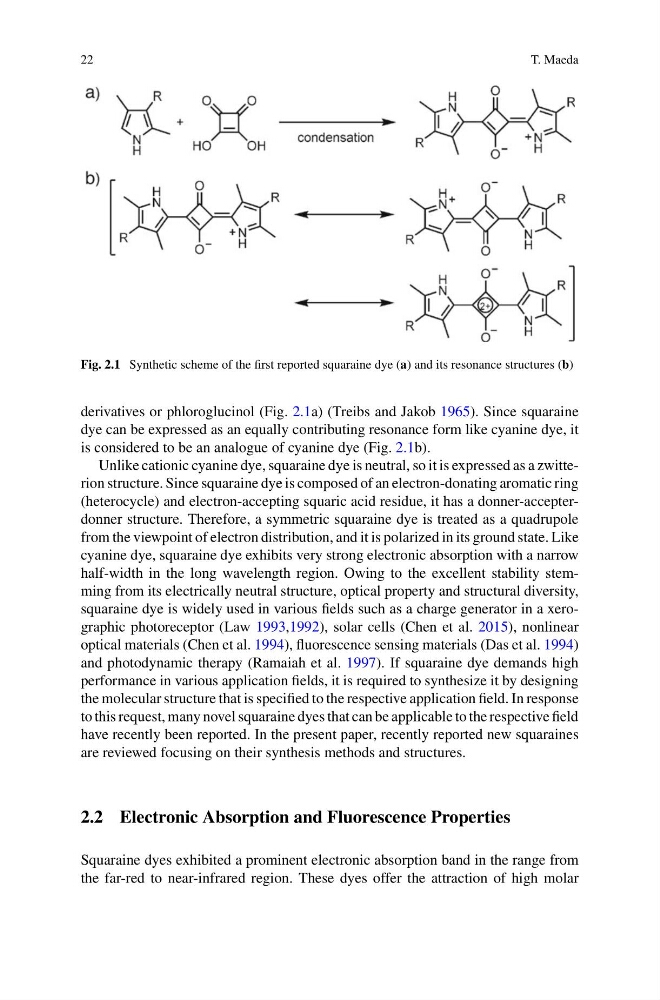
Fig. 2.1 Synthetic scheme of the first reported squaraine dye (a) and its resonance structures (b)
derivatives or phloroglucinol (Fig. 2.1a) (Treibs and Jakob 1965). Since squaraine
dye can be expressed as an equally contributing resonance form like cyanine dye, it
is considered to be an analogue of cyanine dye (Fig. 2.1b).
Unlike cationic cyanine dye, squaraine dye is neutral, so it is expressed as a zwitterion structure. Since squaraine dye is composed of an electron-donating aromatic ring
(heterocycle) and electron-accepting squaric acid residue, it has a donner-accepterdonner structure. Therefore, a symmetric squaraine dye is treated as a quadrupole
from the viewpoint of electron distribution, and it is polarized in its ground state. Like
cyanine dye, squaraine dye exhibits very strong electronic absorption with a narrow
half-width in the long wavelength region. Owing to the excellent stability stemming from its electrically neutral structure, optical property and structural diversity,
squaraine dye is widely used in various fields such as a charge generator in a xerographic photoreceptor (Law 1993,1992), solar cells (Chen et al. 2015), nonlinear
optical materials (Chen et al. 1994), fluorescence sensing materials (Das et al. 1994)
and photodynamic therapy (Ramaiah et al. 1997). If squaraine dye demands high
performance in various application fields, it is required to synthesize it by designing
the molecular structure that is specified to the respective application field. In response
to this request, many novel squaraine dyes that can be applicable to the respective field
have recently been reported. In the present paper, recently reported new squaraines
are reviewed focusing on their synthesis methods and structures.
2.2 Electronic Absorption and Fluorescence Properties
Squaraine dyes exhibited a prominent electronic absorption band in the range from
the far-red to near-infrared region. These dyes offer the attraction of high molar
T. Maeda
Fig. 2.1 Synthetic scheme of the first reported squaraine dye (a) and its resonance structures (b)
derivatives or phloroglucinol (Fig. 2.1a) (Treibs and Jakob 1965). Since squaraine
dye can be expressed as an equally contributing resonance form like cyanine dye, it
is considered to be an analogue of cyanine dye (Fig. 2.1b).
Unlike cationic cyanine dye, squaraine dye is neutral, so it is expressed as a zwitterion structure. Since squaraine dye is composed of an electron-donating aromatic ring
(heterocycle) and electron-accepting squaric acid residue, it has a donner-accepterdonner structure. Therefore, a symmetric squaraine dye is treated as a quadrupole
from the viewpoint of electron distribution, and it is polarized in its ground state. Like
cyanine dye, squaraine dye exhibits very strong electronic absorption with a narrow
half-width in the long wavelength region. Owing to the excellent stability stemming from its electrically neutral structure, optical property and structural diversity,
squaraine dye is widely used in various fields such as a charge generator in a xerographic photoreceptor (Law 1993,1992), solar cells (Chen et al. 2015), nonlinear
optical materials (Chen et al. 1994), fluorescence sensing materials (Das et al. 1994)
and photodynamic therapy (Ramaiah et al. 1997). If squaraine dye demands high
performance in various application fields, it is required to synthesize it by designing
the molecular structure that is specified to the respective application field. In response
to this request, many novel squaraine dyes that can be applicable to the respective field
have recently been reported. In the present paper, recently reported new squaraines
are reviewed focusing on their synthesis methods and structures.
2.2 Electronic Absorption and Fluorescence Properties
Squaraine dyes exhibited a prominent electronic absorption band in the range from
the far-red to near-infrared region. These dyes offer the attraction of high molar