

278
S. Kobatake
‘‘ON’’
‘‘OFF’’
1 mm
1 mm
UV
UV
Vis.
N
N
S
S
CH 3
H 3 C
F
F
F F
F
F
N
N
S
S
CH 3
H 3 C
F F
F
F
F
F
UV
Vis.
-0.1
0
0.1
0.2
0.3
0.4
0.5
0.6
0
5 0
1 0 0
1 5 0
2 0 0
2 5 0
Current / mA
Time / s
A
External resistance
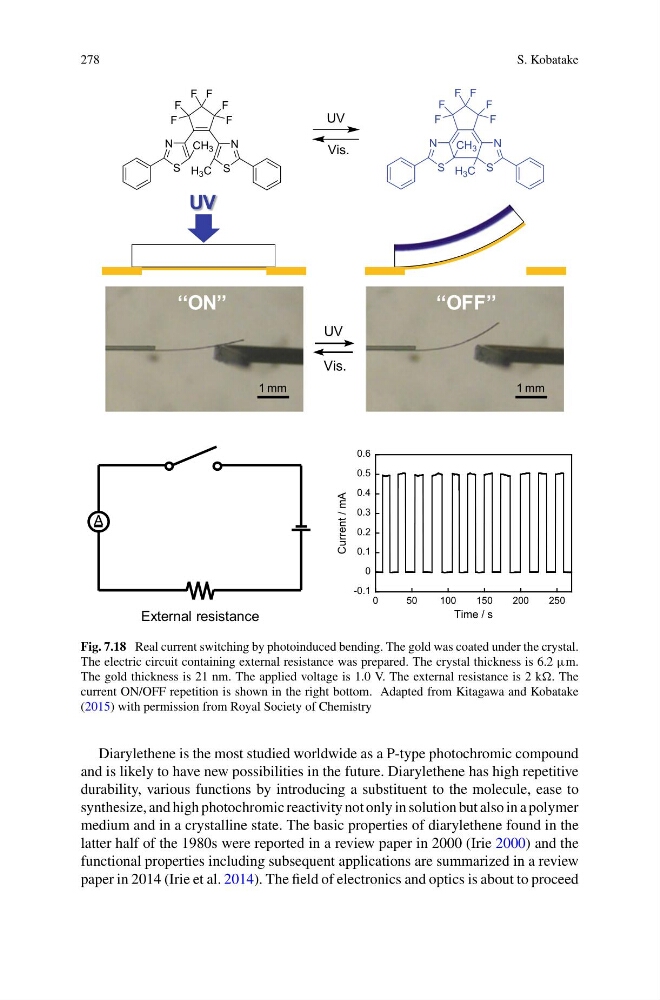
Fig. 7.18 Real current switching by photoinduced bending. The gold was coated under the crystal.
The electric circuit containing external resistance was prepared. The crystal thickness is 6.2 μm.
The gold thickness is 21 nm. The applied voltage is 1.0 V. The external resistance is 2 k. The
current ON/OFF repetition is shown in the right bottom. Adapted from Kitagawa and Kobatake
(2015) with permission from Royal Society of Chemistry
Diarylethene is the most studied worldwide as a P-type photochromic compound
and is likely to have new possibilities in the future. Diarylethene has high repetitive
durability, various functions by introducing a substituent to the molecule, ease to
synthesize, and high photochromic reactivity not only in solution but also in a polymer
medium and in a crystalline state. The basic properties of diarylethene found in the
latter half of the 1980s were reported in a review paper in 2000 (Irie 2000) and the
functional properties including subsequent applications are summarized in a review
paper in 2014 (Irie et al. 2014). The field of electronics and optics is about to proceed
S. Kobatake
‘‘ON’’
‘‘OFF’’
1 mm
1 mm
UV
UV
Vis.
N
N
S
S
CH 3
H 3 C
F
F
F F
F
F
N
N
S
S
CH 3
H 3 C
F F
F
F
F
F
UV
Vis.
-0.1
0
0.1
0.2
0.3
0.4
0.5
0.6
0
5 0
1 0 0
1 5 0
2 0 0
2 5 0
Current / mA
Time / s
A
External resistance
Fig. 7.18 Real current switching by photoinduced bending. The gold was coated under the crystal.
The electric circuit containing external resistance was prepared. The crystal thickness is 6.2 μm.
The gold thickness is 21 nm. The applied voltage is 1.0 V. The external resistance is 2 k. The
current ON/OFF repetition is shown in the right bottom. Adapted from Kitagawa and Kobatake
(2015) with permission from Royal Society of Chemistry
Diarylethene is the most studied worldwide as a P-type photochromic compound
and is likely to have new possibilities in the future. Diarylethene has high repetitive
durability, various functions by introducing a substituent to the molecule, ease to
synthesize, and high photochromic reactivity not only in solution but also in a polymer
medium and in a crystalline state. The basic properties of diarylethene found in the
latter half of the 1980s were reported in a review paper in 2000 (Irie 2000) and the
functional properties including subsequent applications are summarized in a review
paper in 2014 (Irie et al. 2014). The field of electronics and optics is about to proceed