

7 Photochromism
269
N
N
N
N
N
N
N
N
N
N
N
N
N
N
N
N
colorless
green
blue
UV
UV
colorless
Δ
Δ
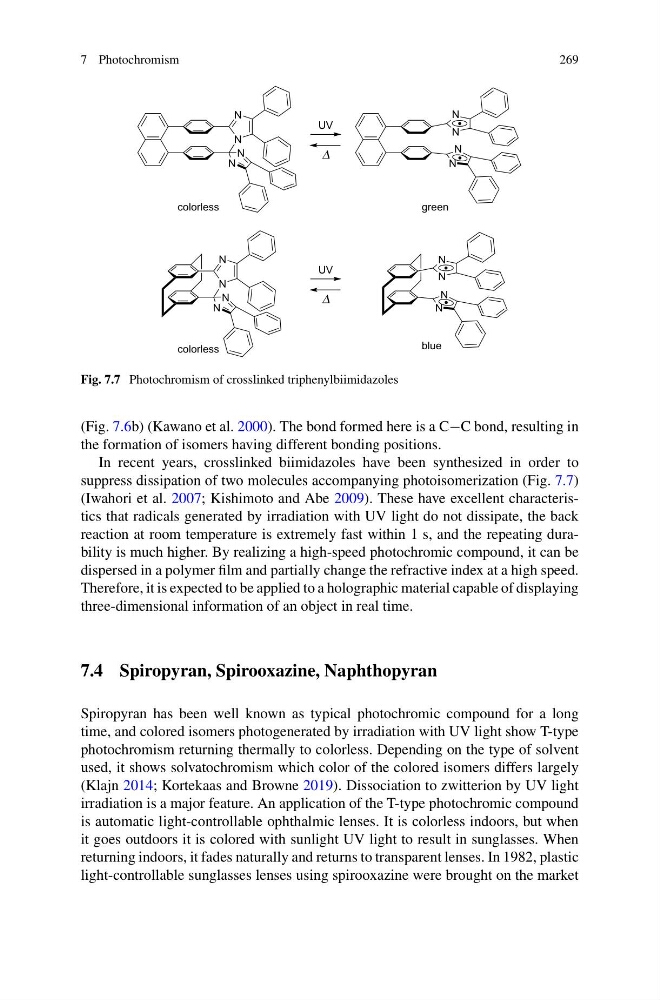
Fig. 7.7 Photochromism of crosslinked triphenylbiimidazoles
(Fig. 7.6b) (Kawano et al. 2000). The bond formed here is a C−C bond, resulting in
the formation of isomers having different bonding positions.
In recent years, crosslinked biimidazoles have been synthesized in order to
suppress dissipation of two molecules accompanying photoisomerization (Fig. 7.7)
(Iwahori et al. 2007; Kishimoto and Abe 2009). These have excellent characteristics that radicals generated by irradiation with UV light do not dissipate, the back
reaction at room temperature is extremely fast within 1 s, and the repeating durability is much higher. By realizing a high-speed photochromic compound, it can be
dispersed in a polymer film and partially change the refractive index at a high speed.
Therefore, it is expected to be applied to a holographic material capable of displaying
three-dimensional information of an object in real time.
7.4 Spiropyran, Spirooxazine, Naphthopyran
Spiropyran has been well known as typical photochromic compound for a long
time, and colored isomers photogenerated by irradiation with UV light show T-type
photochromism returning thermally to colorless. Depending on the type of solvent
used, it shows solvatochromism which color of the colored isomers differs largely
(Klajn 2014; Kortekaas and Browne 2019). Dissociation to zwitterion by UV light
irradiation is a major feature. An application of the T-type photochromic compound
is automatic light-controllable ophthalmic lenses. It is colorless indoors, but when
it goes outdoors it is colored with sunlight UV light to result in sunglasses. When
returning indoors, it fades naturally and returns to transparent lenses. In 1982, plastic
light-controllable sunglasses lenses using spirooxazine were brought on the market
269
N
N
N
N
N
N
N
N
N
N
N
N
N
N
N
N
colorless
green
blue
UV
UV
colorless
Δ
Δ
Fig. 7.7 Photochromism of crosslinked triphenylbiimidazoles
(Fig. 7.6b) (Kawano et al. 2000). The bond formed here is a C−C bond, resulting in
the formation of isomers having different bonding positions.
In recent years, crosslinked biimidazoles have been synthesized in order to
suppress dissipation of two molecules accompanying photoisomerization (Fig. 7.7)
(Iwahori et al. 2007; Kishimoto and Abe 2009). These have excellent characteristics that radicals generated by irradiation with UV light do not dissipate, the back
reaction at room temperature is extremely fast within 1 s, and the repeating durability is much higher. By realizing a high-speed photochromic compound, it can be
dispersed in a polymer film and partially change the refractive index at a high speed.
Therefore, it is expected to be applied to a holographic material capable of displaying
three-dimensional information of an object in real time.
7.4 Spiropyran, Spirooxazine, Naphthopyran
Spiropyran has been well known as typical photochromic compound for a long
time, and colored isomers photogenerated by irradiation with UV light show T-type
photochromism returning thermally to colorless. Depending on the type of solvent
used, it shows solvatochromism which color of the colored isomers differs largely
(Klajn 2014; Kortekaas and Browne 2019). Dissociation to zwitterion by UV light
irradiation is a major feature. An application of the T-type photochromic compound
is automatic light-controllable ophthalmic lenses. It is colorless indoors, but when
it goes outdoors it is colored with sunlight UV light to result in sunglasses. When
returning indoors, it fades naturally and returns to transparent lenses. In 1982, plastic
light-controllable sunglasses lenses using spirooxazine were brought on the market