

268
S. Kobatake
right sides, respectively (Uchida et al. 2015). The crystals moved on the solid surface
away from the UV light source and toward visible light source. The movement is
due to the crystal melting and crystallization by UV and visible light, respectively.
The real photomechanical deformation was observed in azobenzene
single crystals. Small single crystals of azobenzene derivatives such as 4(dimethylamino)azobenzene, 4-aminoazobenzene, etc exhibited photoinduced
bending upon irradiation with UV light and returned to the initial flat at room
temperature after the light was turned off (Koshima et al. 2009; Koshima and Ojima
2012; Taniguchi et al. 2019). The movement was short, but the repeat cycles of 100
or more were confirmed.
7.3 Hexaarylbiimidazole
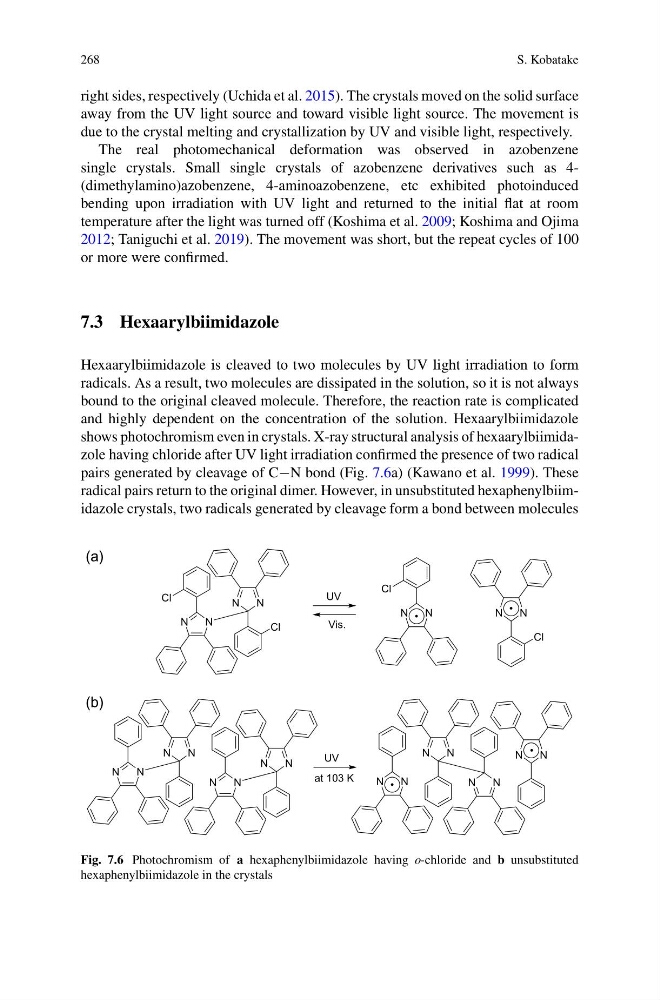
Hexaarylbiimidazole is cleaved to two molecules by UV light irradiation to form
radicals. As a result, two molecules are dissipated in the solution, so it is not always
bound to the original cleaved molecule. Therefore, the reaction rate is complicated
and highly dependent on the concentration of the solution. Hexaarylbiimidazole
shows photochromism even in crystals. X-ray structural analysis of hexaarylbiimidazole having chloride after UV light irradiation confirmed the presence of two radical
pairs generated by cleavage of C−N bond (Fig. 7.6a) (Kawano et al. 1999). These
radical pairs return to the original dimer. However, in unsubstituted hexaphenylbiimidazole crystals, two radicals generated by cleavage form a bond between molecules
N
N
N
N
Cl
Cl
N
N
N
N
Cl
Cl
Vis.
N
N
N
N
N
N
N
N
at 103 K
N
N
N
N
N
N
N
N
(a)
(b)
UV
UV
Fig. 7.6 Photochromism of a hexaphenylbiimidazole having o-chloride and b unsubstituted
hexaphenylbiimidazole in the crystals
S. Kobatake
right sides, respectively (Uchida et al. 2015). The crystals moved on the solid surface
away from the UV light source and toward visible light source. The movement is
due to the crystal melting and crystallization by UV and visible light, respectively.
The real photomechanical deformation was observed in azobenzene
single crystals. Small single crystals of azobenzene derivatives such as 4(dimethylamino)azobenzene, 4-aminoazobenzene, etc exhibited photoinduced
bending upon irradiation with UV light and returned to the initial flat at room
temperature after the light was turned off (Koshima et al. 2009; Koshima and Ojima
2012; Taniguchi et al. 2019). The movement was short, but the repeat cycles of 100
or more were confirmed.
7.3 Hexaarylbiimidazole
Hexaarylbiimidazole is cleaved to two molecules by UV light irradiation to form
radicals. As a result, two molecules are dissipated in the solution, so it is not always
bound to the original cleaved molecule. Therefore, the reaction rate is complicated
and highly dependent on the concentration of the solution. Hexaarylbiimidazole
shows photochromism even in crystals. X-ray structural analysis of hexaarylbiimidazole having chloride after UV light irradiation confirmed the presence of two radical
pairs generated by cleavage of C−N bond (Fig. 7.6a) (Kawano et al. 1999). These
radical pairs return to the original dimer. However, in unsubstituted hexaphenylbiimidazole crystals, two radicals generated by cleavage form a bond between molecules
N
N
N
N
Cl
Cl
N
N
N
N
Cl
Cl
Vis.
N
N
N
N
N
N
N
N
at 103 K
N
N
N
N
N
N
N
N
(a)
(b)
UV
UV
Fig. 7.6 Photochromism of a hexaphenylbiimidazole having o-chloride and b unsubstituted
hexaphenylbiimidazole in the crystals