

6 Molecular and Crystal Structures of Polymorphic …
257
(a) I
(b) II
(c) III
(d) IV
(e) V
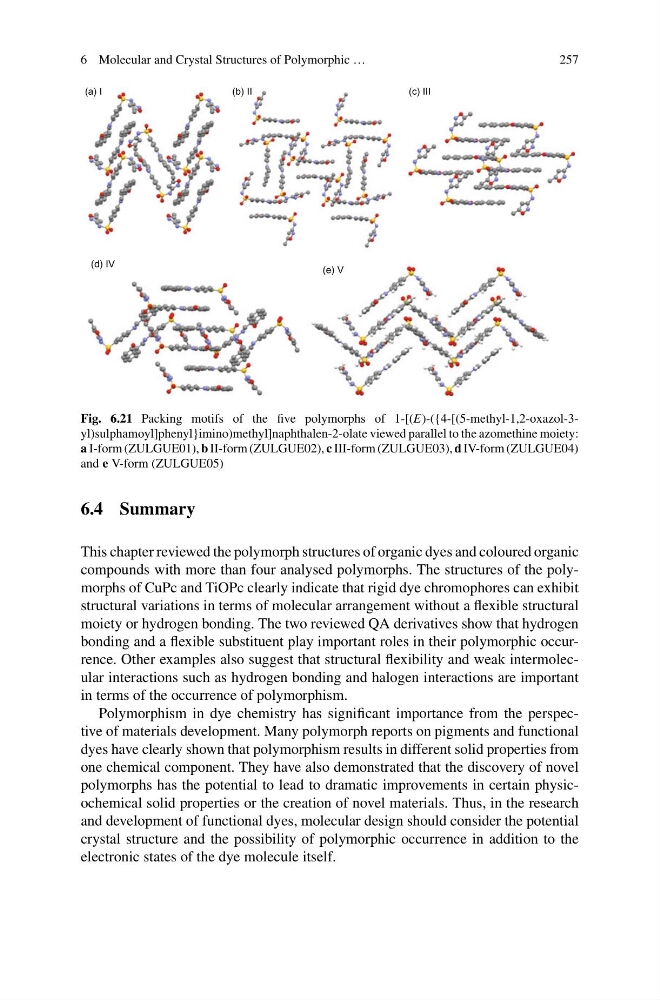
Fig. 6.21 Packing motifs of the five polymorphs of 1-[(E)-({4-[(5-methyl-1,2-oxazol-3yl)sulphamoyl]phenyl}imino)methyl]naphthalen-2-olate viewed parallel to the azomethine moiety:
a I-form (ZULGUE01), b II-form (ZULGUE02), c III-form (ZULGUE03), d IV-form (ZULGUE04)
and e V-form (ZULGUE05)
6.4 Summary
This chapter reviewed the polymorph structures of organic dyes and coloured organic
compounds with more than four analysed polymorphs. The structures of the polymorphs of CuPc and TiOPc clearly indicate that rigid dye chromophores can exhibit
structural variations in terms of molecular arrangement without a flexible structural
moiety or hydrogen bonding. The two reviewed QA derivatives show that hydrogen
bonding and a flexible substituent play important roles in their polymorphic occurrence. Other examples also suggest that structural flexibility and weak intermolecular interactions such as hydrogen bonding and halogen interactions are important
in terms of the occurrence of polymorphism.
Polymorphism in dye chemistry has significant importance from the perspective of materials development. Many polymorph reports on pigments and functional
dyes have clearly shown that polymorphism results in different solid properties from
one chemical component. They have also demonstrated that the discovery of novel
polymorphs has the potential to lead to dramatic improvements in certain physicochemical solid properties or the creation of novel materials. Thus, in the research
and development of functional dyes, molecular design should consider the potential
crystal structure and the possibility of polymorphic occurrence in addition to the
electronic states of the dye molecule itself.
257
(a) I
(b) II
(c) III
(d) IV
(e) V
Fig. 6.21 Packing motifs of the five polymorphs of 1-[(E)-({4-[(5-methyl-1,2-oxazol-3yl)sulphamoyl]phenyl}imino)methyl]naphthalen-2-olate viewed parallel to the azomethine moiety:
a I-form (ZULGUE01), b II-form (ZULGUE02), c III-form (ZULGUE03), d IV-form (ZULGUE04)
and e V-form (ZULGUE05)
6.4 Summary
This chapter reviewed the polymorph structures of organic dyes and coloured organic
compounds with more than four analysed polymorphs. The structures of the polymorphs of CuPc and TiOPc clearly indicate that rigid dye chromophores can exhibit
structural variations in terms of molecular arrangement without a flexible structural
moiety or hydrogen bonding. The two reviewed QA derivatives show that hydrogen
bonding and a flexible substituent play important roles in their polymorphic occurrence. Other examples also suggest that structural flexibility and weak intermolecular interactions such as hydrogen bonding and halogen interactions are important
in terms of the occurrence of polymorphism.
Polymorphism in dye chemistry has significant importance from the perspective of materials development. Many polymorph reports on pigments and functional
dyes have clearly shown that polymorphism results in different solid properties from
one chemical component. They have also demonstrated that the discovery of novel
polymorphs has the potential to lead to dramatic improvements in certain physicochemical solid properties or the creation of novel materials. Thus, in the research
and development of functional dyes, molecular design should consider the potential
crystal structure and the possibility of polymorphic occurrence in addition to the
electronic states of the dye molecule itself.