

256
S. Matsumoto and J. Hwang
(a) I
(b) II
(c) III
(d) IV
(e) V
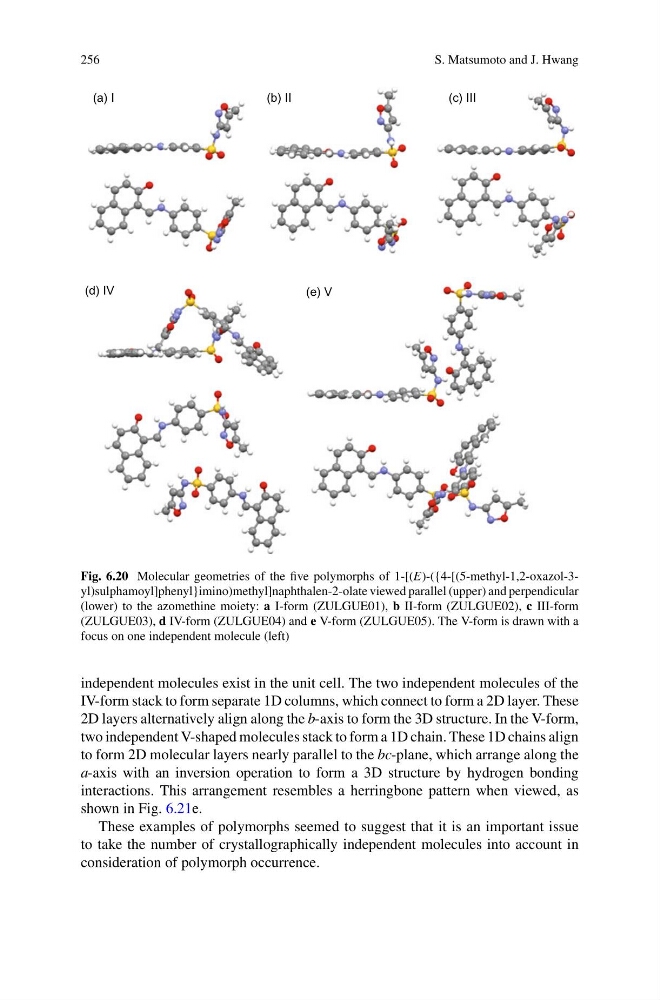
Fig. 6.20 Molecular geometries of the five polymorphs of 1-[(E)-({4-[(5-methyl-1,2-oxazol-3yl)sulphamoyl]phenyl}imino)methyl]naphthalen-2-olate viewed parallel (upper) and perpendicular
(lower) to the azomethine moiety: a I-form (ZULGUE01), b II-form (ZULGUE02), c III-form
(ZULGUE03), d IV-form (ZULGUE04) and e V-form (ZULGUE05). The V-form is drawn with a
focus on one independent molecule (left)
independent molecules exist in the unit cell. The two independent molecules of the
IV-form stack to form separate 1D columns, which connect to form a 2D layer. These
2D layers alternatively align along the b-axis to form the 3D structure. In the V-form,
two independent V-shaped molecules stack to form a 1D chain. These 1D chains align
to form 2D molecular layers nearly parallel to the bc-plane, which arrange along the
a-axis with an inversion operation to form a 3D structure by hydrogen bonding
interactions. This arrangement resembles a herringbone pattern when viewed, as
shown in Fig. 6.21e.
These examples of polymorphs seemed to suggest that it is an important issue
to take the number of crystallographically independent molecules into account in
consideration of polymorph occurrence.
S. Matsumoto and J. Hwang
(a) I
(b) II
(c) III
(d) IV
(e) V
Fig. 6.20 Molecular geometries of the five polymorphs of 1-[(E)-({4-[(5-methyl-1,2-oxazol-3yl)sulphamoyl]phenyl}imino)methyl]naphthalen-2-olate viewed parallel (upper) and perpendicular
(lower) to the azomethine moiety: a I-form (ZULGUE01), b II-form (ZULGUE02), c III-form
(ZULGUE03), d IV-form (ZULGUE04) and e V-form (ZULGUE05). The V-form is drawn with a
focus on one independent molecule (left)
independent molecules exist in the unit cell. The two independent molecules of the
IV-form stack to form separate 1D columns, which connect to form a 2D layer. These
2D layers alternatively align along the b-axis to form the 3D structure. In the V-form,
two independent V-shaped molecules stack to form a 1D chain. These 1D chains align
to form 2D molecular layers nearly parallel to the bc-plane, which arrange along the
a-axis with an inversion operation to form a 3D structure by hydrogen bonding
interactions. This arrangement resembles a herringbone pattern when viewed, as
shown in Fig. 6.21e.
These examples of polymorphs seemed to suggest that it is an important issue
to take the number of crystallographically independent molecules into account in
consideration of polymorph occurrence.