

252
S. Matsumoto and J. Hwang
(a) 1
(b) 2
(c) 3
(d) 4
(e) 5
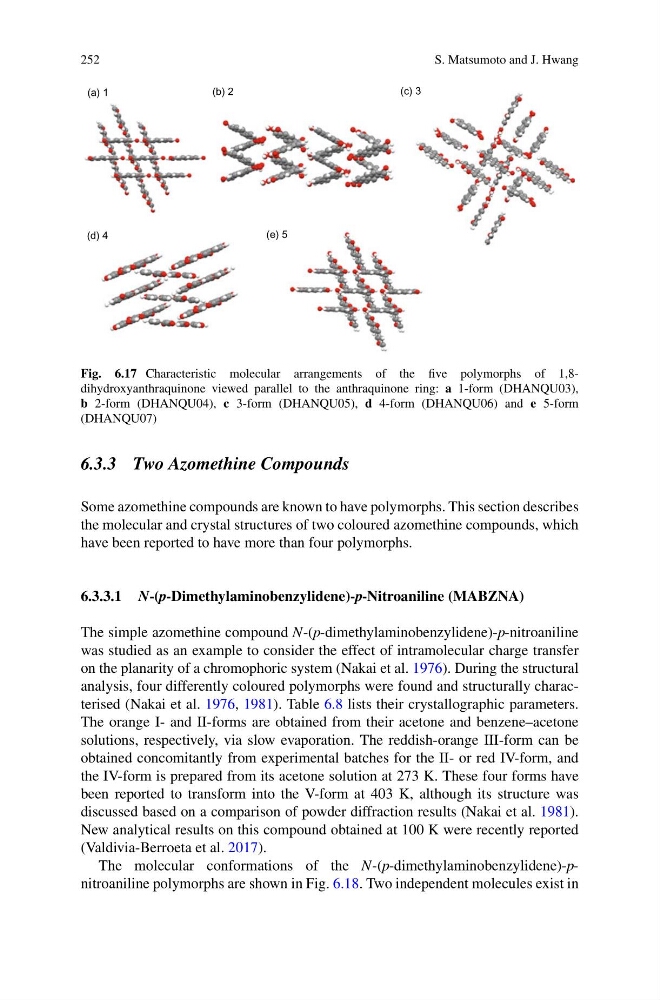
Fig. 6.17 Characteristic molecular arrangements of the five polymorphs of 1,8dihydroxyanthraquinone viewed parallel to the anthraquinone ring: a 1-form (DHANQU03),
b 2-form (DHANQU04), c 3-form (DHANQU05), d 4-form (DHANQU06) and e 5-form
(DHANQU07)
6.3.3 Two Azomethine Compounds
Some azomethine compounds are known to have polymorphs. This section describes
the molecular and crystal structures of two coloured azomethine compounds, which
have been reported to have more than four polymorphs.
6.3.3.1 N-(p-Dimethylaminobenzylidene)-p-Nitroaniline (MABZNA)
The simple azomethine compound N-(p-dimethylaminobenzylidene)-p-nitroaniline
was studied as an example to consider the effect of intramolecular charge transfer
on the planarity of a chromophoric system (Nakai et al. 1976). During the structural
analysis, four differently coloured polymorphs were found and structurally characterised (Nakai et al. 1976, 1981). Table 6.8 lists their crystallographic parameters.
The orange I- and II-forms are obtained from their acetone and benzene–acetone
solutions, respectively, via slow evaporation. The reddish-orange III-form can be
obtained concomitantly from experimental batches for the II- or red IV-form, and
the IV-form is prepared from its acetone solution at 273 K. These four forms have
been reported to transform into the V-form at 403 K, although its structure was
discussed based on a comparison of powder diffraction results (Nakai et al. 1981).
New analytical results on this compound obtained at 100 K were recently reported
(Valdivia-Berroeta et al. 2017).
The molecular conformations of the N-(p-dimethylaminobenzylidene)-pnitroaniline polymorphs are shown in Fig. 6.18. Two independent molecules exist in
S. Matsumoto and J. Hwang
(a) 1
(b) 2
(c) 3
(d) 4
(e) 5
Fig. 6.17 Characteristic molecular arrangements of the five polymorphs of 1,8dihydroxyanthraquinone viewed parallel to the anthraquinone ring: a 1-form (DHANQU03),
b 2-form (DHANQU04), c 3-form (DHANQU05), d 4-form (DHANQU06) and e 5-form
(DHANQU07)
6.3.3 Two Azomethine Compounds
Some azomethine compounds are known to have polymorphs. This section describes
the molecular and crystal structures of two coloured azomethine compounds, which
have been reported to have more than four polymorphs.
6.3.3.1 N-(p-Dimethylaminobenzylidene)-p-Nitroaniline (MABZNA)
The simple azomethine compound N-(p-dimethylaminobenzylidene)-p-nitroaniline
was studied as an example to consider the effect of intramolecular charge transfer
on the planarity of a chromophoric system (Nakai et al. 1976). During the structural
analysis, four differently coloured polymorphs were found and structurally characterised (Nakai et al. 1976, 1981). Table 6.8 lists their crystallographic parameters.
The orange I- and II-forms are obtained from their acetone and benzene–acetone
solutions, respectively, via slow evaporation. The reddish-orange III-form can be
obtained concomitantly from experimental batches for the II- or red IV-form, and
the IV-form is prepared from its acetone solution at 273 K. These four forms have
been reported to transform into the V-form at 403 K, although its structure was
discussed based on a comparison of powder diffraction results (Nakai et al. 1981).
New analytical results on this compound obtained at 100 K were recently reported
(Valdivia-Berroeta et al. 2017).
The molecular conformations of the N-(p-dimethylaminobenzylidene)-pnitroaniline polymorphs are shown in Fig. 6.18. Two independent molecules exist in