

6 Molecular and Crystal Structures of Polymorphic …
249
(a) Y
(b) ON
(c) OP
(e) YN
(d) R
(f) ORP
(g) YT04
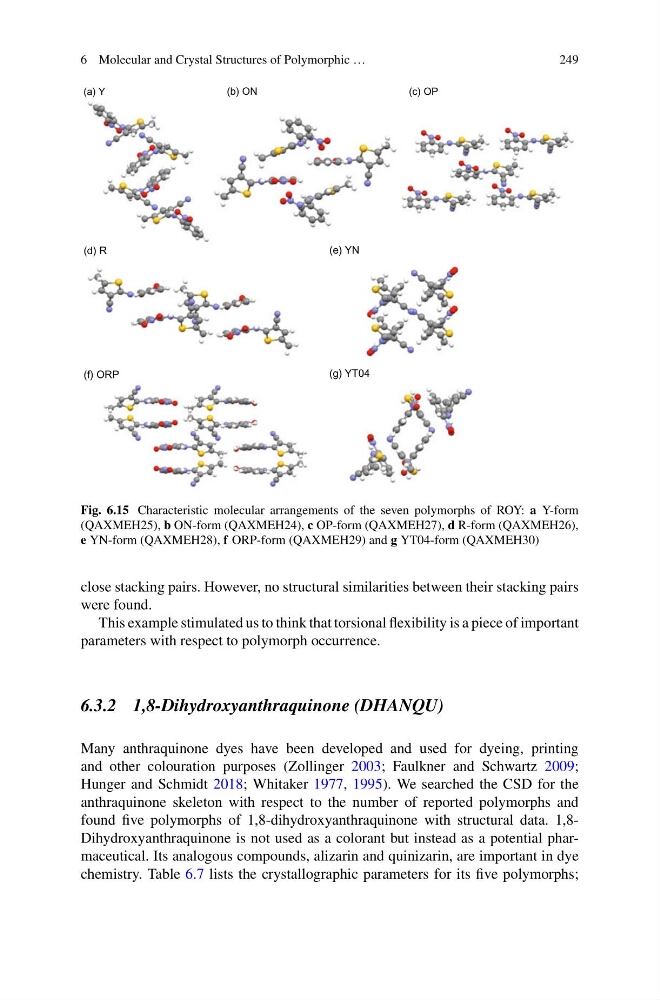
Fig. 6.15 Characteristic molecular arrangements of the seven polymorphs of ROY: a Y-form
(QAXMEH25), b ON-form (QAXMEH24), c OP-form (QAXMEH27), d R-form (QAXMEH26),
e YN-form (QAXMEH28), f ORP-form (QAXMEH29) and g YT04-form (QAXMEH30)
close stacking pairs. However, no structural similarities between their stacking pairs
were found.
This example stimulated us to think that torsional flexibility is a piece of important
parameters with respect to polymorph occurrence.
6.3.2 1,8-Dihydroxyanthraquinone (DHANQU)
Many anthraquinone dyes have been developed and used for dyeing, printing
and other colouration purposes (Zollinger 2003; Faulkner and Schwartz 2009;
Hunger and Schmidt 2018; Whitaker 1977, 1995). We searched the CSD for the
anthraquinone skeleton with respect to the number of reported polymorphs and
found five polymorphs of 1,8-dihydroxyanthraquinone with structural data. 1,8Dihydroxyanthraquinone is not used as a colorant but instead as a potential pharmaceutical. Its analogous compounds, alizarin and quinizarin, are important in dye
chemistry. Table 6.7 lists the crystallographic parameters for its five polymorphs;
249
(a) Y
(b) ON
(c) OP
(e) YN
(d) R
(f) ORP
(g) YT04
Fig. 6.15 Characteristic molecular arrangements of the seven polymorphs of ROY: a Y-form
(QAXMEH25), b ON-form (QAXMEH24), c OP-form (QAXMEH27), d R-form (QAXMEH26),
e YN-form (QAXMEH28), f ORP-form (QAXMEH29) and g YT04-form (QAXMEH30)
close stacking pairs. However, no structural similarities between their stacking pairs
were found.
This example stimulated us to think that torsional flexibility is a piece of important
parameters with respect to polymorph occurrence.
6.3.2 1,8-Dihydroxyanthraquinone (DHANQU)
Many anthraquinone dyes have been developed and used for dyeing, printing
and other colouration purposes (Zollinger 2003; Faulkner and Schwartz 2009;
Hunger and Schmidt 2018; Whitaker 1977, 1995). We searched the CSD for the
anthraquinone skeleton with respect to the number of reported polymorphs and
found five polymorphs of 1,8-dihydroxyanthraquinone with structural data. 1,8Dihydroxyanthraquinone is not used as a colorant but instead as a potential pharmaceutical. Its analogous compounds, alizarin and quinizarin, are important in dye
chemistry. Table 6.7 lists the crystallographic parameters for its five polymorphs;