

244
S. Matsumoto and J. Hwang
(a) Y
(b) YO
(c) DO
a
b
O
c
a
b
O
c
a
b
O
c
(e) RV
(d) R
a
b
O
c
a
b
O
c
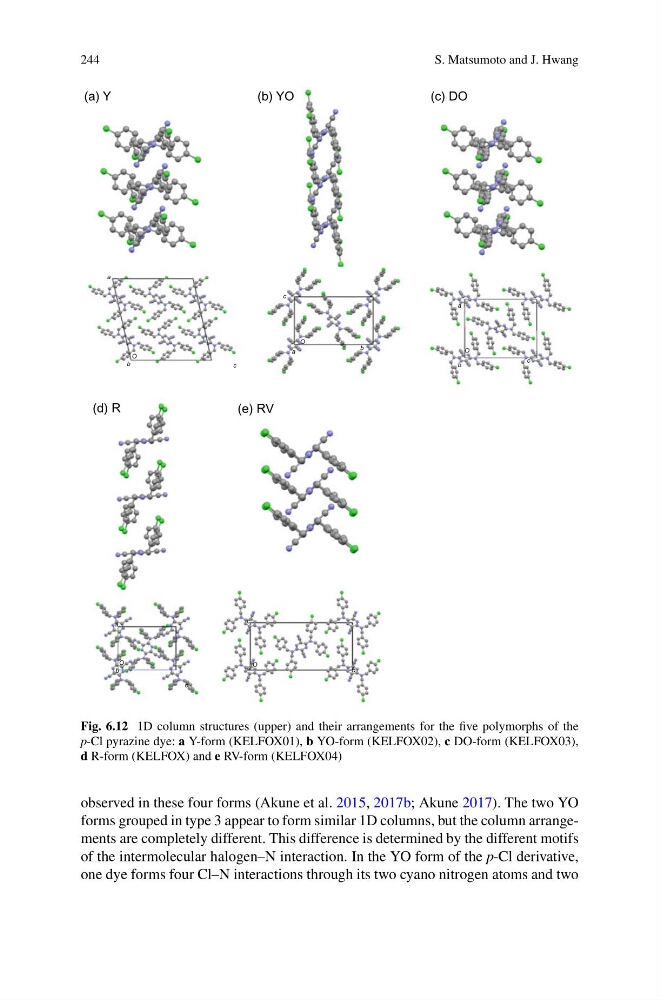
Fig. 6.12 1D column structures (upper) and their arrangements for the five polymorphs of the
p-Cl pyrazine dye: a Y-form (KELFOX01), b YO-form (KELFOX02), c DO-form (KELFOX03),
d R-form (KELFOX) and e RV-form (KELFOX04)
observed in these four forms (Akune et al. 2015, 2017b; Akune 2017). The two YO
forms grouped in type 3 appear to form similar 1D columns, but the column arrangements are completely different. This difference is determined by the different motifs
of the intermolecular halogen–N interaction. In the YO form of the p-Cl derivative,
one dye forms four Cl–N interactions through its two cyano nitrogen atoms and two
S. Matsumoto and J. Hwang
(a) Y
(b) YO
(c) DO
a
b
O
c
a
b
O
c
a
b
O
c
(e) RV
(d) R
a
b
O
c
a
b
O
c
Fig. 6.12 1D column structures (upper) and their arrangements for the five polymorphs of the
p-Cl pyrazine dye: a Y-form (KELFOX01), b YO-form (KELFOX02), c DO-form (KELFOX03),
d R-form (KELFOX) and e RV-form (KELFOX04)
observed in these four forms (Akune et al. 2015, 2017b; Akune 2017). The two YO
forms grouped in type 3 appear to form similar 1D columns, but the column arrangements are completely different. This difference is determined by the different motifs
of the intermolecular halogen–N interaction. In the YO form of the p-Cl derivative,
one dye forms four Cl–N interactions through its two cyano nitrogen atoms and two