

242
S. Matsumoto and J. Hwang
(a) Y
(b) YO
(c) DO
(e) RV
(d) R
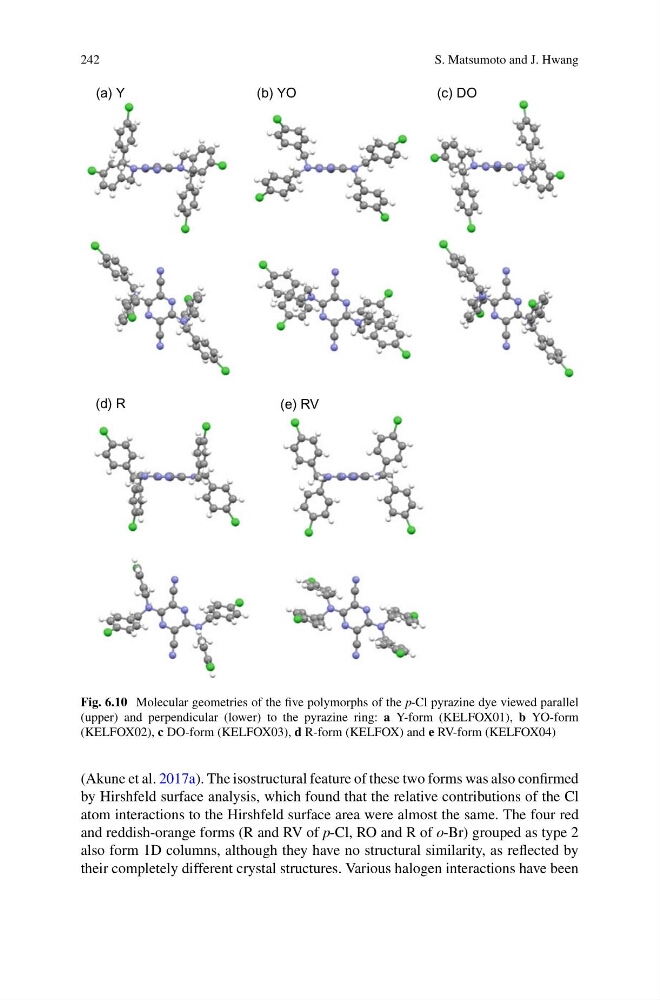
Fig. 6.10 Molecular geometries of the five polymorphs of the p-Cl pyrazine dye viewed parallel
(upper) and perpendicular (lower) to the pyrazine ring: a Y-form (KELFOX01), b YO-form
(KELFOX02), c DO-form (KELFOX03), d R-form (KELFOX) and e RV-form (KELFOX04)
(Akune et al. 2017a). The isostructural feature of these two forms was also confirmed
by Hirshfeld surface analysis, which found that the relative contributions of the Cl
atom interactions to the Hirshfeld surface area were almost the same. The four red
and reddish-orange forms (R and RV of p-Cl, RO and R of o-Br) grouped as type 2
also form 1D columns, although they have no structural similarity, as reflected by
their completely different crystal structures. Various halogen interactions have been
S. Matsumoto and J. Hwang
(a) Y
(b) YO
(c) DO
(e) RV
(d) R
Fig. 6.10 Molecular geometries of the five polymorphs of the p-Cl pyrazine dye viewed parallel
(upper) and perpendicular (lower) to the pyrazine ring: a Y-form (KELFOX01), b YO-form
(KELFOX02), c DO-form (KELFOX03), d R-form (KELFOX) and e RV-form (KELFOX04)
(Akune et al. 2017a). The isostructural feature of these two forms was also confirmed
by Hirshfeld surface analysis, which found that the relative contributions of the Cl
atom interactions to the Hirshfeld surface area were almost the same. The four red
and reddish-orange forms (R and RV of p-Cl, RO and R of o-Br) grouped as type 2
also form 1D columns, although they have no structural similarity, as reflected by
their completely different crystal structures. Various halogen interactions have been