

6 Molecular and Crystal Structures of Polymorphic …
237
(a) A
(b) B
(c) C
(d) D
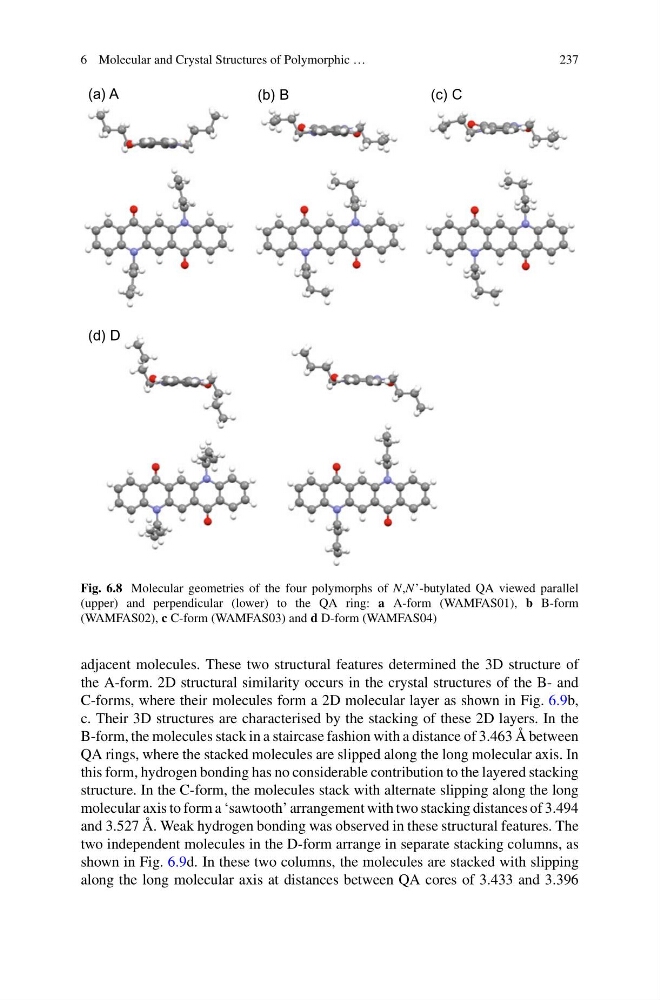
Fig. 6.8 Molecular geometries of the four polymorphs of N,N’-butylated QA viewed parallel
(upper) and perpendicular (lower) to the QA ring: a A-form (WAMFAS01), b B-form
(WAMFAS02), c C-form (WAMFAS03) and d D-form (WAMFAS04)
adjacent molecules. These two structural features determined the 3D structure of
the A-form. 2D structural similarity occurs in the crystal structures of the B- and
C-forms, where their molecules form a 2D molecular layer as shown in Fig. 6.9b,
c. Their 3D structures are characterised by the stacking of these 2D layers. In the
B-form, the molecules stack in a staircase fashion with a distance of 3.463 Å between
QA rings, where the stacked molecules are slipped along the long molecular axis. In
this form, hydrogen bonding has no considerable contribution to the layered stacking
structure. In the C-form, the molecules stack with alternate slipping along the long
molecular axis to form a ‘sawtooth’ arrangement with two stacking distances of 3.494
and 3.527 Å. Weak hydrogen bonding was observed in these structural features. The
two independent molecules in the D-form arrange in separate stacking columns, as
shown in Fig. 6.9d. In these two columns, the molecules are stacked with slipping
along the long molecular axis at distances between QA cores of 3.433 and 3.396
237
(a) A
(b) B
(c) C
(d) D
Fig. 6.8 Molecular geometries of the four polymorphs of N,N’-butylated QA viewed parallel
(upper) and perpendicular (lower) to the QA ring: a A-form (WAMFAS01), b B-form
(WAMFAS02), c C-form (WAMFAS03) and d D-form (WAMFAS04)
adjacent molecules. These two structural features determined the 3D structure of
the A-form. 2D structural similarity occurs in the crystal structures of the B- and
C-forms, where their molecules form a 2D molecular layer as shown in Fig. 6.9b,
c. Their 3D structures are characterised by the stacking of these 2D layers. In the
B-form, the molecules stack in a staircase fashion with a distance of 3.463 Å between
QA rings, where the stacked molecules are slipped along the long molecular axis. In
this form, hydrogen bonding has no considerable contribution to the layered stacking
structure. In the C-form, the molecules stack with alternate slipping along the long
molecular axis to form a ‘sawtooth’ arrangement with two stacking distances of 3.494
and 3.527 Å. Weak hydrogen bonding was observed in these structural features. The
two independent molecules in the D-form arrange in separate stacking columns, as
shown in Fig. 6.9d. In these two columns, the molecules are stacked with slipping
along the long molecular axis at distances between QA cores of 3.433 and 3.396