

16
M. Matsui
N
N S
O
C 8 H 17
N
S
O
HOOC CN
N
N S
O
C 8 H 17
N
S
O
NC CN
N
N S
O
HOOC(H 2 C) 7
N
S
O
NC CN
N
N S
O
C 8 H 17
N
S
O
HOOC CN
C 8 H 17
N
N S
O
C 8 H 17
N
S
O
HOOC CN
1.60
N
N S
O
C 8 H 17
N
S
O
NC CN
1.57
N
N S
O
HOOC(H 2 C) 7
N
S
O
NC CN
1.59
N
N S
O
C 8 H 17
N
S
O
HOOC CN
C 8 H 17
1.58
<
<
C 4 H 9
C 4 H 9
C 4 H 9
C 4 H 9
C 4 H 9
C 4 H 9
C 4 H 9
C 4 H 9
COOH
COOH
COOH
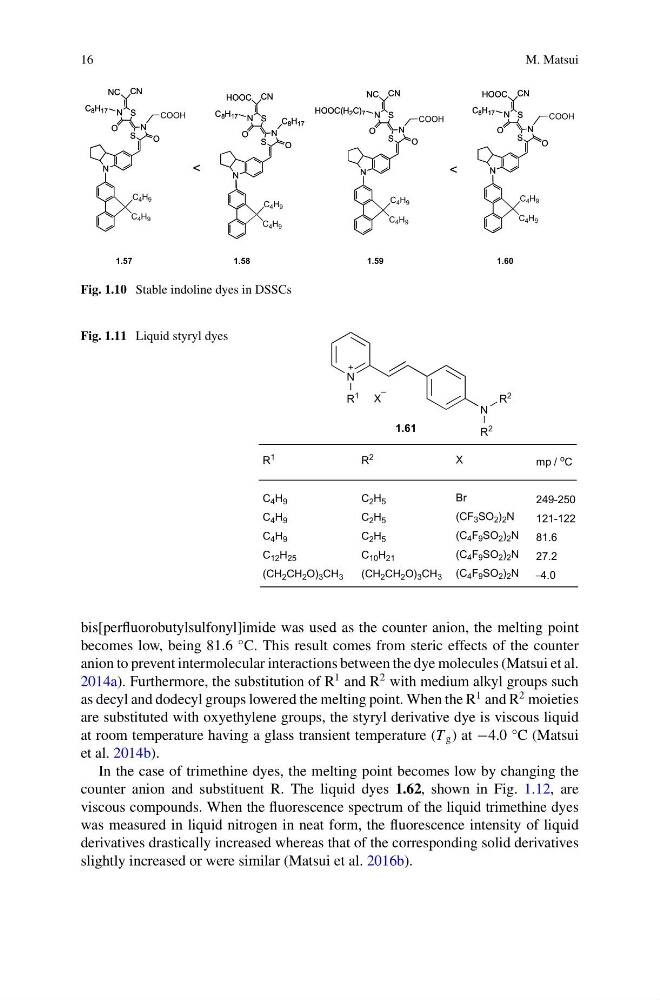
Fig. 1.10 Stable indoline dyes in DSSCs
Fig. 1.11 Liquid styryl dyes
N
R
1
N
X
R
2
R
2
X
Br
(CF 3 SO 2 ) 2 N
(C 4 F 9 SO 2 ) 2 N
(C 4 F 9 SO 2 ) 2 N
(C 4 F 9 SO 2 ) 2 N
R
1
C 4 H 9
C 4 H 9
C 4 H 9
C 12 H 25
(CH 2 CH 2 O) 3 CH 3
R
2
C 2 H 5
C 2 H 5
C 2 H 5
C 10 H 21
(CH 2 CH 2 O) 3 CH 3
mp /
o C
249-250
121-122
81.6
27.2
_ 4.0
1.61
bis[perfluorobutylsulfonyl]imide was used as the counter anion, the melting point
becomes low, being 81.6 °C. This result comes from steric effects of the counter
anion to prevent intermolecular interactions between the dye molecules (Matsui et al.
2014a). Furthermore, the substitution of R
1 and R
2 with medium alkyl groups such
as decyl and dodecyl groups lowered the melting point. When the R
1 and R
2 moieties
are substituted with oxyethylene groups, the styryl derivative dye is viscous liquid
at room temperature having a glass transient temperature (T g ) at −4.0 °C (Matsui
et al. 2014b).
In the case of trimethine dyes, the melting point becomes low by changing the
counter anion and substituent R. The liquid dyes 1.62, shown in Fig. 1.12, are
viscous compounds. When the fluorescence spectrum of the liquid trimethine dyes
was measured in liquid nitrogen in neat form, the fluorescence intensity of liquid
derivatives drastically increased whereas that of the corresponding solid derivatives
slightly increased or were similar (Matsui et al. 2016b).
M. Matsui
N
N S
O
C 8 H 17
N
S
O
HOOC CN
N
N S
O
C 8 H 17
N
S
O
NC CN
N
N S
O
HOOC(H 2 C) 7
N
S
O
NC CN
N
N S
O
C 8 H 17
N
S
O
HOOC CN
C 8 H 17
N
N S
O
C 8 H 17
N
S
O
HOOC CN
1.60
N
N S
O
C 8 H 17
N
S
O
NC CN
1.57
N
N S
O
HOOC(H 2 C) 7
N
S
O
NC CN
1.59
N
N S
O
C 8 H 17
N
S
O
HOOC CN
C 8 H 17
1.58
<
<
C 4 H 9
C 4 H 9
C 4 H 9
C 4 H 9
C 4 H 9
C 4 H 9
C 4 H 9
C 4 H 9
COOH
COOH
COOH
Fig. 1.10 Stable indoline dyes in DSSCs
Fig. 1.11 Liquid styryl dyes
N
R
1
N
X
R
2
R
2
X
Br
(CF 3 SO 2 ) 2 N
(C 4 F 9 SO 2 ) 2 N
(C 4 F 9 SO 2 ) 2 N
(C 4 F 9 SO 2 ) 2 N
R
1
C 4 H 9
C 4 H 9
C 4 H 9
C 12 H 25
(CH 2 CH 2 O) 3 CH 3
R
2
C 2 H 5
C 2 H 5
C 2 H 5
C 10 H 21
(CH 2 CH 2 O) 3 CH 3
mp /
o C
249-250
121-122
81.6
27.2
_ 4.0
1.61
bis[perfluorobutylsulfonyl]imide was used as the counter anion, the melting point
becomes low, being 81.6 °C. This result comes from steric effects of the counter
anion to prevent intermolecular interactions between the dye molecules (Matsui et al.
2014a). Furthermore, the substitution of R
1 and R
2 with medium alkyl groups such
as decyl and dodecyl groups lowered the melting point. When the R
1 and R
2 moieties
are substituted with oxyethylene groups, the styryl derivative dye is viscous liquid
at room temperature having a glass transient temperature (T g ) at −4.0 °C (Matsui
et al. 2014b).
In the case of trimethine dyes, the melting point becomes low by changing the
counter anion and substituent R. The liquid dyes 1.62, shown in Fig. 1.12, are
viscous compounds. When the fluorescence spectrum of the liquid trimethine dyes
was measured in liquid nitrogen in neat form, the fluorescence intensity of liquid
derivatives drastically increased whereas that of the corresponding solid derivatives
slightly increased or were similar (Matsui et al. 2016b).