

1 Polymethine Dyes
15
N
N
S
O
N
S
O
C 8 H 17
S
COOH
N
N
S
O
N
S
O
C 8 H 17
CN
NC
COOH
CH 3
CH 3
N
N
S
O
N
S
O
C 8 H 17
CN
NC
COOH
1.54 (D205)
1.55
1.56
N
N
S
O
N
S
O
C 2 H 5
S
COOH
1.53 (D149)
= 4.92 % (ZnO)
= 5.15 % (ZnO)
= 5.55 % (ZnO)
η
η
η
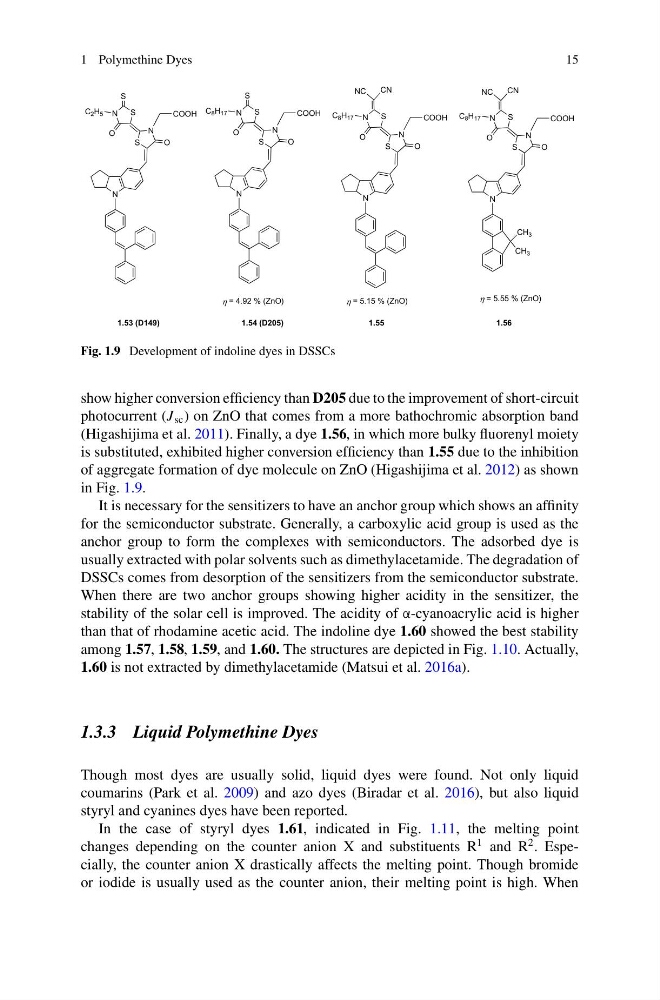
Fig. 1.9 Development of indoline dyes in DSSCs
show higher conversion efficiency than D205 due to the improvement of short-circuit
photocurrent (J sc ) on ZnO that comes from a more bathochromic absorption band
(Higashijima et al. 2011). Finally, a dye 1.56, in which more bulky fluorenyl moiety
is substituted, exhibited higher conversion efficiency than 1.55 due to the inhibition
of aggregate formation of dye molecule on ZnO (Higashijima et al. 2012) as shown
in Fig. 1.9.
It is necessary for the sensitizers to have an anchor group which shows an affinity
for the semiconductor substrate. Generally, a carboxylic acid group is used as the
anchor group to form the complexes with semiconductors. The adsorbed dye is
usually extracted with polar solvents such as dimethylacetamide. The degradation of
DSSCs comes from desorption of the sensitizers from the semiconductor substrate.
When there are two anchor groups showing higher acidity in the sensitizer, the
stability of the solar cell is improved. The acidity of α-cyanoacrylic acid is higher
than that of rhodamine acetic acid. The indoline dye 1.60 showed the best stability
among 1.57, 1.58, 1.59, and 1.60. The structures are depicted in Fig. 1.10. Actually,
1.60 is not extracted by dimethylacetamide (Matsui et al. 2016a).
1.3.3 Liquid Polymethine Dyes
Though most dyes are usually solid, liquid dyes were found. Not only liquid
coumarins (Park et al. 2009) and azo dyes (Biradar et al. 2016), but also liquid
styryl and cyanines dyes have been reported.
In the case of styryl dyes 1.61, indicated in Fig. 1.11, the melting point
changes depending on the counter anion X and substituents R
1 and R
2 . Especially, the counter anion X drastically affects the melting point. Though bromide
or iodide is usually used as the counter anion, their melting point is high. When
15
N
N
S
O
N
S
O
C 8 H 17
S
COOH
N
N
S
O
N
S
O
C 8 H 17
CN
NC
COOH
CH 3
CH 3
N
N
S
O
N
S
O
C 8 H 17
CN
NC
COOH
1.54 (D205)
1.55
1.56
N
N
S
O
N
S
O
C 2 H 5
S
COOH
1.53 (D149)
= 4.92 % (ZnO)
= 5.15 % (ZnO)
= 5.55 % (ZnO)
η
η
η
Fig. 1.9 Development of indoline dyes in DSSCs
show higher conversion efficiency than D205 due to the improvement of short-circuit
photocurrent (J sc ) on ZnO that comes from a more bathochromic absorption band
(Higashijima et al. 2011). Finally, a dye 1.56, in which more bulky fluorenyl moiety
is substituted, exhibited higher conversion efficiency than 1.55 due to the inhibition
of aggregate formation of dye molecule on ZnO (Higashijima et al. 2012) as shown
in Fig. 1.9.
It is necessary for the sensitizers to have an anchor group which shows an affinity
for the semiconductor substrate. Generally, a carboxylic acid group is used as the
anchor group to form the complexes with semiconductors. The adsorbed dye is
usually extracted with polar solvents such as dimethylacetamide. The degradation of
DSSCs comes from desorption of the sensitizers from the semiconductor substrate.
When there are two anchor groups showing higher acidity in the sensitizer, the
stability of the solar cell is improved. The acidity of α-cyanoacrylic acid is higher
than that of rhodamine acetic acid. The indoline dye 1.60 showed the best stability
among 1.57, 1.58, 1.59, and 1.60. The structures are depicted in Fig. 1.10. Actually,
1.60 is not extracted by dimethylacetamide (Matsui et al. 2016a).
1.3.3 Liquid Polymethine Dyes
Though most dyes are usually solid, liquid dyes were found. Not only liquid
coumarins (Park et al. 2009) and azo dyes (Biradar et al. 2016), but also liquid
styryl and cyanines dyes have been reported.
In the case of styryl dyes 1.61, indicated in Fig. 1.11, the melting point
changes depending on the counter anion X and substituents R
1 and R
2 . Especially, the counter anion X drastically affects the melting point. Though bromide
or iodide is usually used as the counter anion, their melting point is high. When