

5 BODIPY Dyes and Their Analogues
189
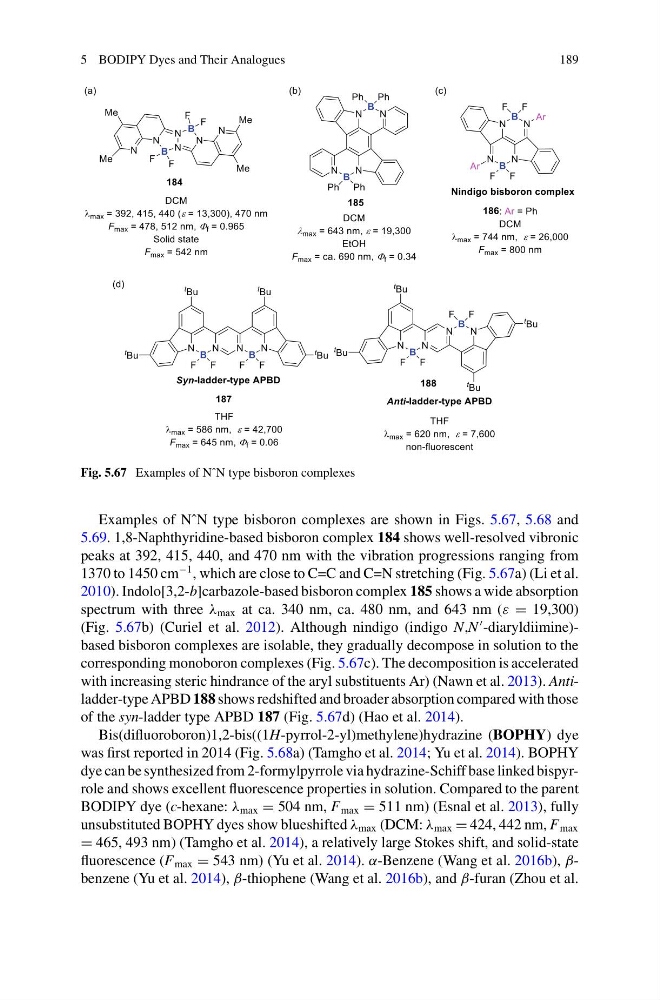
Fig. 5.67 Examples of NˆN type bisboron complexes
Examples of NˆN type bisboron complexes are shown in Figs. 5.67, 5.68 and
5.69. 1,8-Naphthyridine-based bisboron complex 184 shows well-resolved vibronic
peaks at 392, 415, 440, and 470 nm with the vibration progressions ranging from
1370 to 1450 cm
−1 , which are close to C=C and C=N stretching (Fig. 5.67a) (Li et al.
2010). Indolo[3,2-b]carbazole-based bisboron complex 185 shows a wide absorption
spectrum with three λ max at ca. 340 nm, ca. 480 nm, and 643 nm (ε = 19,300)
(Fig. 5.67b) (Curiel et al. 2012). Although nindigo (indigo N,N
-diaryldiimine)based bisboron complexes are isolable, they gradually decompose in solution to the
corresponding monoboron complexes (Fig. 5.67c). The decomposition is accelerated
with increasing steric hindrance of the aryl substituents Ar) (Nawn et al. 2013). Antiladder-type APBD 188 shows redshifted and broader absorption compared with those
of the syn-ladder type APBD 187 (Fig. 5.67d) (Hao et al. 2014).
Bis(difluoroboron)1,2-bis((1H-pyrrol-2-yl)methylene)hydrazine (BOPHY) dye
was first reported in 2014 (Fig. 5.68a) (Tamgho et al. 2014; Yu et al. 2014). BOPHY
dye can be synthesized from 2-formylpyrrole via hydrazine-Schiff base linked bispyrrole and shows excellent fluorescence properties in solution. Compared to the parent
BODIPY dye (c-hexane: λ max = 504 nm, F max = 511 nm) (Esnal et al. 2013), fully
unsubstituted BOPHY dyes show blueshifted λ max (DCM: λ max = 424, 442 nm, F max
= 465, 493 nm) (Tamgho et al. 2014), a relatively large Stokes shift, and solid-state
fluorescence (F max = 543 nm) (Yu et al. 2014). α-Benzene (Wang et al. 2016b), βbenzene (Yu et al. 2014), β-thiophene (Wang et al. 2016b), and β-furan (Zhou et al.
189
Fig. 5.67 Examples of NˆN type bisboron complexes
Examples of NˆN type bisboron complexes are shown in Figs. 5.67, 5.68 and
5.69. 1,8-Naphthyridine-based bisboron complex 184 shows well-resolved vibronic
peaks at 392, 415, 440, and 470 nm with the vibration progressions ranging from
1370 to 1450 cm
−1 , which are close to C=C and C=N stretching (Fig. 5.67a) (Li et al.
2010). Indolo[3,2-b]carbazole-based bisboron complex 185 shows a wide absorption
spectrum with three λ max at ca. 340 nm, ca. 480 nm, and 643 nm (ε = 19,300)
(Fig. 5.67b) (Curiel et al. 2012). Although nindigo (indigo N,N
-diaryldiimine)based bisboron complexes are isolable, they gradually decompose in solution to the
corresponding monoboron complexes (Fig. 5.67c). The decomposition is accelerated
with increasing steric hindrance of the aryl substituents Ar) (Nawn et al. 2013). Antiladder-type APBD 188 shows redshifted and broader absorption compared with those
of the syn-ladder type APBD 187 (Fig. 5.67d) (Hao et al. 2014).
Bis(difluoroboron)1,2-bis((1H-pyrrol-2-yl)methylene)hydrazine (BOPHY) dye
was first reported in 2014 (Fig. 5.68a) (Tamgho et al. 2014; Yu et al. 2014). BOPHY
dye can be synthesized from 2-formylpyrrole via hydrazine-Schiff base linked bispyrrole and shows excellent fluorescence properties in solution. Compared to the parent
BODIPY dye (c-hexane: λ max = 504 nm, F max = 511 nm) (Esnal et al. 2013), fully
unsubstituted BOPHY dyes show blueshifted λ max (DCM: λ max = 424, 442 nm, F max
= 465, 493 nm) (Tamgho et al. 2014), a relatively large Stokes shift, and solid-state
fluorescence (F max = 543 nm) (Yu et al. 2014). α-Benzene (Wang et al. 2016b), βbenzene (Yu et al. 2014), β-thiophene (Wang et al. 2016b), and β-furan (Zhou et al.