

162
Y. Kubota
Other type 3 boron diiminate dyes have also been reported (Liu et al. 2010; Perumal
et al. 2012).
For type 4, anilido-benzoxazole boron difluoride (ABB) dyes have been reported
(Meesala et al. 2015). The reaction of 2-iodo-N-(2-bromophenyl) benzamide with
anilines in the presence of K 2 CO 3 and copper iodide gives the corresponding anilidobenzoxazole ligands, and the subsequent boron complexation provides ABB dyes.
In solution, 76 (Φ f = 0.96) shows higher Φ f compared to that of 75 (Φ f = 0.45)
because of the constraint of the rotation of the orthogonal anilido phenyl moiety
caused by ortho substituents (Fig. 5.44d). ABB dyes show solid-state fluorescence.
Other type 4 boron diiminate dyes have also been reported (Araneda et al. 2011;
Frath et al. 2013; Roubinet et al. 2015; Pais et al. 2016).
For type 5, the above-mentioned pyridomethene-BF 2 complexes (Kubota et al.
2010a; Scheibe et al. 1969; Douglass et al. 1973; Golden et al. 2017, 2018; Lin and
Chow 2013; Lin et al. 2015) and isoindoline-benzazole-based BF 2 complex (Wang
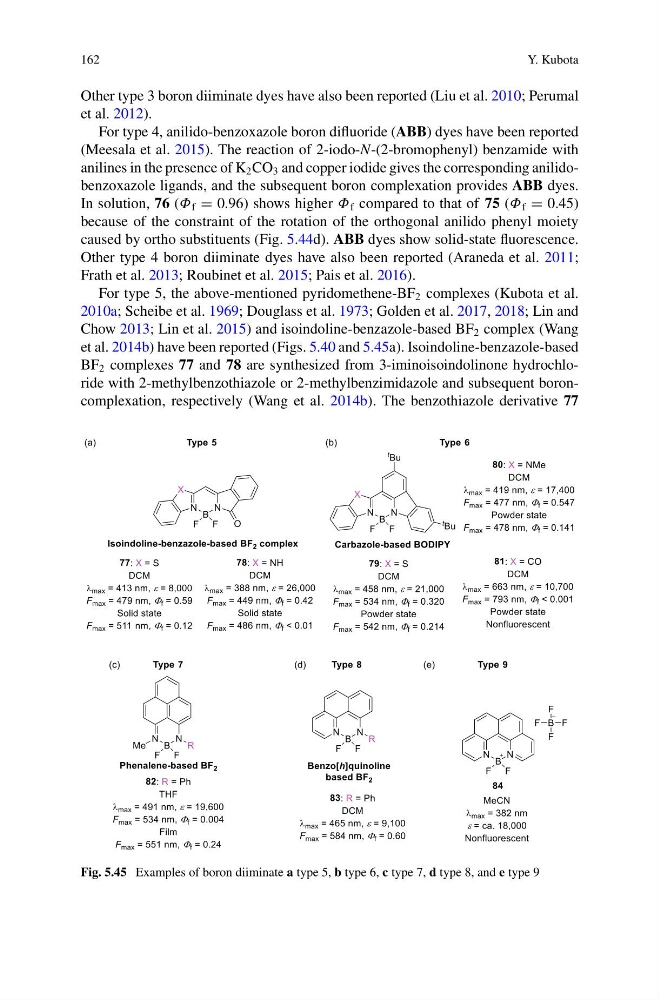
et al. 2014b) have been reported (Figs. 5.40 and 5.45a). Isoindoline-benzazole-based
BF 2 complexes 77 and 78 are synthesized from 3-iminoisoindolinone hydrochloride with 2-methylbenzothiazole or 2-methylbenzimidazole and subsequent boroncomplexation, respectively (Wang et al. 2014b). The benzothiazole derivative 77
Fig. 5.45 Examples of boron diiminate a type 5, b type 6, c type 7, d type 8, and e type 9
Y. Kubota
Other type 3 boron diiminate dyes have also been reported (Liu et al. 2010; Perumal
et al. 2012).
For type 4, anilido-benzoxazole boron difluoride (ABB) dyes have been reported
(Meesala et al. 2015). The reaction of 2-iodo-N-(2-bromophenyl) benzamide with
anilines in the presence of K 2 CO 3 and copper iodide gives the corresponding anilidobenzoxazole ligands, and the subsequent boron complexation provides ABB dyes.
In solution, 76 (Φ f = 0.96) shows higher Φ f compared to that of 75 (Φ f = 0.45)
because of the constraint of the rotation of the orthogonal anilido phenyl moiety
caused by ortho substituents (Fig. 5.44d). ABB dyes show solid-state fluorescence.
Other type 4 boron diiminate dyes have also been reported (Araneda et al. 2011;
Frath et al. 2013; Roubinet et al. 2015; Pais et al. 2016).
For type 5, the above-mentioned pyridomethene-BF 2 complexes (Kubota et al.
2010a; Scheibe et al. 1969; Douglass et al. 1973; Golden et al. 2017, 2018; Lin and
Chow 2013; Lin et al. 2015) and isoindoline-benzazole-based BF 2 complex (Wang
et al. 2014b) have been reported (Figs. 5.40 and 5.45a). Isoindoline-benzazole-based
BF 2 complexes 77 and 78 are synthesized from 3-iminoisoindolinone hydrochloride with 2-methylbenzothiazole or 2-methylbenzimidazole and subsequent boroncomplexation, respectively (Wang et al. 2014b). The benzothiazole derivative 77
Fig. 5.45 Examples of boron diiminate a type 5, b type 6, c type 7, d type 8, and e type 9