

158
Y. Kubota
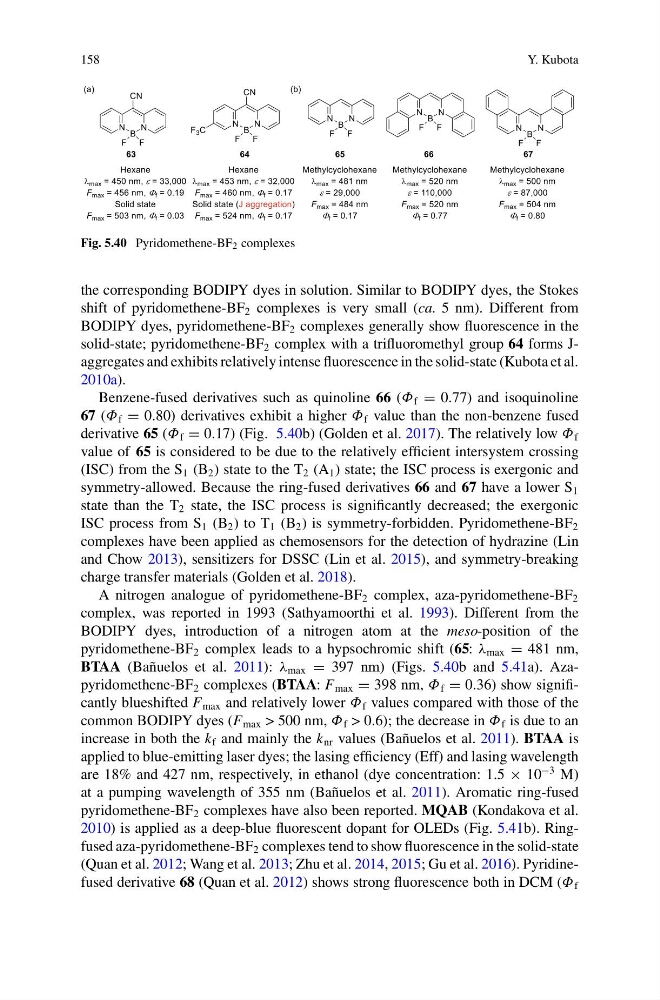
Fig. 5.40 Pyridomethene-BF 2 complexes
the corresponding BODIPY dyes in solution. Similar to BODIPY dyes, the Stokes
shift of pyridomethene-BF 2 complexes is very small (ca. 5 nm). Different from
BODIPY dyes, pyridomethene-BF 2 complexes generally show fluorescence in the
solid-state; pyridomethene-BF 2 complex with a trifluoromethyl group 64 forms Jaggregates and exhibits relatively intense fluorescence in the solid-state (Kubota et al.
2010a).
Benzene-fused derivatives such as quinoline 66 (Φ f = 0.77) and isoquinoline
67 (Φ f = 0.80) derivatives exhibit a higher Φ f value than the non-benzene fused
derivative 65 (Φ f = 0.17) (Fig. 5.40b) (Golden et al. 2017). The relatively low Φ f
value of 65 is considered to be due to the relatively efficient intersystem crossing
(ISC) from the S 1 (B 2 ) state to the T 2 (A 1 ) state; the ISC process is exergonic and
symmetry-allowed. Because the ring-fused derivatives 66 and 67 have a lower S 1
state than the T 2 state, the ISC process is significantly decreased; the exergonic
ISC process from S 1 (B 2 ) to T 1 (B 2 ) is symmetry-forbidden. Pyridomethene-BF 2
complexes have been applied as chemosensors for the detection of hydrazine (Lin
and Chow 2013), sensitizers for DSSC (Lin et al. 2015), and symmetry-breaking
charge transfer materials (Golden et al. 2018).
A nitrogen analogue of pyridomethene-BF 2 complex, aza-pyridomethene-BF 2
complex, was reported in 1993 (Sathyamoorthi et al. 1993). Different from the
BODIPY dyes, introduction of a nitrogen atom at the meso-position of the
pyridomethene-BF 2 complex leads to a hypsochromic shift (65: λ max = 481 nm,
BTAA (Bañuelos et al. 2011): λ max = 397 nm) (Figs. 5.40b and 5.41a). Azapyridomethene-BF 2 complexes (BTAA: F max = 398 nm, Φ f = 0.36) show significantly blueshifted F max and relatively lower Φ f values compared with those of the
common BODIPY dyes (F max > 500 nm, Φ f > 0.6); the decrease in Φ f is due to an
increase in both the k f and mainly the k nr values (Bañuelos et al. 2011). BTAA is
applied to blue-emitting laser dyes; the lasing efficiency (Eff) and lasing wavelength
are 18% and 427 nm, respectively, in ethanol (dye concentration: 1.5 × 10
−3 M)
at a pumping wavelength of 355 nm (Bañuelos et al. 2011). Aromatic ring-fused
pyridomethene-BF 2 complexes have also been reported. MQAB (Kondakova et al.
2010) is applied as a deep-blue fluorescent dopant for OLEDs (Fig. 5.41b). Ringfused aza-pyridomethene-BF 2 complexes tend to show fluorescence in the solid-state
(Quan et al. 2012; Wang et al. 2013; Zhu et al. 2014, 2015; Gu et al. 2016). Pyridinefused derivative 68 (Quan et al. 2012) shows strong fluorescence both in DCM (Φ f
Y. Kubota
Fig. 5.40 Pyridomethene-BF 2 complexes
the corresponding BODIPY dyes in solution. Similar to BODIPY dyes, the Stokes
shift of pyridomethene-BF 2 complexes is very small (ca. 5 nm). Different from
BODIPY dyes, pyridomethene-BF 2 complexes generally show fluorescence in the
solid-state; pyridomethene-BF 2 complex with a trifluoromethyl group 64 forms Jaggregates and exhibits relatively intense fluorescence in the solid-state (Kubota et al.
2010a).
Benzene-fused derivatives such as quinoline 66 (Φ f = 0.77) and isoquinoline
67 (Φ f = 0.80) derivatives exhibit a higher Φ f value than the non-benzene fused
derivative 65 (Φ f = 0.17) (Fig. 5.40b) (Golden et al. 2017). The relatively low Φ f
value of 65 is considered to be due to the relatively efficient intersystem crossing
(ISC) from the S 1 (B 2 ) state to the T 2 (A 1 ) state; the ISC process is exergonic and
symmetry-allowed. Because the ring-fused derivatives 66 and 67 have a lower S 1
state than the T 2 state, the ISC process is significantly decreased; the exergonic
ISC process from S 1 (B 2 ) to T 1 (B 2 ) is symmetry-forbidden. Pyridomethene-BF 2
complexes have been applied as chemosensors for the detection of hydrazine (Lin
and Chow 2013), sensitizers for DSSC (Lin et al. 2015), and symmetry-breaking
charge transfer materials (Golden et al. 2018).
A nitrogen analogue of pyridomethene-BF 2 complex, aza-pyridomethene-BF 2
complex, was reported in 1993 (Sathyamoorthi et al. 1993). Different from the
BODIPY dyes, introduction of a nitrogen atom at the meso-position of the
pyridomethene-BF 2 complex leads to a hypsochromic shift (65: λ max = 481 nm,
BTAA (Bañuelos et al. 2011): λ max = 397 nm) (Figs. 5.40b and 5.41a). Azapyridomethene-BF 2 complexes (BTAA: F max = 398 nm, Φ f = 0.36) show significantly blueshifted F max and relatively lower Φ f values compared with those of the
common BODIPY dyes (F max > 500 nm, Φ f > 0.6); the decrease in Φ f is due to an
increase in both the k f and mainly the k nr values (Bañuelos et al. 2011). BTAA is
applied to blue-emitting laser dyes; the lasing efficiency (Eff) and lasing wavelength
are 18% and 427 nm, respectively, in ethanol (dye concentration: 1.5 × 10
−3 M)
at a pumping wavelength of 355 nm (Bañuelos et al. 2011). Aromatic ring-fused
pyridomethene-BF 2 complexes have also been reported. MQAB (Kondakova et al.
2010) is applied as a deep-blue fluorescent dopant for OLEDs (Fig. 5.41b). Ringfused aza-pyridomethene-BF 2 complexes tend to show fluorescence in the solid-state
(Quan et al. 2012; Wang et al. 2013; Zhu et al. 2014, 2015; Gu et al. 2016). Pyridinefused derivative 68 (Quan et al. 2012) shows strong fluorescence both in DCM (Φ f