

5 BODIPY Dyes and Their Analogues
137
5.2.3.6 Solution Approach to the Drawback of BODIPY
Solid-state fluorescence
BODIPY dyes do have a few drawbacks, including aggregation-caused quenching
(Mei et al. 2015) (ACQ) and small Stokes shifts, which limit their applications.
There have been substantial efforts to improve these limitations. In terms of ACQ,
dyes which show fluorescence in dilute solution generally quench or reduce the fluorescence intensity in the solid-state; this phenomenon is called ACQ or concentration
quenching and is a common phenomenon in organic dyes. The main cause of ACQ is
the formation of π–π stacking in the solid-state. Since BODIPY dyes have extended
planar π-conjugated structures, they easily induce ACQ phenomena. In many cases,
BODIPY dyes do not show fluorescence in the solid-state. Strategies to express and
enhance solid-state fluorescence in BODIPY dyes include the following: (1) prevention of intermolecular interactions between neighbouring fluorophores (Kubota et al.
2010b; Ozdemir et al. 2009; Lu et al. 2012), which causes fluorescence quenching, (2)
formation of emissive J-aggregates (Kim et al. 2015), and (3) solid-state entrapment
of BODIPY in metal-organic frameworks (MOFs) (Glembockyte et al. 2018).
In light of strategy (1), the introduction of bulky substituents into a BODIPY core is
an effective strategy to enhance solid-state fluorescence by preventing intermolecular
interactions, such as π–π interactions, by steric repulsion. When considering ease of
synthesis and overall effectiveness, the introduction of bulky groups is favoured at
the boron atom (4-position). For instance, although the BF 2 complex did not exhibit
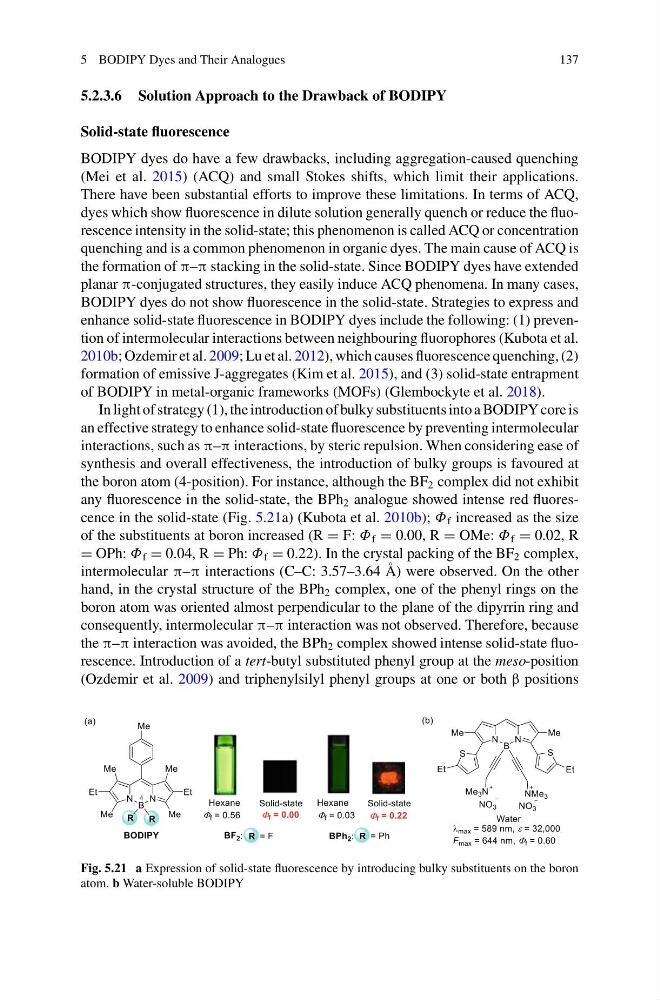
any fluorescence in the solid-state, the BPh 2 analogue showed intense red fluorescence in the solid-state (Fig. 5.21a) (Kubota et al. 2010b); Φ f increased as the size
of the substituents at boron increased (R = F: Φ f = 0.00, R = OMe: Φ f = 0.02, R
= OPh: Φ f = 0.04, R = Ph: Φ f = 0.22). In the crystal packing of the BF 2 complex,
intermolecular π–π interactions (C–C: 3.57–3.64 Å) were observed. On the other
hand, in the crystal structure of the BPh 2 complex, one of the phenyl rings on the
boron atom was oriented almost perpendicular to the plane of the dipyrrin ring and
consequently, intermolecular π–π interaction was not observed. Therefore, because
the π–π interaction was avoided, the BPh 2 complex showed intense solid-state fluorescence. Introduction of a tert-butyl substituted phenyl group at the meso-position
(Ozdemir et al. 2009) and triphenylsilyl phenyl groups at one or both β positions
Fig. 5.21 a Expression of solid-state fluorescence by introducing bulky substituents on the boron
atom. b Water-soluble BODIPY
137
5.2.3.6 Solution Approach to the Drawback of BODIPY
Solid-state fluorescence
BODIPY dyes do have a few drawbacks, including aggregation-caused quenching
(Mei et al. 2015) (ACQ) and small Stokes shifts, which limit their applications.
There have been substantial efforts to improve these limitations. In terms of ACQ,
dyes which show fluorescence in dilute solution generally quench or reduce the fluorescence intensity in the solid-state; this phenomenon is called ACQ or concentration
quenching and is a common phenomenon in organic dyes. The main cause of ACQ is
the formation of π–π stacking in the solid-state. Since BODIPY dyes have extended
planar π-conjugated structures, they easily induce ACQ phenomena. In many cases,
BODIPY dyes do not show fluorescence in the solid-state. Strategies to express and
enhance solid-state fluorescence in BODIPY dyes include the following: (1) prevention of intermolecular interactions between neighbouring fluorophores (Kubota et al.
2010b; Ozdemir et al. 2009; Lu et al. 2012), which causes fluorescence quenching, (2)
formation of emissive J-aggregates (Kim et al. 2015), and (3) solid-state entrapment
of BODIPY in metal-organic frameworks (MOFs) (Glembockyte et al. 2018).
In light of strategy (1), the introduction of bulky substituents into a BODIPY core is
an effective strategy to enhance solid-state fluorescence by preventing intermolecular
interactions, such as π–π interactions, by steric repulsion. When considering ease of
synthesis and overall effectiveness, the introduction of bulky groups is favoured at
the boron atom (4-position). For instance, although the BF 2 complex did not exhibit
any fluorescence in the solid-state, the BPh 2 analogue showed intense red fluorescence in the solid-state (Fig. 5.21a) (Kubota et al. 2010b); Φ f increased as the size
of the substituents at boron increased (R = F: Φ f = 0.00, R = OMe: Φ f = 0.02, R
= OPh: Φ f = 0.04, R = Ph: Φ f = 0.22). In the crystal packing of the BF 2 complex,
intermolecular π–π interactions (C–C: 3.57–3.64 Å) were observed. On the other
hand, in the crystal structure of the BPh 2 complex, one of the phenyl rings on the
boron atom was oriented almost perpendicular to the plane of the dipyrrin ring and
consequently, intermolecular π–π interaction was not observed. Therefore, because
the π–π interaction was avoided, the BPh 2 complex showed intense solid-state fluorescence. Introduction of a tert-butyl substituted phenyl group at the meso-position
(Ozdemir et al. 2009) and triphenylsilyl phenyl groups at one or both β positions
Fig. 5.21 a Expression of solid-state fluorescence by introducing bulky substituents on the boron
atom. b Water-soluble BODIPY