

136
Y. Kubota
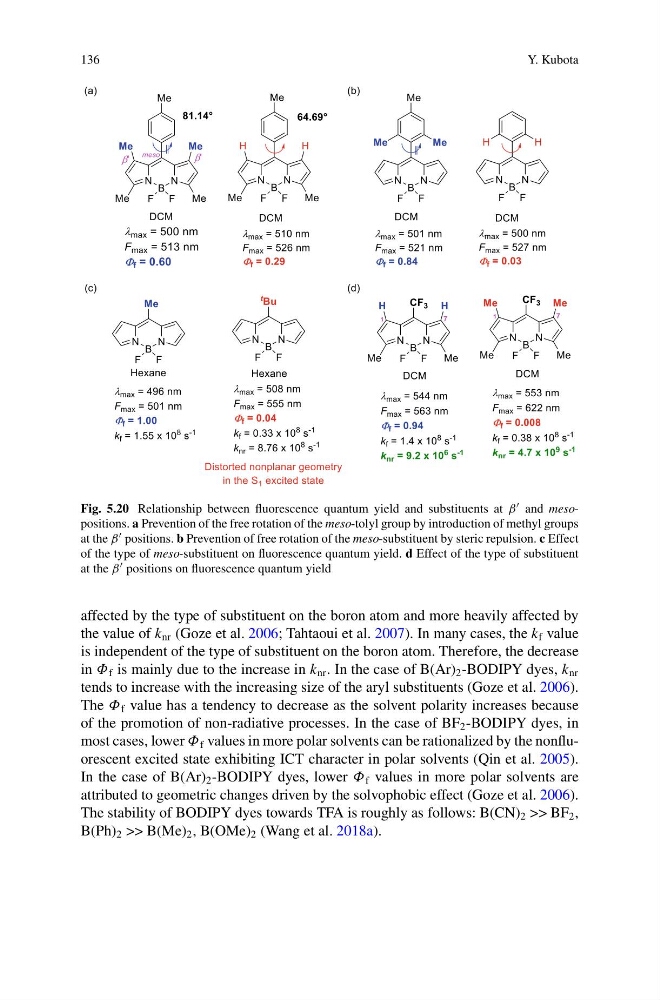
Fig. 5.20 Relationship between fluorescence quantum yield and substituents at β and mesopositions. a Prevention of the free rotation of the meso-tolyl group by introduction of methyl groups
at the β positions. b Prevention of free rotation of the meso-substituent by steric repulsion. c Effect
of the type of meso-substituent on fluorescence quantum yield. d Effect of the type of substituent
at the β positions on fluorescence quantum yield
affected by the type of substituent on the boron atom and more heavily affected by
the value of k nr (Goze et al. 2006; Tahtaoui et al. 2007). In many cases, the k f value
is independent of the type of substituent on the boron atom. Therefore, the decrease
in Φ f is mainly due to the increase in k nr . In the case of B(Ar) 2 -BODIPY dyes, k nr
tends to increase with the increasing size of the aryl substituents (Goze et al. 2006).
The Φ f value has a tendency to decrease as the solvent polarity increases because
of the promotion of non-radiative processes. In the case of BF 2 -BODIPY dyes, in
most cases, lower Φ f values in more polar solvents can be rationalized by the nonfluorescent excited state exhibiting ICT character in polar solvents (Qin et al. 2005).
In the case of B(Ar) 2 -BODIPY dyes, lower Φ f values in more polar solvents are
attributed to geometric changes driven by the solvophobic effect (Goze et al. 2006).
The stability of BODIPY dyes towards TFA is roughly as follows: B(CN) 2 >> BF 2 ,
B(Ph) 2 >> B(Me) 2 , B(OMe) 2 (Wang et al. 2018a).
Y. Kubota
Fig. 5.20 Relationship between fluorescence quantum yield and substituents at β and mesopositions. a Prevention of the free rotation of the meso-tolyl group by introduction of methyl groups
at the β positions. b Prevention of free rotation of the meso-substituent by steric repulsion. c Effect
of the type of meso-substituent on fluorescence quantum yield. d Effect of the type of substituent
at the β positions on fluorescence quantum yield
affected by the type of substituent on the boron atom and more heavily affected by
the value of k nr (Goze et al. 2006; Tahtaoui et al. 2007). In many cases, the k f value
is independent of the type of substituent on the boron atom. Therefore, the decrease
in Φ f is mainly due to the increase in k nr . In the case of B(Ar) 2 -BODIPY dyes, k nr
tends to increase with the increasing size of the aryl substituents (Goze et al. 2006).
The Φ f value has a tendency to decrease as the solvent polarity increases because
of the promotion of non-radiative processes. In the case of BF 2 -BODIPY dyes, in
most cases, lower Φ f values in more polar solvents can be rationalized by the nonfluorescent excited state exhibiting ICT character in polar solvents (Qin et al. 2005).
In the case of B(Ar) 2 -BODIPY dyes, lower Φ f values in more polar solvents are
attributed to geometric changes driven by the solvophobic effect (Goze et al. 2006).
The stability of BODIPY dyes towards TFA is roughly as follows: B(CN) 2 >> BF 2 ,
B(Ph) 2 >> B(Me) 2 , B(OMe) 2 (Wang et al. 2018a).