

124
Y. Kubota
the following favourable properties: sharp absorption and fluorescence spectra (halfwidths: 25–35 nm, in most cases), high ε (ε: 40,000–110,000, in most cases), high
Φ f (Φ f : 0.6–0.9, in most cases), negligible triplet-state formation, tunable absorption maximum (λ max ) and fluorescence maximum (F max ) values across the entire
visible and near-infrared region, high photostability, chemical robustness, solubility
in organic solvents, and insensitivity to the polarity and pH of solvent.
Nowadays, BODIPY dyes have attracted increasing attention in various fields
including fluorescent probes (Boens et al. 2012; Kim et al. 2012; Culzoni et al.
2013; Yuan et al. 2013; Ni and Wu 2014; Kolemen and Akkaya 2018), fluorescent
molecular rotors (FMRs) (Lee et al. 2018), circularly polarized luminescence (CPL)
materials (Lu et al. 2016; Tanaka et al. 2018), dye lasers (Duran-Sampedro et al. 2014;
Thorat et al. 2015), bulk heterojunction solar cells (BHJSCs) (Bessette and Hanan
2014; Bucher et al. 2017), dye-sensitized solar cells (DSSCs) (Singh and Gayathri
2014; Mao and Song 2016; Klfout et al. 2017), organic thin-film transistors (OTFTs)
(Ho et al. 2019), photodynamic therapy (PDT) (Awuah and You 2012; Kamkaew
et al. 2013; Zhao et al. 2015a), photodynamic inactivation (PDI) (Durantini et al.
2018), self-assembled materials (Cherumukkil et al. 2018; Solomonov et al. 2019),
colorimetric sensors (Xia et al. 2018), energy transfer cassettes (Fan et al. 2013),
and two-photon absorption (TPA) materials (Yang et al. 2018). Due to the excellent
optical properties of BODIPY and the implementation of straightforward molecular
design by regioselective post-synthetic functionalization (Boens et al. 2015; Lakshmi
et al. 2016; Bodio and Goze 2019; Clarke and Hall 2019), these dyes can fit many
applications.
5.2.3.2 Synthesis of BODIPY Core
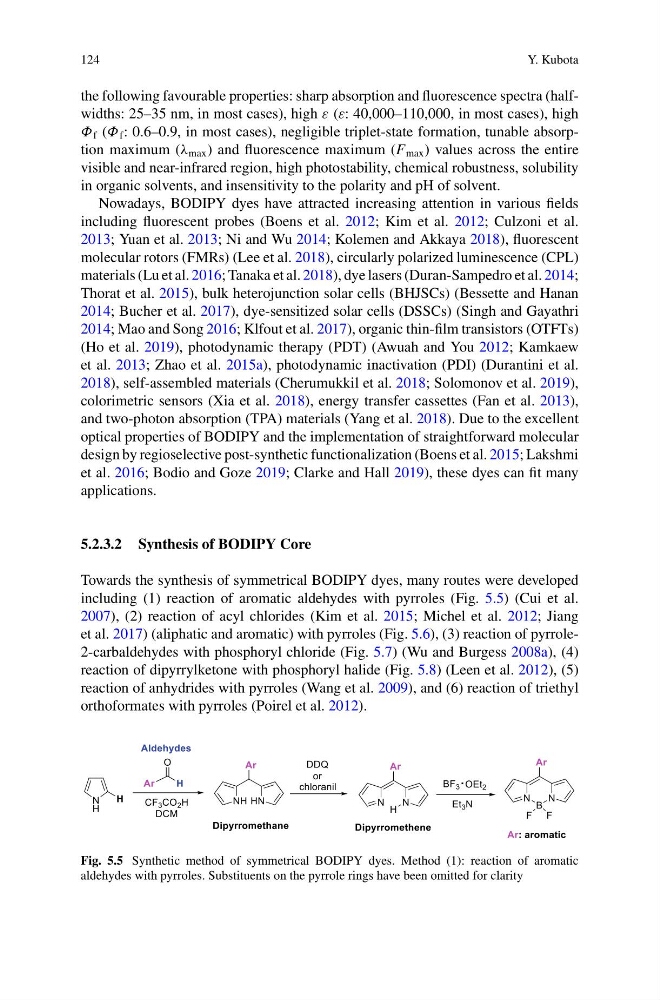
Towards the synthesis of symmetrical BODIPY dyes, many routes were developed
including (1) reaction of aromatic aldehydes with pyrroles (Fig. 5.5) (Cui et al.
2007), (2) reaction of acyl chlorides (Kim et al. 2015; Michel et al. 2012; Jiang
et al. 2017) (aliphatic and aromatic) with pyrroles (Fig. 5.6), (3) reaction of pyrrole2-carbaldehydes with phosphoryl chloride (Fig. 5.7) (Wu and Burgess 2008a), (4)
reaction of dipyrrylketone with phosphoryl halide (Fig. 5.8) (Leen et al. 2012), (5)
reaction of anhydrides with pyrroles (Wang et al. 2009), and (6) reaction of triethyl
orthoformates with pyrroles (Poirel et al. 2012).
Fig. 5.5 Synthetic method of symmetrical BODIPY dyes. Method (1): reaction of aromatic
aldehydes with pyrroles. Substituents on the pyrrole rings have been omitted for clarity
Y. Kubota
the following favourable properties: sharp absorption and fluorescence spectra (halfwidths: 25–35 nm, in most cases), high ε (ε: 40,000–110,000, in most cases), high
Φ f (Φ f : 0.6–0.9, in most cases), negligible triplet-state formation, tunable absorption maximum (λ max ) and fluorescence maximum (F max ) values across the entire
visible and near-infrared region, high photostability, chemical robustness, solubility
in organic solvents, and insensitivity to the polarity and pH of solvent.
Nowadays, BODIPY dyes have attracted increasing attention in various fields
including fluorescent probes (Boens et al. 2012; Kim et al. 2012; Culzoni et al.
2013; Yuan et al. 2013; Ni and Wu 2014; Kolemen and Akkaya 2018), fluorescent
molecular rotors (FMRs) (Lee et al. 2018), circularly polarized luminescence (CPL)
materials (Lu et al. 2016; Tanaka et al. 2018), dye lasers (Duran-Sampedro et al. 2014;
Thorat et al. 2015), bulk heterojunction solar cells (BHJSCs) (Bessette and Hanan
2014; Bucher et al. 2017), dye-sensitized solar cells (DSSCs) (Singh and Gayathri
2014; Mao and Song 2016; Klfout et al. 2017), organic thin-film transistors (OTFTs)
(Ho et al. 2019), photodynamic therapy (PDT) (Awuah and You 2012; Kamkaew
et al. 2013; Zhao et al. 2015a), photodynamic inactivation (PDI) (Durantini et al.
2018), self-assembled materials (Cherumukkil et al. 2018; Solomonov et al. 2019),
colorimetric sensors (Xia et al. 2018), energy transfer cassettes (Fan et al. 2013),
and two-photon absorption (TPA) materials (Yang et al. 2018). Due to the excellent
optical properties of BODIPY and the implementation of straightforward molecular
design by regioselective post-synthetic functionalization (Boens et al. 2015; Lakshmi
et al. 2016; Bodio and Goze 2019; Clarke and Hall 2019), these dyes can fit many
applications.
5.2.3.2 Synthesis of BODIPY Core
Towards the synthesis of symmetrical BODIPY dyes, many routes were developed
including (1) reaction of aromatic aldehydes with pyrroles (Fig. 5.5) (Cui et al.
2007), (2) reaction of acyl chlorides (Kim et al. 2015; Michel et al. 2012; Jiang
et al. 2017) (aliphatic and aromatic) with pyrroles (Fig. 5.6), (3) reaction of pyrrole2-carbaldehydes with phosphoryl chloride (Fig. 5.7) (Wu and Burgess 2008a), (4)
reaction of dipyrrylketone with phosphoryl halide (Fig. 5.8) (Leen et al. 2012), (5)
reaction of anhydrides with pyrroles (Wang et al. 2009), and (6) reaction of triethyl
orthoformates with pyrroles (Poirel et al. 2012).
Fig. 5.5 Synthetic method of symmetrical BODIPY dyes. Method (1): reaction of aromatic
aldehydes with pyrroles. Substituents on the pyrrole rings have been omitted for clarity