

5 BODIPY Dyes and Their Analogues
123
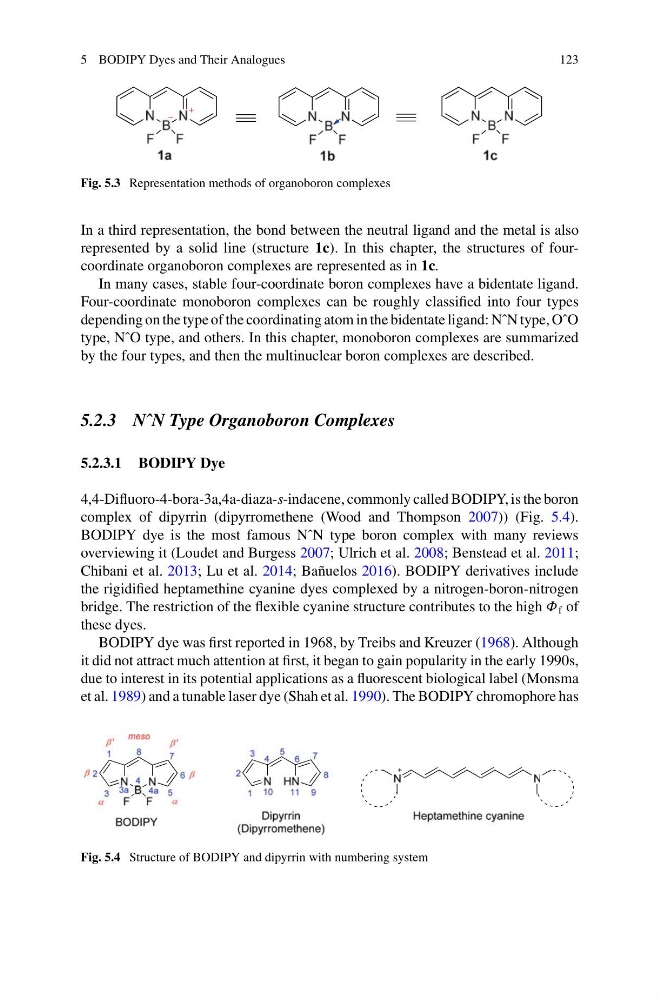
Fig. 5.3 Representation methods of organoboron complexes
In a third representation, the bond between the neutral ligand and the metal is also
represented by a solid line (structure 1c). In this chapter, the structures of fourcoordinate organoboron complexes are represented as in 1c.
In many cases, stable four-coordinate boron complexes have a bidentate ligand.
Four-coordinate monoboron complexes can be roughly classified into four types
depending on the type of the coordinating atom in the bidentate ligand: NˆN type, OˆO
type, NˆO type, and others. In this chapter, monoboron complexes are summarized
by the four types, and then the multinuclear boron complexes are described.
5.2.3 NˆN Type Organoboron Complexes
5.2.3.1 BODIPY Dye
4,4-Difluoro-4-bora-3a,4a-diaza-s-indacene, commonly called BODIPY, is the boron
complex of dipyrrin (dipyrromethene (Wood and Thompson 2007)) (Fig. 5.4).
BODIPY dye is the most famous NˆN type boron complex with many reviews
overviewing it (Loudet and Burgess 2007; Ulrich et al. 2008; Benstead et al. 2011;
Chibani et al. 2013; Lu et al. 2014; Bañuelos 2016). BODIPY derivatives include
the rigidified heptamethine cyanine dyes complexed by a nitrogen-boron-nitrogen
bridge. The restriction of the flexible cyanine structure contributes to the high Φ f of
these dyes.
BODIPY dye was first reported in 1968, by Treibs and Kreuzer (1968). Although
it did not attract much attention at first, it began to gain popularity in the early 1990s,
due to interest in its potential applications as a fluorescent biological label (Monsma
et al. 1989) and a tunable laser dye (Shah et al. 1990). The BODIPY chromophore has
Fig. 5.4 Structure of BODIPY and dipyrrin with numbering system
123
Fig. 5.3 Representation methods of organoboron complexes
In a third representation, the bond between the neutral ligand and the metal is also
represented by a solid line (structure 1c). In this chapter, the structures of fourcoordinate organoboron complexes are represented as in 1c.
In many cases, stable four-coordinate boron complexes have a bidentate ligand.
Four-coordinate monoboron complexes can be roughly classified into four types
depending on the type of the coordinating atom in the bidentate ligand: NˆN type, OˆO
type, NˆO type, and others. In this chapter, monoboron complexes are summarized
by the four types, and then the multinuclear boron complexes are described.
5.2.3 NˆN Type Organoboron Complexes
5.2.3.1 BODIPY Dye
4,4-Difluoro-4-bora-3a,4a-diaza-s-indacene, commonly called BODIPY, is the boron
complex of dipyrrin (dipyrromethene (Wood and Thompson 2007)) (Fig. 5.4).
BODIPY dye is the most famous NˆN type boron complex with many reviews
overviewing it (Loudet and Burgess 2007; Ulrich et al. 2008; Benstead et al. 2011;
Chibani et al. 2013; Lu et al. 2014; Bañuelos 2016). BODIPY derivatives include
the rigidified heptamethine cyanine dyes complexed by a nitrogen-boron-nitrogen
bridge. The restriction of the flexible cyanine structure contributes to the high Φ f of
these dyes.
BODIPY dye was first reported in 1968, by Treibs and Kreuzer (1968). Although
it did not attract much attention at first, it began to gain popularity in the early 1990s,
due to interest in its potential applications as a fluorescent biological label (Monsma
et al. 1989) and a tunable laser dye (Shah et al. 1990). The BODIPY chromophore has
Fig. 5.4 Structure of BODIPY and dipyrrin with numbering system