

5 BODIPY Dyes and Their Analogues
121
5.2 Four-Coordinate Organoboron Complexes
5.2.1 Boron Complexation
Four-coordinate organoboron complexes represent one of the most important classes
of fluorescent dyes (Li et al. 2013a). Boron complexation of a dye (ligand) is a simple
but very effective strategy to express or increase the fluorescence quantum yield (Φ f )
of the dye (ligand). Additionally, the fluorescence properties of the boron complex
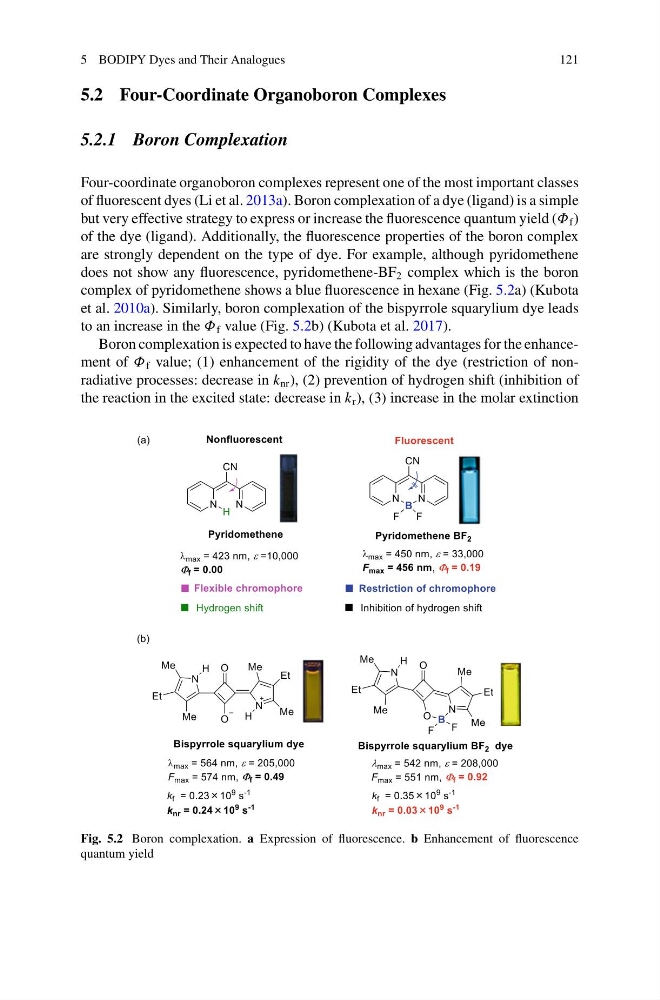
are strongly dependent on the type of dye. For example, although pyridomethene
does not show any fluorescence, pyridomethene-BF 2 complex which is the boron
complex of pyridomethene shows a blue fluorescence in hexane (Fig. 5.2a) (Kubota
et al. 2010a). Similarly, boron complexation of the bispyrrole squarylium dye leads
to an increase in the Φ f value (Fig. 5.2b) (Kubota et al. 2017).
Boron complexation is expected to have the following advantages for the enhancement of Φ f value; (1) enhancement of the rigidity of the dye (restriction of nonradiative processes: decrease in k nr ), (2) prevention of hydrogen shift (inhibition of
the reaction in the excited state: decrease in k r ), (3) increase in the molar extinction
Fig. 5.2 Boron complexation. a Expression of fluorescence. b Enhancement of fluorescence
quantum yield
121
5.2 Four-Coordinate Organoboron Complexes
5.2.1 Boron Complexation
Four-coordinate organoboron complexes represent one of the most important classes
of fluorescent dyes (Li et al. 2013a). Boron complexation of a dye (ligand) is a simple
but very effective strategy to express or increase the fluorescence quantum yield (Φ f )
of the dye (ligand). Additionally, the fluorescence properties of the boron complex
are strongly dependent on the type of dye. For example, although pyridomethene
does not show any fluorescence, pyridomethene-BF 2 complex which is the boron
complex of pyridomethene shows a blue fluorescence in hexane (Fig. 5.2a) (Kubota
et al. 2010a). Similarly, boron complexation of the bispyrrole squarylium dye leads
to an increase in the Φ f value (Fig. 5.2b) (Kubota et al. 2017).
Boron complexation is expected to have the following advantages for the enhancement of Φ f value; (1) enhancement of the rigidity of the dye (restriction of nonradiative processes: decrease in k nr ), (2) prevention of hydrogen shift (inhibition of
the reaction in the excited state: decrease in k r ), (3) increase in the molar extinction
Fig. 5.2 Boron complexation. a Expression of fluorescence. b Enhancement of fluorescence
quantum yield