

120
Y. Kubota
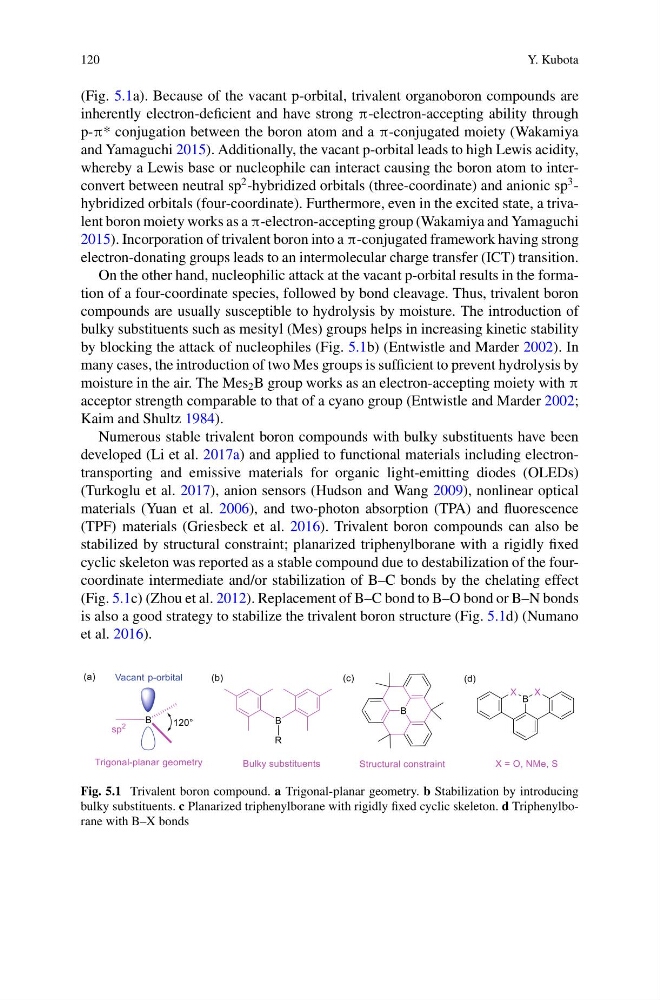
(Fig. 5.1a). Because of the vacant p-orbital, trivalent organoboron compounds are
inherently electron-deficient and have strong π-electron-accepting ability through
p-π* conjugation between the boron atom and a π-conjugated moiety (Wakamiya
and Yamaguchi 2015). Additionally, the vacant p-orbital leads to high Lewis acidity,
whereby a Lewis base or nucleophile can interact causing the boron atom to interconvert between neutral sp
2 -hybridized orbitals (three-coordinate) and anionic sp
3 -
hybridized orbitals (four-coordinate). Furthermore, even in the excited state, a trivalent boron moiety works as a π-electron-accepting group (Wakamiya and Yamaguchi
2015). Incorporation of trivalent boron into a π-conjugated framework having strong
electron-donating groups leads to an intermolecular charge transfer (ICT) transition.
On the other hand, nucleophilic attack at the vacant p-orbital results in the formation of a four-coordinate species, followed by bond cleavage. Thus, trivalent boron
compounds are usually susceptible to hydrolysis by moisture. The introduction of
bulky substituents such as mesityl (Mes) groups helps in increasing kinetic stability
by blocking the attack of nucleophiles (Fig. 5.1b) (Entwistle and Marder 2002). In
many cases, the introduction of two Mes groups is sufficient to prevent hydrolysis by
moisture in the air. The Mes 2 B group works as an electron-accepting moiety with π
acceptor strength comparable to that of a cyano group (Entwistle and Marder 2002;
Kaim and Shultz 1984).
Numerous stable trivalent boron compounds with bulky substituents have been
developed (Li et al. 2017a) and applied to functional materials including electrontransporting and emissive materials for organic light-emitting diodes (OLEDs)
(Turkoglu et al. 2017), anion sensors (Hudson and Wang 2009), nonlinear optical
materials (Yuan et al. 2006), and two-photon absorption (TPA) and fluorescence
(TPF) materials (Griesbeck et al. 2016). Trivalent boron compounds can also be
stabilized by structural constraint; planarized triphenylborane with a rigidly fixed
cyclic skeleton was reported as a stable compound due to destabilization of the fourcoordinate intermediate and/or stabilization of B–C bonds by the chelating effect
(Fig. 5.1c) (Zhou et al. 2012). Replacement of B–C bond to B–O bond or B–N bonds
is also a good strategy to stabilize the trivalent boron structure (Fig. 5.1d) (Numano
et al. 2016).
Fig. 5.1 Trivalent boron compound. a Trigonal-planar geometry. b Stabilization by introducing
bulky substituents. c Planarized triphenylborane with rigidly fixed cyclic skeleton. d Triphenylborane with B–X bonds
Y. Kubota
(Fig. 5.1a). Because of the vacant p-orbital, trivalent organoboron compounds are
inherently electron-deficient and have strong π-electron-accepting ability through
p-π* conjugation between the boron atom and a π-conjugated moiety (Wakamiya
and Yamaguchi 2015). Additionally, the vacant p-orbital leads to high Lewis acidity,
whereby a Lewis base or nucleophile can interact causing the boron atom to interconvert between neutral sp
2 -hybridized orbitals (three-coordinate) and anionic sp
3 -
hybridized orbitals (four-coordinate). Furthermore, even in the excited state, a trivalent boron moiety works as a π-electron-accepting group (Wakamiya and Yamaguchi
2015). Incorporation of trivalent boron into a π-conjugated framework having strong
electron-donating groups leads to an intermolecular charge transfer (ICT) transition.
On the other hand, nucleophilic attack at the vacant p-orbital results in the formation of a four-coordinate species, followed by bond cleavage. Thus, trivalent boron
compounds are usually susceptible to hydrolysis by moisture. The introduction of
bulky substituents such as mesityl (Mes) groups helps in increasing kinetic stability
by blocking the attack of nucleophiles (Fig. 5.1b) (Entwistle and Marder 2002). In
many cases, the introduction of two Mes groups is sufficient to prevent hydrolysis by
moisture in the air. The Mes 2 B group works as an electron-accepting moiety with π
acceptor strength comparable to that of a cyano group (Entwistle and Marder 2002;
Kaim and Shultz 1984).
Numerous stable trivalent boron compounds with bulky substituents have been
developed (Li et al. 2017a) and applied to functional materials including electrontransporting and emissive materials for organic light-emitting diodes (OLEDs)
(Turkoglu et al. 2017), anion sensors (Hudson and Wang 2009), nonlinear optical
materials (Yuan et al. 2006), and two-photon absorption (TPA) and fluorescence
(TPF) materials (Griesbeck et al. 2016). Trivalent boron compounds can also be
stabilized by structural constraint; planarized triphenylborane with a rigidly fixed
cyclic skeleton was reported as a stable compound due to destabilization of the fourcoordinate intermediate and/or stabilization of B–C bonds by the chelating effect
(Fig. 5.1c) (Zhou et al. 2012). Replacement of B–C bond to B–O bond or B–N bonds
is also a good strategy to stabilize the trivalent boron structure (Fig. 5.1d) (Numano
et al. 2016).
Fig. 5.1 Trivalent boron compound. a Trigonal-planar geometry. b Stabilization by introducing
bulky substituents. c Planarized triphenylborane with rigidly fixed cyclic skeleton. d Triphenylborane with B–X bonds