

4 Phthalocyanine and Related Analogues
111
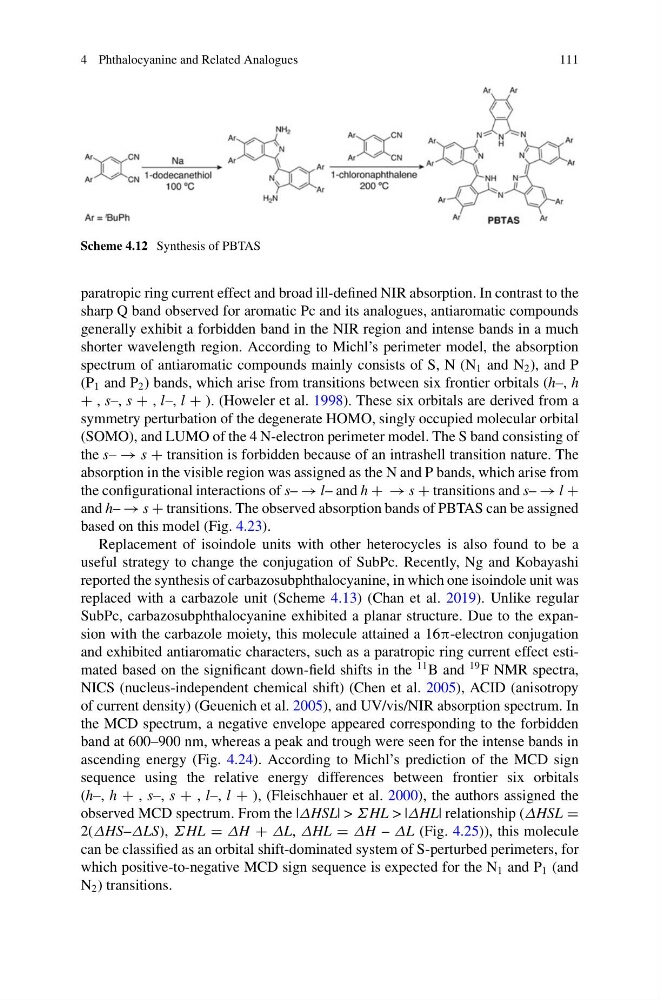
Scheme 4.12 Synthesis of PBTAS
paratropic ring current effect and broad ill-defined NIR absorption. In contrast to the
sharp Q band observed for aromatic Pc and its analogues, antiaromatic compounds
generally exhibit a forbidden band in the NIR region and intense bands in a much
shorter wavelength region. According to Michl’s perimeter model, the absorption
spectrum of antiaromatic compounds mainly consists of S, N (N 1 and N 2 ), and P
(P 1 and P 2 ) bands, which arise from transitions between six frontier orbitals (h–, h
+ , s–, s + , l–, l + ). (Howeler et al. 1998). These six orbitals are derived from a
symmetry perturbation of the degenerate HOMO, singly occupied molecular orbital
(SOMO), and LUMO of the 4 N-electron perimeter model. The S band consisting of
the s– → s + transition is forbidden because of an intrashell transition nature. The
absorption in the visible region was assigned as the N and P bands, which arise from
the configurational interactions of s– → l– and h + → s + transitions and s– → l +
and h– → s + transitions. The observed absorption bands of PBTAS can be assigned
based on this model (Fig. 4.23).
Replacement of isoindole units with other heterocycles is also found to be a
useful strategy to change the conjugation of SubPc. Recently, Ng and Kobayashi
reported the synthesis of carbazosubphthalocyanine, in which one isoindole unit was
replaced with a carbazole unit (Scheme 4.13) (Chan et al. 2019). Unlike regular
SubPc, carbazosubphthalocyanine exhibited a planar structure. Due to the expansion with the carbazole moiety, this molecule attained a 16π-electron conjugation
and exhibited antiaromatic characters, such as a paratropic ring current effect estimated based on the significant down-field shifts in the
11 B and
19 F NMR spectra,
NICS (nucleus-independent chemical shift) (Chen et al. 2005), ACID (anisotropy
of current density) (Geuenich et al. 2005), and UV/vis/NIR absorption spectrum. In
the MCD spectrum, a negative envelope appeared corresponding to the forbidden
band at 600–900 nm, whereas a peak and trough were seen for the intense bands in
ascending energy (Fig. 4.24). According to Michl’s prediction of the MCD sign
sequence using the relative energy differences between frontier six orbitals
(h–, h + , s–, s + , l–, l + ), (Fleischhauer et al. 2000), the authors assigned the
observed MCD spectrum. From the |ΔHSL| > ΣHL > |ΔHL| relationship (ΔHSL =
2(ΔHS–ΔLS), ΣHL = ΔH + ΔL, ΔHL = ΔH – ΔL (Fig. 4.25)), this molecule
can be classified as an orbital shift-dominated system of S-perturbed perimeters, for
which positive-to-negative MCD sign sequence is expected for the N 1 and P 1 (and
N 2 ) transitions.
111
Scheme 4.12 Synthesis of PBTAS
paratropic ring current effect and broad ill-defined NIR absorption. In contrast to the
sharp Q band observed for aromatic Pc and its analogues, antiaromatic compounds
generally exhibit a forbidden band in the NIR region and intense bands in a much
shorter wavelength region. According to Michl’s perimeter model, the absorption
spectrum of antiaromatic compounds mainly consists of S, N (N 1 and N 2 ), and P
(P 1 and P 2 ) bands, which arise from transitions between six frontier orbitals (h–, h
+ , s–, s + , l–, l + ). (Howeler et al. 1998). These six orbitals are derived from a
symmetry perturbation of the degenerate HOMO, singly occupied molecular orbital
(SOMO), and LUMO of the 4 N-electron perimeter model. The S band consisting of
the s– → s + transition is forbidden because of an intrashell transition nature. The
absorption in the visible region was assigned as the N and P bands, which arise from
the configurational interactions of s– → l– and h + → s + transitions and s– → l +
and h– → s + transitions. The observed absorption bands of PBTAS can be assigned
based on this model (Fig. 4.23).
Replacement of isoindole units with other heterocycles is also found to be a
useful strategy to change the conjugation of SubPc. Recently, Ng and Kobayashi
reported the synthesis of carbazosubphthalocyanine, in which one isoindole unit was
replaced with a carbazole unit (Scheme 4.13) (Chan et al. 2019). Unlike regular
SubPc, carbazosubphthalocyanine exhibited a planar structure. Due to the expansion with the carbazole moiety, this molecule attained a 16π-electron conjugation
and exhibited antiaromatic characters, such as a paratropic ring current effect estimated based on the significant down-field shifts in the
11 B and
19 F NMR spectra,
NICS (nucleus-independent chemical shift) (Chen et al. 2005), ACID (anisotropy
of current density) (Geuenich et al. 2005), and UV/vis/NIR absorption spectrum. In
the MCD spectrum, a negative envelope appeared corresponding to the forbidden
band at 600–900 nm, whereas a peak and trough were seen for the intense bands in
ascending energy (Fig. 4.24). According to Michl’s prediction of the MCD sign
sequence using the relative energy differences between frontier six orbitals
(h–, h + , s–, s + , l–, l + ), (Fleischhauer et al. 2000), the authors assigned the
observed MCD spectrum. From the |ΔHSL| > ΣHL > |ΔHL| relationship (ΔHSL =
2(ΔHS–ΔLS), ΣHL = ΔH + ΔL, ΔHL = ΔH – ΔL (Fig. 4.25)), this molecule
can be classified as an orbital shift-dominated system of S-perturbed perimeters, for
which positive-to-negative MCD sign sequence is expected for the N 1 and P 1 (and
N 2 ) transitions.