

110
S. Shimizu
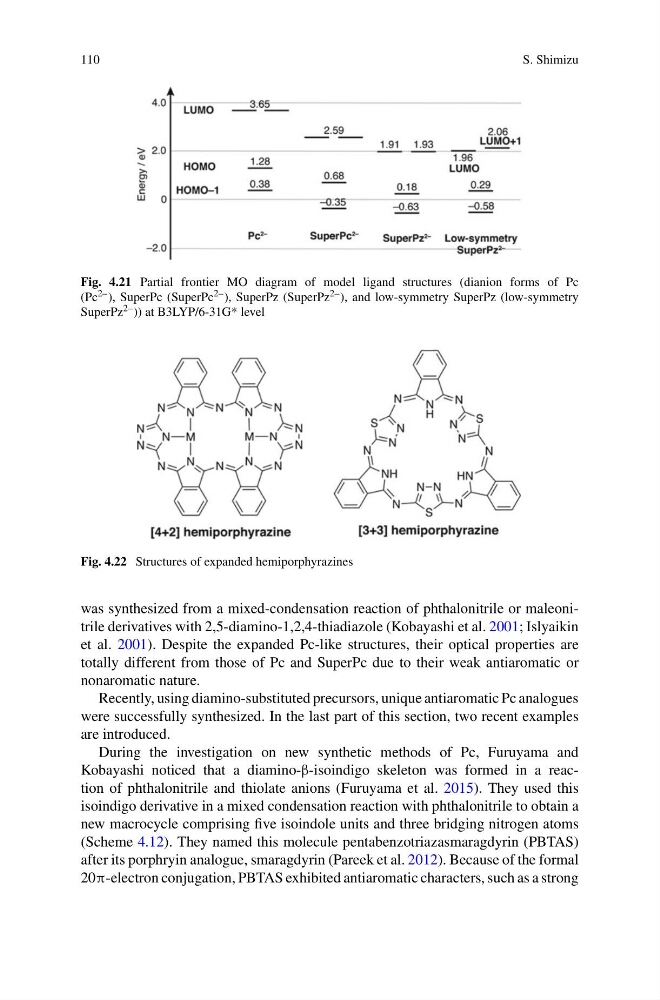
Fig. 4.21 Partial frontier MO diagram of model ligand structures (dianion forms of Pc
(Pc 2– ), SuperPc (SuperPc 2– ), SuperPz (SuperPz 2– ), and low-symmetry SuperPz (low-symmetry
SuperPz 2– )) at B3LYP/6-31G* level
Fig. 4.22 Structures of expanded hemiporphyrazines
was synthesized from a mixed-condensation reaction of phthalonitrile or maleonitrile derivatives with 2,5-diamino-1,2,4-thiadiazole (Kobayashi et al. 2001; Islyaikin
et al. 2001). Despite the expanded Pc-like structures, their optical properties are
totally different from those of Pc and SuperPc due to their weak antiaromatic or
nonaromatic nature.
Recently, using diamino-substituted precursors, unique antiaromatic Pc analogues
were successfully synthesized. In the last part of this section, two recent examples
are introduced.
During the investigation on new synthetic methods of Pc, Furuyama and
Kobayashi noticed that a diamino-β-isoindigo skeleton was formed in a reaction of phthalonitrile and thiolate anions (Furuyama et al. 2015). They used this
isoindigo derivative in a mixed condensation reaction with phthalonitrile to obtain a
new macrocycle comprising five isoindole units and three bridging nitrogen atoms
(Scheme 4.12). They named this molecule pentabenzotriazasmaragdyrin (PBTAS)
after its porphryin analogue, smaragdyrin (Pareek et al. 2012). Because of the formal
20π-electron conjugation, PBTAS exhibited antiaromatic characters, such as a strong
S. Shimizu
Fig. 4.21 Partial frontier MO diagram of model ligand structures (dianion forms of Pc
(Pc 2– ), SuperPc (SuperPc 2– ), SuperPz (SuperPz 2– ), and low-symmetry SuperPz (low-symmetry
SuperPz 2– )) at B3LYP/6-31G* level
Fig. 4.22 Structures of expanded hemiporphyrazines
was synthesized from a mixed-condensation reaction of phthalonitrile or maleonitrile derivatives with 2,5-diamino-1,2,4-thiadiazole (Kobayashi et al. 2001; Islyaikin
et al. 2001). Despite the expanded Pc-like structures, their optical properties are
totally different from those of Pc and SuperPc due to their weak antiaromatic or
nonaromatic nature.
Recently, using diamino-substituted precursors, unique antiaromatic Pc analogues
were successfully synthesized. In the last part of this section, two recent examples
are introduced.
During the investigation on new synthetic methods of Pc, Furuyama and
Kobayashi noticed that a diamino-β-isoindigo skeleton was formed in a reaction of phthalonitrile and thiolate anions (Furuyama et al. 2015). They used this
isoindigo derivative in a mixed condensation reaction with phthalonitrile to obtain a
new macrocycle comprising five isoindole units and three bridging nitrogen atoms
(Scheme 4.12). They named this molecule pentabenzotriazasmaragdyrin (PBTAS)
after its porphryin analogue, smaragdyrin (Pareek et al. 2012). Because of the formal
20π-electron conjugation, PBTAS exhibited antiaromatic characters, such as a strong