

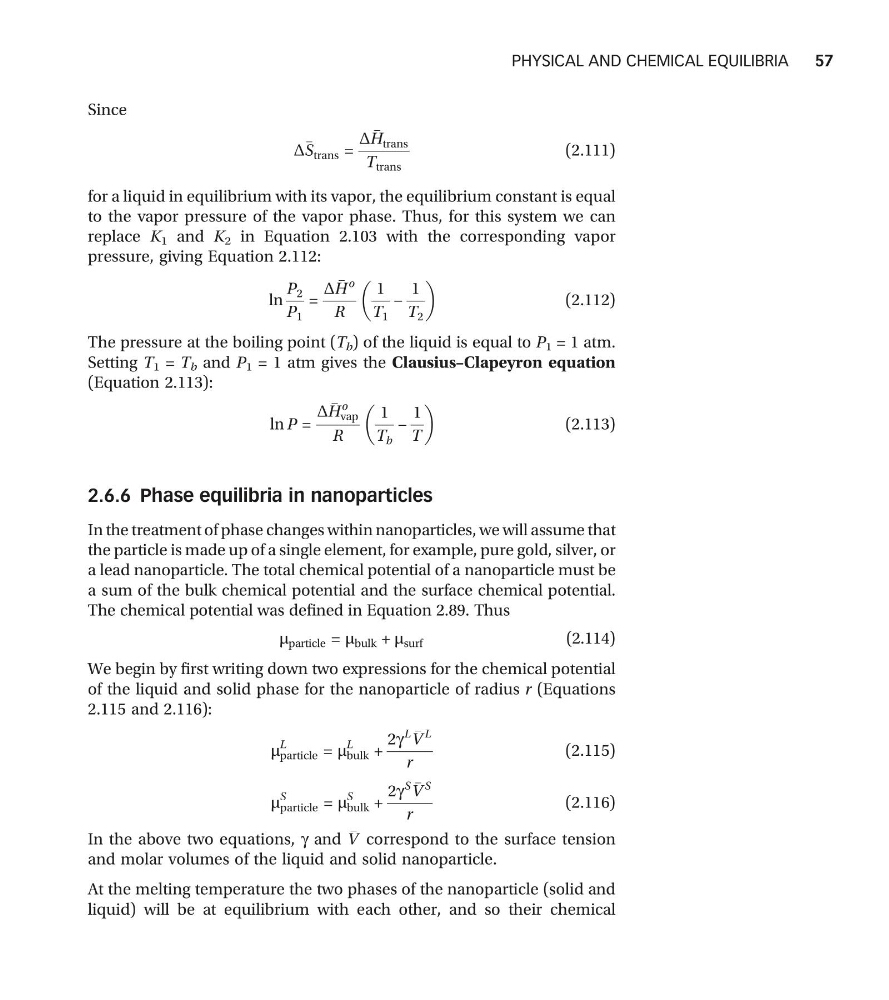
Since
Δ
S trans =
Δ
H trans
T trans
(2.111)
for a liquid in equilibrium with its vapor, the equilibrium constant is equal
to the vapor pressure of the vapor phase. Thus, for this system we can
replace K 1 and K 2 in Equation 2.103 with the corresponding vapor
pressure, giving Equation 2.112:
ln
P 2
P 1
=
Δ
H
o
R
1
T 1
−
1
T 2
(2.112)
The pressure at the boiling point (T b ) of the liquid is equal to P 1 = 1 atm.
Setting T 1 = T b and P 1 = 1 atm gives the Clausius–Clapeyron equation
(Equation 2.113):
ln P =
Δ
H
o
vap
R
1
T b
−
1
T
(2.113)
2.6.6 Phase equilibria in nanoparticles
In the treatment of phase changes within nanoparticles, we will assume that
the particle is made up of a single element, for example, pure gold, silver, or
a lead nanoparticle. The total chemical potential of a nanoparticle must be
a sum of the bulk chemical potential and the surface chemical potential.
The chemical potential was defined in Equation 2.89. Thus
μ particle = μ bulk + μ surf
(2.114)
We begin by first writing down two expressions for the chemical potential
of the liquid and solid phase for the nanoparticle of radius r (Equations
2.115 and 2.116):
μ
L
particle = μ
L
bulk +
2g
L
V
L
r
(2.115)
μ
S
particle = μ
S
bulk +
2g
S
V
S
r
(2.116)
In the above two equations, g and
V correspond to the surface tension
and molar volumes of the liquid and solid nanoparticle.
At the melting temperature the two phases of the nanoparticle (solid and
liquid) will be at equilibrium with each other, and so their chemical
PHYSICAL AND CHEMICAL EQUILIBRIA
57
Δ
S trans =
Δ
H trans
T trans
(2.111)
for a liquid in equilibrium with its vapor, the equilibrium constant is equal
to the vapor pressure of the vapor phase. Thus, for this system we can
replace K 1 and K 2 in Equation 2.103 with the corresponding vapor
pressure, giving Equation 2.112:
ln
P 2
P 1
=
Δ
H
o
R
1
T 1
−
1
T 2
(2.112)
The pressure at the boiling point (T b ) of the liquid is equal to P 1 = 1 atm.
Setting T 1 = T b and P 1 = 1 atm gives the Clausius–Clapeyron equation
(Equation 2.113):
ln P =
Δ
H
o
vap
R
1
T b
−
1
T
(2.113)
2.6.6 Phase equilibria in nanoparticles
In the treatment of phase changes within nanoparticles, we will assume that
the particle is made up of a single element, for example, pure gold, silver, or
a lead nanoparticle. The total chemical potential of a nanoparticle must be
a sum of the bulk chemical potential and the surface chemical potential.
The chemical potential was defined in Equation 2.89. Thus
μ particle = μ bulk + μ surf
(2.114)
We begin by first writing down two expressions for the chemical potential
of the liquid and solid phase for the nanoparticle of radius r (Equations
2.115 and 2.116):
μ
L
particle = μ
L
bulk +
2g
L
V
L
r
(2.115)
μ
S
particle = μ
S
bulk +
2g
S
V
S
r
(2.116)
In the above two equations, g and
V correspond to the surface tension
and molar volumes of the liquid and solid nanoparticle.
At the melting temperature the two phases of the nanoparticle (solid and
liquid) will be at equilibrium with each other, and so their chemical
PHYSICAL AND CHEMICAL EQUILIBRIA
57