

U Signal
1 0 1 1
1
0
1
1
5 μ m
Output
PPI
MZI-modulator
Photonic–plasmonic
interferometer (PPI)
Source
Au
Si
(a)
(b)
SiO 2
Signal
Island
Ground rail
PPM
5 μm
PPI
PPI
Bridge
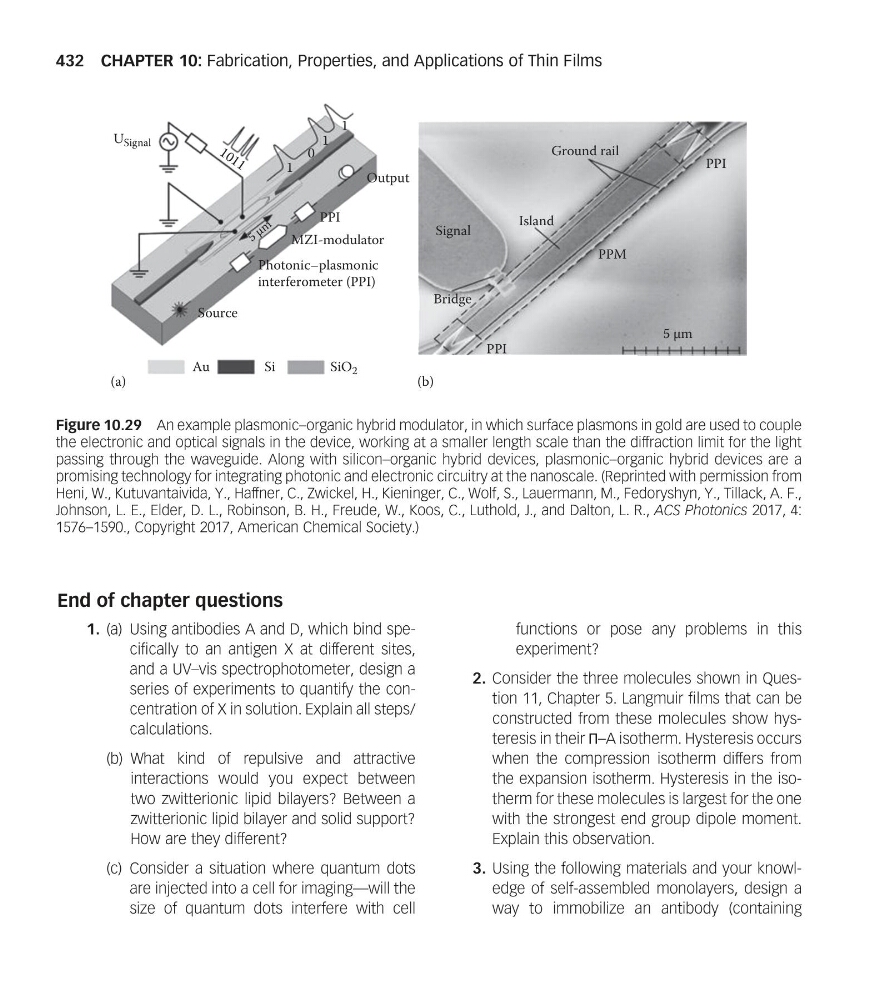
Figure 10.29 An example plasmonic–organic hybrid modulator, in which surface plasmons in gold are used to couple
the electronic and optical signals in the device, working at a smaller length scale than the diffraction limit for the light
passing through the waveguide. Along with silicon–organic hybrid devices, plasmonic–organic hybrid devices are a
promising technology for integrating photonic and electronic circuitry at the nanoscale. (Reprinted with permission from
Heni, W., Kutuvantaivida, Y., Haffner, C., Zwickel, H., Kieninger, C., Wolf, S., Lauermann, M., Fedoryshyn, Y., Tillack, A. F.,
Johnson, L. E., Elder, D. L., Robinson, B. H., Freude, W., Koos, C., Luthold, J., and Dalton, L. R., ACS Photonics 2017, 4:
1576–1590., Copyright 2017, American Chemical Society.)
End of chapter questions
1. (a) Using antibodies A and D, which bind specifically to an antigen X at different sites,
and a UV–vis spectrophotometer, design a
series of experiments to quantify the concentration of X in solution. Explain all steps/
calculations.
(b) What kind of repulsive and attractive
interactions would you expect between
two zwitterionic lipid bilayers? Between a
zwitterionic lipid bilayer and solid support?
How are they different?
(c) Consider a situation where quantum dots
are injected into a cell for imaging—will the
size of quantum dots interfere with cell
functions or pose any problems in this
experiment?
2. Consider the three molecules shown in Question 11, Chapter 5. Langmuir films that can be
constructed from these molecules show hysteresis in their Π–A isotherm. Hysteresis occurs
when the compression isotherm differs from
the expansion isotherm. Hysteresis in the isotherm for these molecules is largest for the one
with the strongest end group dipole moment.
Explain this observation.
3. Using the following materials and your knowledge of self-assembled monolayers, design a
way to immobilize an antibody (containing
CHAPTER 10: Fabrication, Properties, and Applications of Thin Films
432
1 0 1 1
1
0
1
1
5 μ m
Output
PPI
MZI-modulator
Photonic–plasmonic
interferometer (PPI)
Source
Au
Si
(a)
(b)
SiO 2
Signal
Island
Ground rail
PPM
5 μm
PPI
PPI
Bridge
Figure 10.29 An example plasmonic–organic hybrid modulator, in which surface plasmons in gold are used to couple
the electronic and optical signals in the device, working at a smaller length scale than the diffraction limit for the light
passing through the waveguide. Along with silicon–organic hybrid devices, plasmonic–organic hybrid devices are a
promising technology for integrating photonic and electronic circuitry at the nanoscale. (Reprinted with permission from
Heni, W., Kutuvantaivida, Y., Haffner, C., Zwickel, H., Kieninger, C., Wolf, S., Lauermann, M., Fedoryshyn, Y., Tillack, A. F.,
Johnson, L. E., Elder, D. L., Robinson, B. H., Freude, W., Koos, C., Luthold, J., and Dalton, L. R., ACS Photonics 2017, 4:
1576–1590., Copyright 2017, American Chemical Society.)
End of chapter questions
1. (a) Using antibodies A and D, which bind specifically to an antigen X at different sites,
and a UV–vis spectrophotometer, design a
series of experiments to quantify the concentration of X in solution. Explain all steps/
calculations.
(b) What kind of repulsive and attractive
interactions would you expect between
two zwitterionic lipid bilayers? Between a
zwitterionic lipid bilayer and solid support?
How are they different?
(c) Consider a situation where quantum dots
are injected into a cell for imaging—will the
size of quantum dots interfere with cell
functions or pose any problems in this
experiment?
2. Consider the three molecules shown in Question 11, Chapter 5. Langmuir films that can be
constructed from these molecules show hysteresis in their Π–A isotherm. Hysteresis occurs
when the compression isotherm differs from
the expansion isotherm. Hysteresis in the isotherm for these molecules is largest for the one
with the strongest end group dipole moment.
Explain this observation.
3. Using the following materials and your knowledge of self-assembled monolayers, design a
way to immobilize an antibody (containing
CHAPTER 10: Fabrication, Properties, and Applications of Thin Films
432