

allowing vastly more powerful integrated circuits containing billions of
components.
A similar transition is presently underway in photonics, or performing
information processing using light. While optical fibers have been used to
efficiently transmit information for decades, the components used for
converting signals between electronic systems and optical systems have
been bulky and expensive. While substantial strides have been made
toward smaller and more efficient photonic circuitry, photonics have not
yet reached the scale where complex electronic and photonic circuits can
be combined on the same chip, taking advantage of the small size of
electronic systems and the high operating speeds/bandwidths of optical
circuitry (Heni, 2017).
10.8.1 The electro-optic effect
One of the principal barriers to chip-scale integration has been developing materials with adequate nonlinear optical activity that can be
integrated into conventional chip-making processes. Converting between
electronic signals requires the ability to generate short pulses of light
(representing digital ones and zeros) at incredibly high speeds (gigahertz
to terahertz), which requires materials that can control their optical
properties (e.g., the real or imaginary components of their refractive
index) at short timescales (Dalton, 2015). Of these devices, ones based on
changing the real component of the refractive index are of interest due to
lower signal loss and distortion than devices based on absorbance of light.
Changing a material’s refractive index in response to an electric field is a
nonlinear optical process akin to sum-frequency generation, but where
one of the two interacting electric fields is an electrical signal and the other
is a beam of light. Such effects are called electro-optic (EO) effects. While
several electro-optic effects exist, we will focus on the Pockels effect, which
is the strongest EO effect in materials that are noncentrosymmetric; for
example, have net alignment of their dipoles in a single direction (see
Chapter 8). The strength of the Pockels effect is proportional to the applied
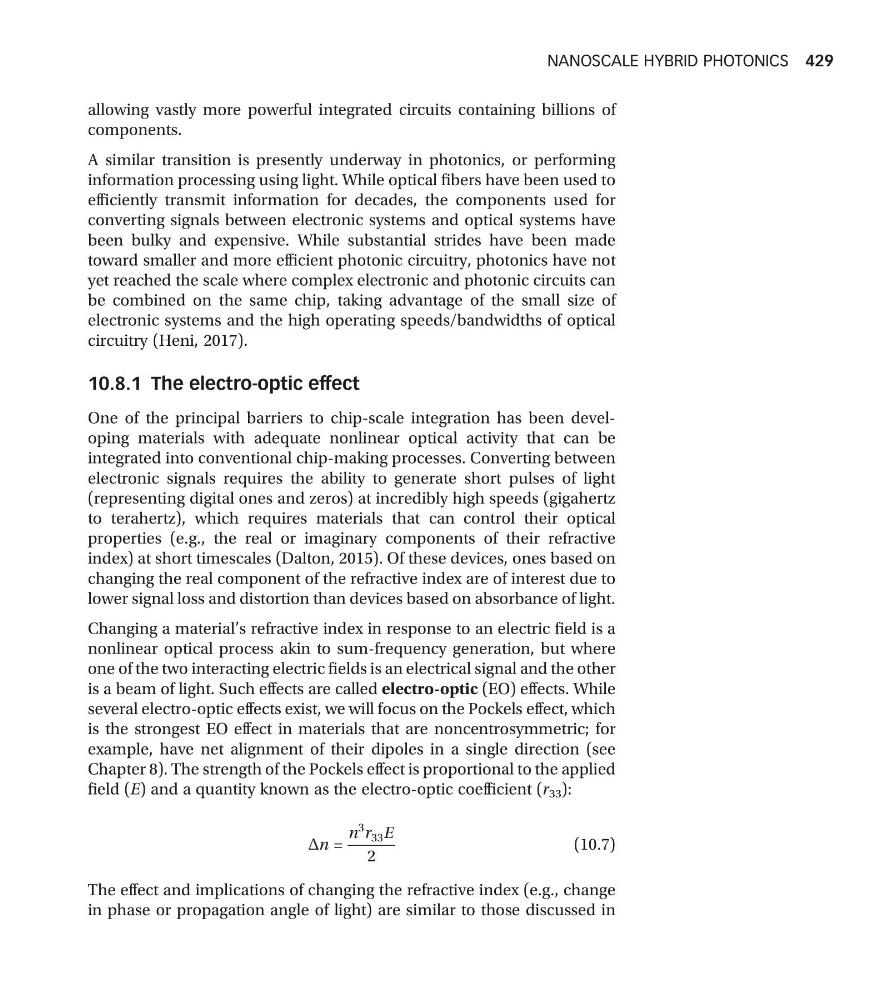
field (E) and a quantity known as the electro-optic coefficient (r 33 ):
Δn =
n
3 r 33 E
2
(10.7)
The effect and implications of changing the refractive index (e.g., change
in phase or propagation angle of light) are similar to those discussed in
NANOSCALE HYBRID PHOTONICS 429
components.
A similar transition is presently underway in photonics, or performing
information processing using light. While optical fibers have been used to
efficiently transmit information for decades, the components used for
converting signals between electronic systems and optical systems have
been bulky and expensive. While substantial strides have been made
toward smaller and more efficient photonic circuitry, photonics have not
yet reached the scale where complex electronic and photonic circuits can
be combined on the same chip, taking advantage of the small size of
electronic systems and the high operating speeds/bandwidths of optical
circuitry (Heni, 2017).
10.8.1 The electro-optic effect
One of the principal barriers to chip-scale integration has been developing materials with adequate nonlinear optical activity that can be
integrated into conventional chip-making processes. Converting between
electronic signals requires the ability to generate short pulses of light
(representing digital ones and zeros) at incredibly high speeds (gigahertz
to terahertz), which requires materials that can control their optical
properties (e.g., the real or imaginary components of their refractive
index) at short timescales (Dalton, 2015). Of these devices, ones based on
changing the real component of the refractive index are of interest due to
lower signal loss and distortion than devices based on absorbance of light.
Changing a material’s refractive index in response to an electric field is a
nonlinear optical process akin to sum-frequency generation, but where
one of the two interacting electric fields is an electrical signal and the other
is a beam of light. Such effects are called electro-optic (EO) effects. While
several electro-optic effects exist, we will focus on the Pockels effect, which
is the strongest EO effect in materials that are noncentrosymmetric; for
example, have net alignment of their dipoles in a single direction (see
Chapter 8). The strength of the Pockels effect is proportional to the applied
field (E) and a quantity known as the electro-optic coefficient (r 33 ):
Δn =
n
3 r 33 E
2
(10.7)
The effect and implications of changing the refractive index (e.g., change
in phase or propagation angle of light) are similar to those discussed in
NANOSCALE HYBRID PHOTONICS 429