

surface. Electron-beam lithography suffers the drawback of low throughput, making scaling to industrial use difficult, and it requires costly electron microscopy instrumentation to perform.
10.6.2 Soft lithography
Another common patterning technique is soft lithography. This method
refers to a family of lithographic techniques for patterning using molds
and elastomeric stamps. The stamps are usually pieces of polydimethylsiloxane (PDMS) that have been patterned usually against a master to
form a relief pattern.
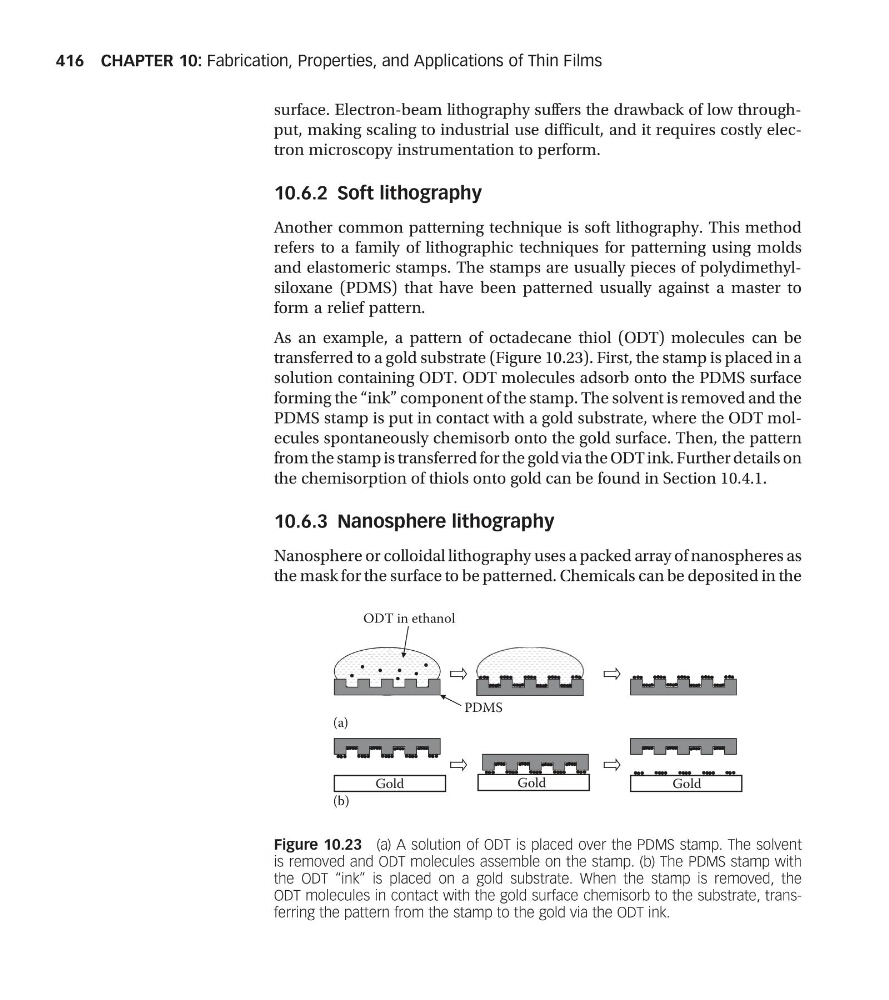
As an example, a pattern of octadecane thiol (ODT) molecules can be
transferred to a gold substrate (Figure 10.23). First, the stamp is placed in a
solution containing ODT. ODT molecules adsorb onto the PDMS surface
forming the “ink” component of the stamp. The solvent is removed and the
PDMS stamp is put in contact with a gold substrate, where the ODT molecules spontaneously chemisorb onto the gold surface. Then, the pattern
from the stamp is transferred for the gold via the ODT ink. Further details on
the chemisorption of thiols onto gold can be found in Section 10.4.1.
10.6.3 Nanosphere lithography
Nanosphere or colloidal lithography uses a packed array of nanospheres as
the mask for the surface to be patterned. Chemicals can be deposited in the
PDMS
(a)
Gold
Gold
Gold
(b)
ODT in ethanol
Figure 10.23 (a) A solution of ODT is placed over the PDMS stamp. The solvent
is removed and ODT molecules assemble on the stamp. (b) The PDMS stamp with
the ODT “ink” is placed on a gold substrate. When the stamp is removed, the
ODT molecules in contact with the gold surface chemisorb to the substrate, transferring the pattern from the stamp to the gold via the ODT ink.
CHAPTER 10: Fabrication, Properties, and Applications of Thin Films
416
10.6.2 Soft lithography
Another common patterning technique is soft lithography. This method
refers to a family of lithographic techniques for patterning using molds
and elastomeric stamps. The stamps are usually pieces of polydimethylsiloxane (PDMS) that have been patterned usually against a master to
form a relief pattern.
As an example, a pattern of octadecane thiol (ODT) molecules can be
transferred to a gold substrate (Figure 10.23). First, the stamp is placed in a
solution containing ODT. ODT molecules adsorb onto the PDMS surface
forming the “ink” component of the stamp. The solvent is removed and the
PDMS stamp is put in contact with a gold substrate, where the ODT molecules spontaneously chemisorb onto the gold surface. Then, the pattern
from the stamp is transferred for the gold via the ODT ink. Further details on
the chemisorption of thiols onto gold can be found in Section 10.4.1.
10.6.3 Nanosphere lithography
Nanosphere or colloidal lithography uses a packed array of nanospheres as
the mask for the surface to be patterned. Chemicals can be deposited in the
PDMS
(a)
Gold
Gold
Gold
(b)
ODT in ethanol
Figure 10.23 (a) A solution of ODT is placed over the PDMS stamp. The solvent
is removed and ODT molecules assemble on the stamp. (b) The PDMS stamp with
the ODT “ink” is placed on a gold substrate. When the stamp is removed, the
ODT molecules in contact with the gold surface chemisorb to the substrate, transferring the pattern from the stamp to the gold via the ODT ink.
CHAPTER 10: Fabrication, Properties, and Applications of Thin Films
416