

temperature (T g , the point at which it transitions from a solid to a rubbery,
viscous liquid) and placed under a strong electric field. The dipoles of the
molecules reorient to align with the field, resisted by thermal energy, which
causes them to randomly rotate. For a weakly-interacting system (for
example, a dye at low concentrations in a polymer film), the order with
respect to the electric field can be approximated by the Langevin model.
cos q
h
i≈
μE 0
3k B T
cos
3 q
≈
μE 0
5k B T
(10.4)
where q is the angle between the dipole and the electric field, μ is the
dipole moment of the molecule being poled, and average E 0 is the local
electric field acting on each dipole, approximated as
E 0 =
3e
2e + n
2
E applied
(10.5)
where e is the dielectric constant of the material, n is the refractive index of
the material, and E applied is the applied field strength, which is simply the
applied voltage divided by the thickness of the film (V/d). Note the similarities of Equations 10.4 and 10.5 to the Onsager model discussed in
Chapter 5; both models rely on the same assumption that the response of a
molecule to an electric field (dielectric response) can be modeled by freely
rotating dipoles that only interact with their surrounding environment in
an averaged manner.
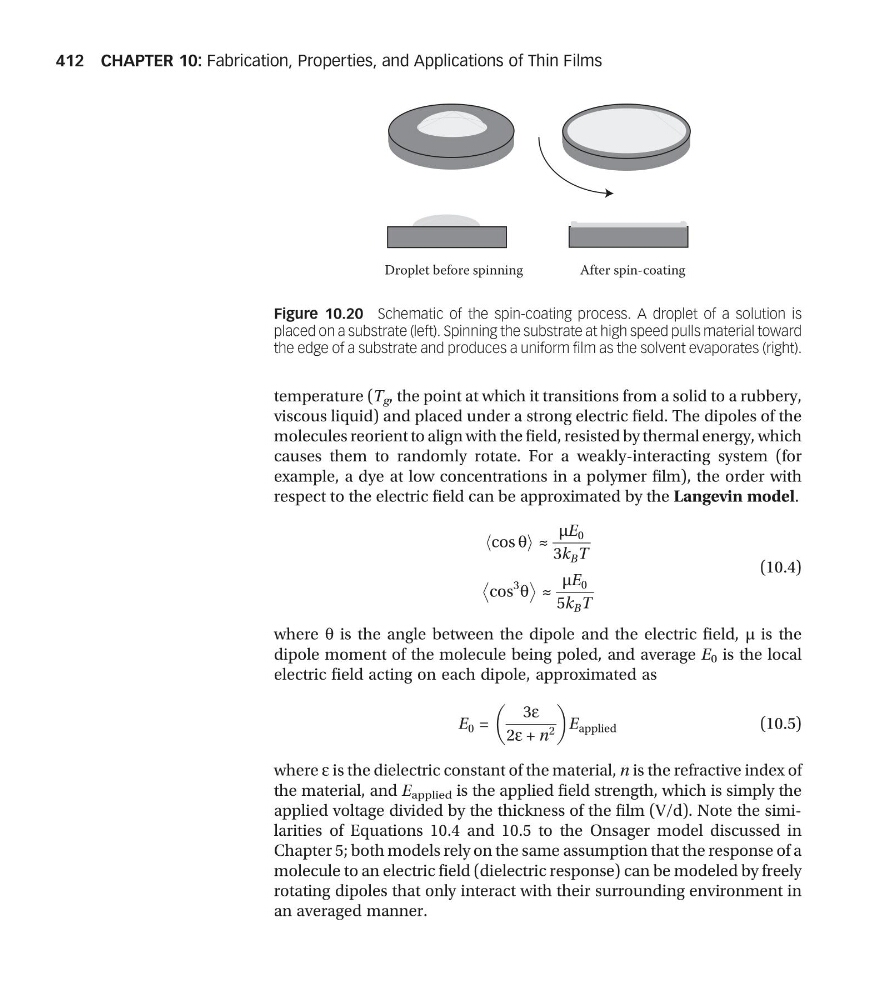
Droplet before spinning
After spin-coating
Figure 10.20 Schematic of the spin-coating process. A droplet of a solution is
placed on a substrate (left). Spinning the substrate at high speed pulls material toward
the edge of a substrate and produces a uniform film as the solvent evaporates (right).
CHAPTER 10: Fabrication, Properties, and Applications of Thin Films
412
viscous liquid) and placed under a strong electric field. The dipoles of the
molecules reorient to align with the field, resisted by thermal energy, which
causes them to randomly rotate. For a weakly-interacting system (for
example, a dye at low concentrations in a polymer film), the order with
respect to the electric field can be approximated by the Langevin model.
cos q
h
i≈
μE 0
3k B T
cos
3 q
≈
μE 0
5k B T
(10.4)
where q is the angle between the dipole and the electric field, μ is the
dipole moment of the molecule being poled, and average E 0 is the local
electric field acting on each dipole, approximated as
E 0 =
3e
2e + n
2
E applied
(10.5)
where e is the dielectric constant of the material, n is the refractive index of
the material, and E applied is the applied field strength, which is simply the
applied voltage divided by the thickness of the film (V/d). Note the similarities of Equations 10.4 and 10.5 to the Onsager model discussed in
Chapter 5; both models rely on the same assumption that the response of a
molecule to an electric field (dielectric response) can be modeled by freely
rotating dipoles that only interact with their surrounding environment in
an averaged manner.
Droplet before spinning
After spin-coating
Figure 10.20 Schematic of the spin-coating process. A droplet of a solution is
placed on a substrate (left). Spinning the substrate at high speed pulls material toward
the edge of a substrate and produces a uniform film as the solvent evaporates (right).
CHAPTER 10: Fabrication, Properties, and Applications of Thin Films
412