

to stabilize the reactive surface of the particle and can provide specific
organic functional groups at the particle–solvent interface. This surface
functionalization is particularly useful for applications, such as immunoassays, that are dependent on the chemical composition of the surface.
10.4.2 Silanes on glass
Silanes are generally used to construct SAMs on nonmetallic oxide surfaces, such as those found on silicon and glass surfaces (SiO 2 ). The most
commonly used silane to produce a SAM is octadecyltrichlorosilane (also
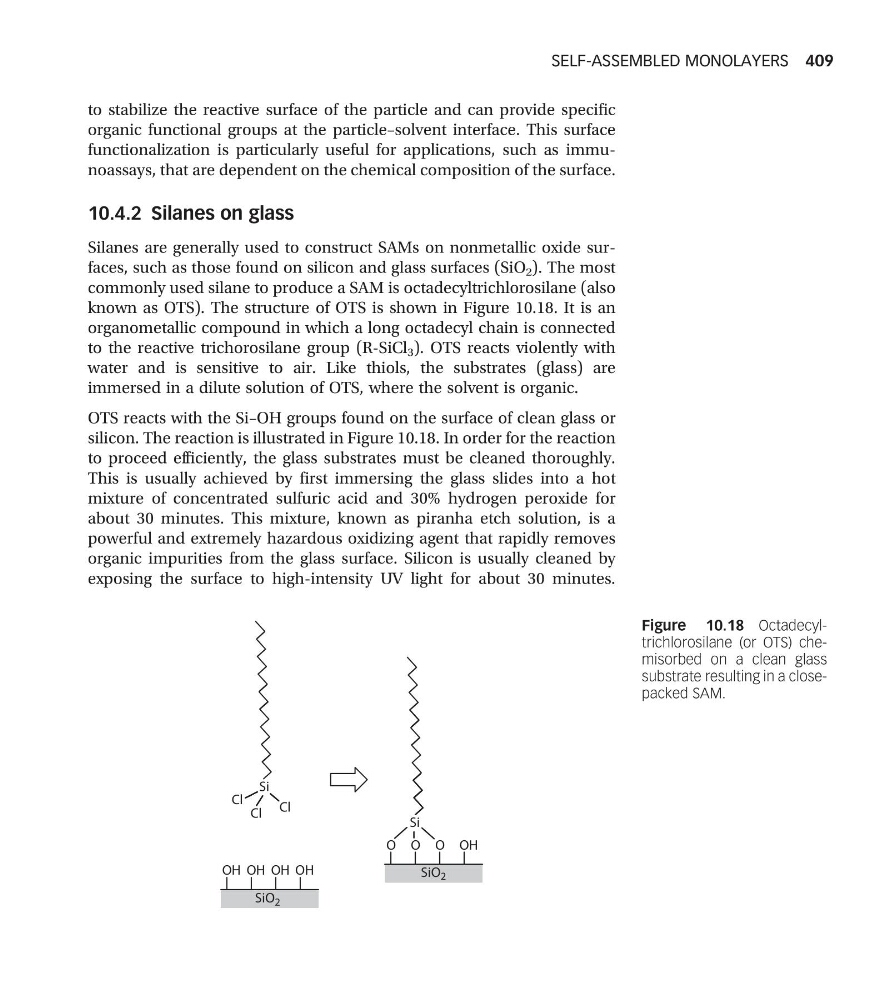
known as OTS). The structure of OTS is shown in Figure 10.18. It is an
organometallic compound in which a long octadecyl chain is connected
to the reactive trichorosilane group (R-SiCl 3 ). OTS reacts violently with
water and is sensitive to air. Like thiols, the substrates (glass) are
immersed in a dilute solution of OTS, where the solvent is organic.
OTS reacts with the Si–OH groups found on the surface of clean glass or
silicon. The reaction is illustrated in Figure 10.18. In order for the reaction
to proceed efficiently, the glass substrates must be cleaned thoroughly.
This is usually achieved by first immersing the glass slides into a hot
mixture of concentrated sulfuric acid and 30% hydrogen peroxide for
about 30 minutes. This mixture, known as piranha etch solution, is a
powerful and extremely hazardous oxidizing agent that rapidly removes
organic impurities from the glass surface. Silicon is usually cleaned by
exposing the surface to high-intensity UV light for about 30 minutes.
Si
Cl
OH OH OH OH
Cl
Cl
O O O OH
Si
SiO 2
SiO 2
Figure 10.18 Octadecyltrichlorosilane (or OTS) chemisorbed on a clean glass
substrate resulting in a closepacked SAM.
SELF-ASSEMBLED MONOLAYERS 409
organic functional groups at the particle–solvent interface. This surface
functionalization is particularly useful for applications, such as immunoassays, that are dependent on the chemical composition of the surface.
10.4.2 Silanes on glass
Silanes are generally used to construct SAMs on nonmetallic oxide surfaces, such as those found on silicon and glass surfaces (SiO 2 ). The most
commonly used silane to produce a SAM is octadecyltrichlorosilane (also
known as OTS). The structure of OTS is shown in Figure 10.18. It is an
organometallic compound in which a long octadecyl chain is connected
to the reactive trichorosilane group (R-SiCl 3 ). OTS reacts violently with
water and is sensitive to air. Like thiols, the substrates (glass) are
immersed in a dilute solution of OTS, where the solvent is organic.
OTS reacts with the Si–OH groups found on the surface of clean glass or
silicon. The reaction is illustrated in Figure 10.18. In order for the reaction
to proceed efficiently, the glass substrates must be cleaned thoroughly.
This is usually achieved by first immersing the glass slides into a hot
mixture of concentrated sulfuric acid and 30% hydrogen peroxide for
about 30 minutes. This mixture, known as piranha etch solution, is a
powerful and extremely hazardous oxidizing agent that rapidly removes
organic impurities from the glass surface. Silicon is usually cleaned by
exposing the surface to high-intensity UV light for about 30 minutes.
Si
Cl
OH OH OH OH
Cl
Cl
O O O OH
Si
SiO 2
SiO 2
Figure 10.18 Octadecyltrichlorosilane (or OTS) chemisorbed on a clean glass
substrate resulting in a closepacked SAM.
SELF-ASSEMBLED MONOLAYERS 409