

the surface tension of the pure water and the surface tension of the
aqueous solution containing amphiphilic solutes. This phenomenon is
especially important in Langmuir films. If the number of molecules
comprising the Langmuir film is known, then surface pressure as a
function of the area occupied by each molecule may be studied. The
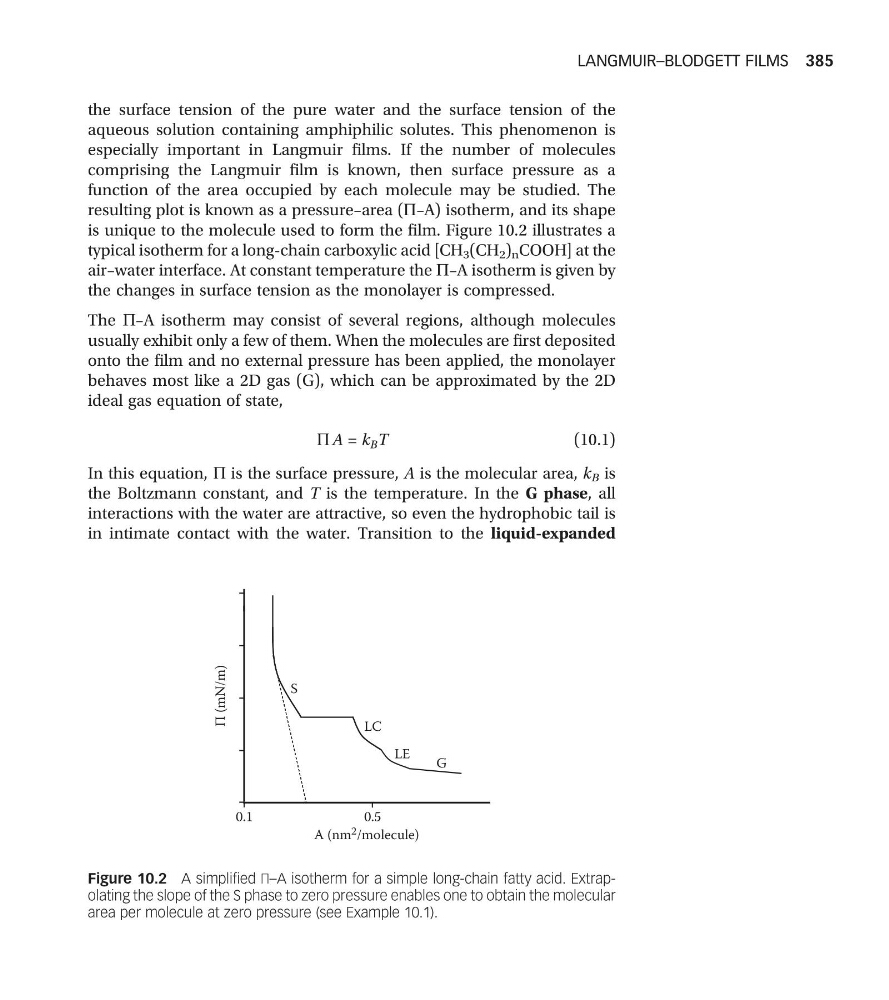
resulting plot is known as a pressure–area (P–A) isotherm, and its shape
is unique to the molecule used to form the film. Figure 10.2 illustrates a
typical isotherm for a long-chain carboxylic acid [CH 3 (CH 2 ) n COOH] at the
air–water interface. At constant temperature the P–A isotherm is given by
the changes in surface tension as the monolayer is compressed.
The P–A isotherm may consist of several regions, although molecules
usually exhibit only a few of them. When the molecules are first deposited
onto the film and no external pressure has been applied, the monolayer
behaves most like a 2D gas (G), which can be approximated by the 2D
ideal gas equation of state,
P A = k B T
(10.1)
In this equation, P is the surface pressure, A is the molecular area, k B is
the Boltzmann constant, and T is the temperature. In the G phase, all
interactions with the water are attractive, so even the hydrophobic tail is
in intimate contact with the water. Transition to the liquid-expanded
Π (mN/m)
LC
S
G
LE
A (nm 2 /molecule)
0.1
0.5
Figure 10.2 A simplified Π–A isotherm for a simple long-chain fatty acid. Extrapolating the slope of the S phase to zero pressure enables one to obtain the molecular
area per molecule at zero pressure (see Example 10.1).
LANGMUIR–BLODGETT FILMS 385
aqueous solution containing amphiphilic solutes. This phenomenon is
especially important in Langmuir films. If the number of molecules
comprising the Langmuir film is known, then surface pressure as a
function of the area occupied by each molecule may be studied. The
resulting plot is known as a pressure–area (P–A) isotherm, and its shape
is unique to the molecule used to form the film. Figure 10.2 illustrates a
typical isotherm for a long-chain carboxylic acid [CH 3 (CH 2 ) n COOH] at the
air–water interface. At constant temperature the P–A isotherm is given by
the changes in surface tension as the monolayer is compressed.
The P–A isotherm may consist of several regions, although molecules
usually exhibit only a few of them. When the molecules are first deposited
onto the film and no external pressure has been applied, the monolayer
behaves most like a 2D gas (G), which can be approximated by the 2D
ideal gas equation of state,
P A = k B T
(10.1)
In this equation, P is the surface pressure, A is the molecular area, k B is
the Boltzmann constant, and T is the temperature. In the G phase, all
interactions with the water are attractive, so even the hydrophobic tail is
in intimate contact with the water. Transition to the liquid-expanded
Π (mN/m)
LC
S
G
LE
A (nm 2 /molecule)
0.1
0.5
Figure 10.2 A simplified Π–A isotherm for a simple long-chain fatty acid. Extrapolating the slope of the S phase to zero pressure enables one to obtain the molecular
area per molecule at zero pressure (see Example 10.1).
LANGMUIR–BLODGETT FILMS 385