

10.1.1 Langmuir films
The first step of LB multilayer assembly is to form a Langmuir film by
dissolving surface-active organic molecules, such as surfactants or
amphiphiles, in a nonpolar, volatile solvent and then spreading the
solution onto a polar liquid surface, usually water. Once the volatile
solvent evaporates, the remaining amphiphilic molecules are oriented at
the air–water interface so that the hydrophilic headgroups are buried in
the bulk aqueous phase while the hydrophobic tail groups are directed
upward into the air. However, for this orientation to occur, two conditions
must be met: (1) the hydrophobic tail must be long enough to prevent its
dissolution in the aqueous media, and (2) the hydrophilicity of the
headgroup must be strong enough to prevent the formation of thicker
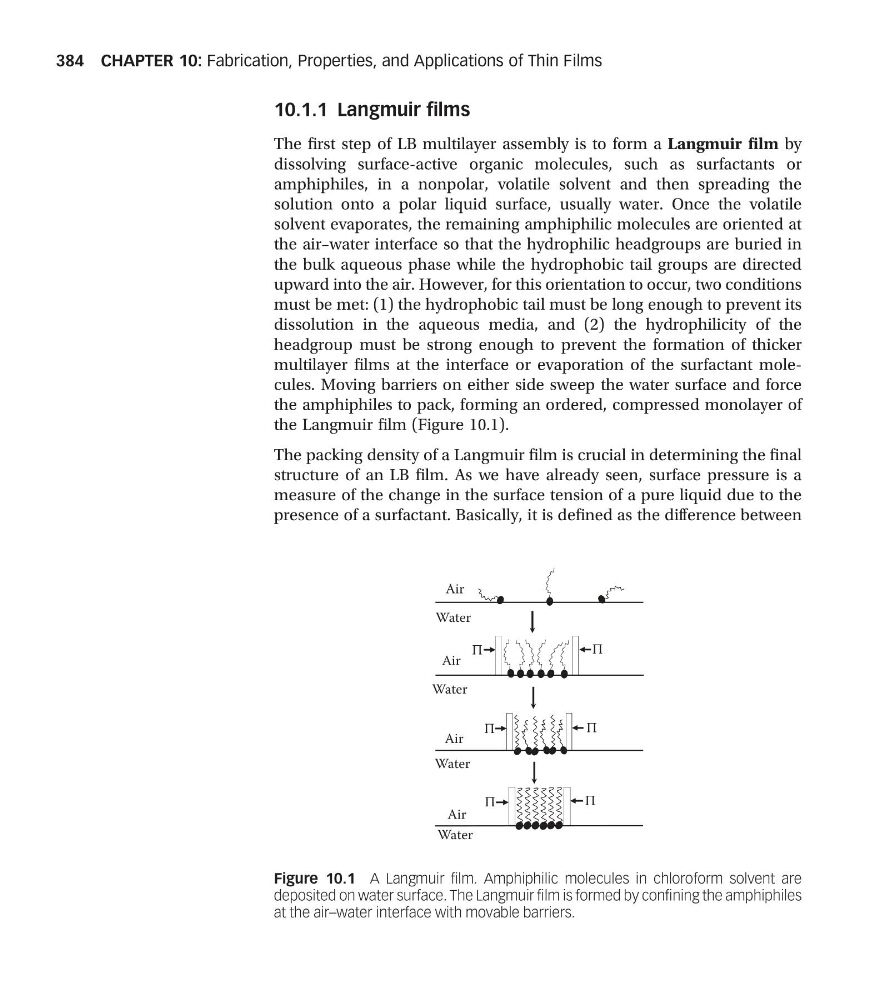
multilayer films at the interface or evaporation of the surfactant molecules. Moving barriers on either side sweep the water surface and force
the amphiphiles to pack, forming an ordered, compressed monolayer of
the Langmuir film (Figure 10.1).
The packing density of a Langmuir film is crucial in determining the final
structure of an LB film. As we have already seen, surface pressure is a
measure of the change in the surface tension of a pure liquid due to the
presence of a surfactant. Basically, it is defined as the difference between
Air
Π
Π
Water
Air
Π
Π
Water
Π
Π
Air
Water
Air
Water
Figure 10.1 A Langmuir film. Amphiphilic molecules in chloroform solvent are
deposited on water surface. The Langmuir film is formed by confining the amphiphiles
at the air–water interface with movable barriers.
CHAPTER 10: Fabrication, Properties, and Applications of Thin Films
384
The first step of LB multilayer assembly is to form a Langmuir film by
dissolving surface-active organic molecules, such as surfactants or
amphiphiles, in a nonpolar, volatile solvent and then spreading the
solution onto a polar liquid surface, usually water. Once the volatile
solvent evaporates, the remaining amphiphilic molecules are oriented at
the air–water interface so that the hydrophilic headgroups are buried in
the bulk aqueous phase while the hydrophobic tail groups are directed
upward into the air. However, for this orientation to occur, two conditions
must be met: (1) the hydrophobic tail must be long enough to prevent its
dissolution in the aqueous media, and (2) the hydrophilicity of the
headgroup must be strong enough to prevent the formation of thicker
multilayer films at the interface or evaporation of the surfactant molecules. Moving barriers on either side sweep the water surface and force
the amphiphiles to pack, forming an ordered, compressed monolayer of
the Langmuir film (Figure 10.1).
The packing density of a Langmuir film is crucial in determining the final
structure of an LB film. As we have already seen, surface pressure is a
measure of the change in the surface tension of a pure liquid due to the
presence of a surfactant. Basically, it is defined as the difference between
Air
Π
Π
Water
Air
Π
Π
Water
Π
Π
Air
Water
Air
Water
Figure 10.1 A Langmuir film. Amphiphilic molecules in chloroform solvent are
deposited on water surface. The Langmuir film is formed by confining the amphiphiles
at the air–water interface with movable barriers.
CHAPTER 10: Fabrication, Properties, and Applications of Thin Films
384