

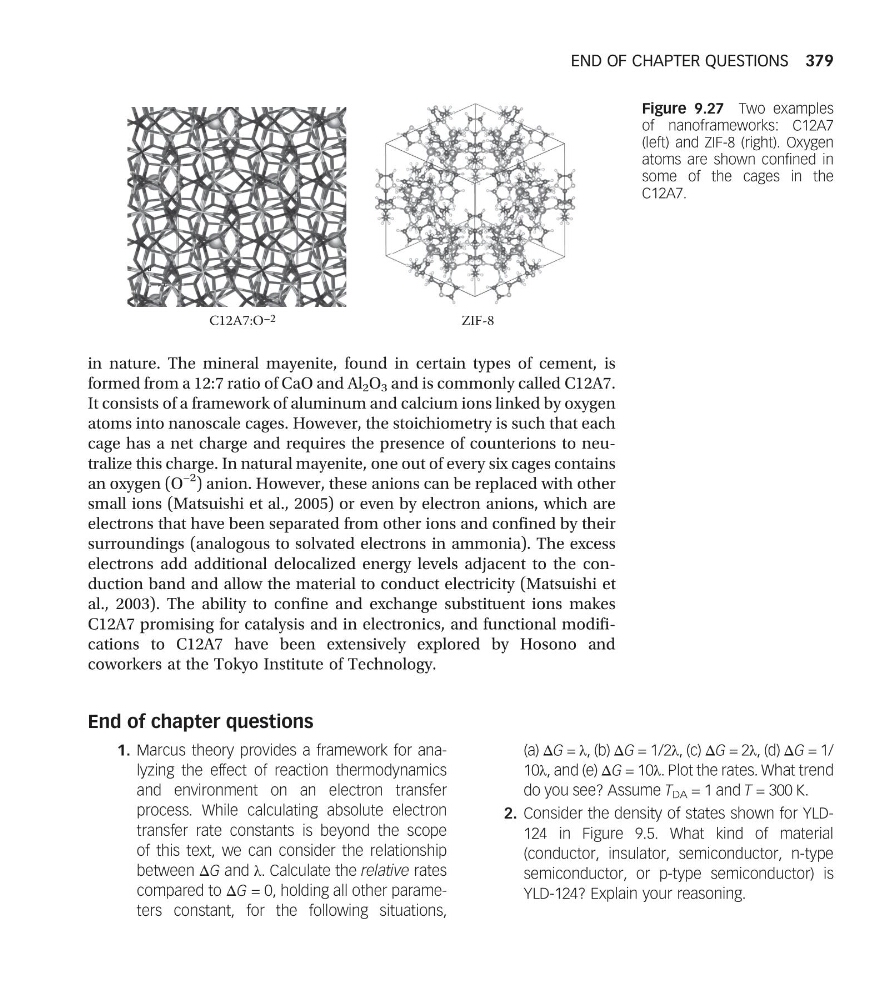
in nature. The mineral mayenite, found in certain types of cement, is
formed from a 12:7 ratio of CaO and Al 2 O 3 and is commonly called C12A7.
It consists of a framework of aluminum and calcium ions linked by oxygen
atoms into nanoscale cages. However, the stoichiometry is such that each
cage has a net charge and requires the presence of counterions to neutralize this charge. In natural mayenite, one out of every six cages contains
an oxygen (O
−2 ) anion. However, these anions can be replaced with other
small ions (Matsuishi et al., 2005) or even by electron anions, which are
electrons that have been separated from other ions and confined by their
surroundings (analogous to solvated electrons in ammonia). The excess
electrons add additional delocalized energy levels adjacent to the conduction band and allow the material to conduct electricity (Matsuishi et
al., 2003). The ability to confine and exchange substituent ions makes
C12A7 promising for catalysis and in electronics, and functional modifications to C12A7 have been extensively explored by Hosono and
coworkers at the Tokyo Institute of Technology.
C12A7:O –2
ZIF-8
Figure 9.27 Two examples
of nanoframeworks: C12A7
(left) and ZIF-8 (right). Oxygen
atoms are shown confined in
some of the cages in the
C12A7.
End of chapter questions
1. Marcus theory provides a framework for analyzing the effect of reaction thermodynamics
and environment on an electron transfer
process. While calculating absolute electron
transfer rate constants is beyond the scope
of this text, we can consider the relationship
between ΔG and λ. Calculate the relative rates
compared to ΔG = 0, holding all other parameters constant, for the following situations,
(a) ΔG = λ, (b) ΔG = 1/2λ, (c) ΔG = 2λ, (d) ΔG = 1/
10λ, and (e) ΔG = 10λ. Plot the rates. What trend
do you see? Assume T DA = 1 and T = 300 K.
2. Consider the density of states shown for YLD124 in Figure 9.5. What kind of material
(conductor, insulator, semiconductor, n-type
semiconductor, or p-type semiconductor) is
YLD-124? Explain your reasoning.
END OF CHAPTER QUESTIONS 379
formed from a 12:7 ratio of CaO and Al 2 O 3 and is commonly called C12A7.
It consists of a framework of aluminum and calcium ions linked by oxygen
atoms into nanoscale cages. However, the stoichiometry is such that each
cage has a net charge and requires the presence of counterions to neutralize this charge. In natural mayenite, one out of every six cages contains
an oxygen (O
−2 ) anion. However, these anions can be replaced with other
small ions (Matsuishi et al., 2005) or even by electron anions, which are
electrons that have been separated from other ions and confined by their
surroundings (analogous to solvated electrons in ammonia). The excess
electrons add additional delocalized energy levels adjacent to the conduction band and allow the material to conduct electricity (Matsuishi et
al., 2003). The ability to confine and exchange substituent ions makes
C12A7 promising for catalysis and in electronics, and functional modifications to C12A7 have been extensively explored by Hosono and
coworkers at the Tokyo Institute of Technology.
C12A7:O –2
ZIF-8
Figure 9.27 Two examples
of nanoframeworks: C12A7
(left) and ZIF-8 (right). Oxygen
atoms are shown confined in
some of the cages in the
C12A7.
End of chapter questions
1. Marcus theory provides a framework for analyzing the effect of reaction thermodynamics
and environment on an electron transfer
process. While calculating absolute electron
transfer rate constants is beyond the scope
of this text, we can consider the relationship
between ΔG and λ. Calculate the relative rates
compared to ΔG = 0, holding all other parameters constant, for the following situations,
(a) ΔG = λ, (b) ΔG = 1/2λ, (c) ΔG = 2λ, (d) ΔG = 1/
10λ, and (e) ΔG = 10λ. Plot the rates. What trend
do you see? Assume T DA = 1 and T = 300 K.
2. Consider the density of states shown for YLD124 in Figure 9.5. What kind of material
(conductor, insulator, semiconductor, n-type
semiconductor, or p-type semiconductor) is
YLD-124? Explain your reasoning.
END OF CHAPTER QUESTIONS 379