

Another interesting property of graphene is its ability to exhibit quantized
conductance when subjected to a strong magnetic field. This effect is
known as the quantum Hall effect and had been previously observed in
other two-dimensional materials at low temperatures but can occur in
graphene at room temperature (Novoselov et al., 2007). Materials
exhibiting the quantum Hall effect exhibit discrete states with different
conductivities in a manner similar to nanowires; the conductance of a 2D
system exhibiting the quantum Hall effect is the von Klitzing equation
(Klitzing et al., 1980):
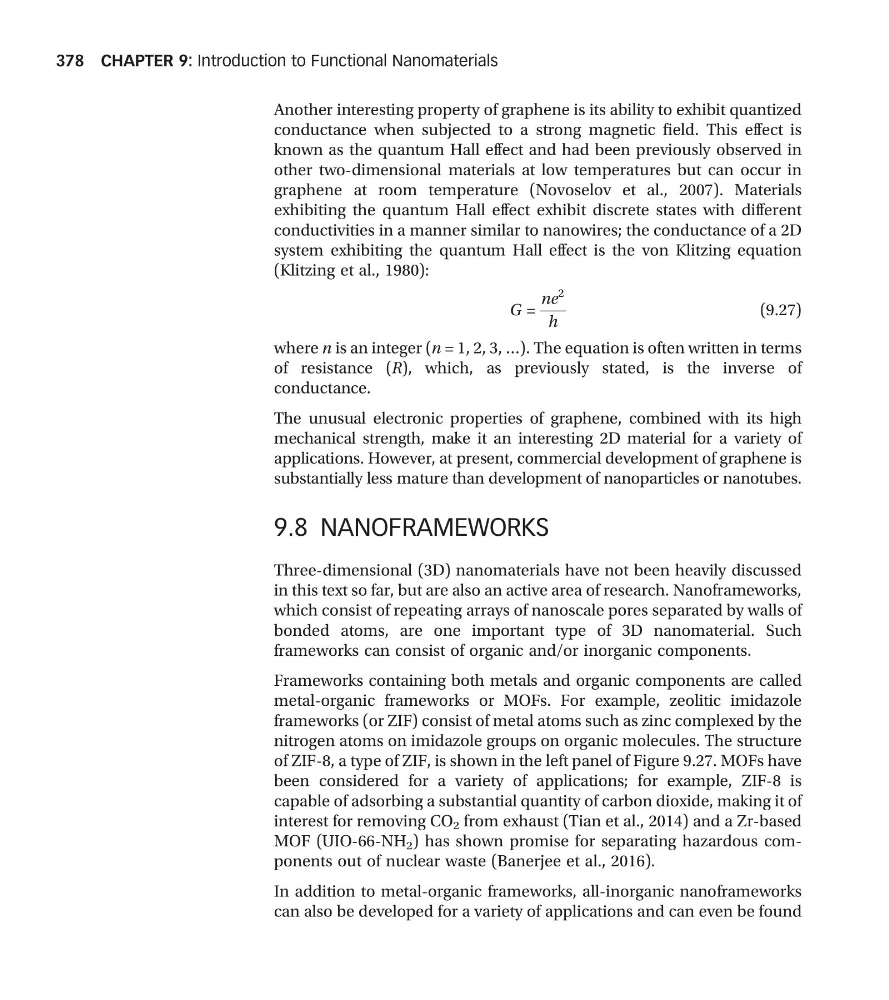
G =
ne
2
h
(9.27)
where n is an integer (n = 1, 2, 3, …). The equation is often written in terms
of resistance (R), which, as previously stated, is the inverse of
conductance.
The unusual electronic properties of graphene, combined with its high
mechanical strength, make it an interesting 2D material for a variety of
applications. However, at present, commercial development of graphene is
substantially less mature than development of nanoparticles or nanotubes.
9.8 NANOFRAMEWORKS
Three-dimensional (3D) nanomaterials have not been heavily discussed
in this text so far, but are also an active area of research. Nanoframeworks,
which consist of repeating arrays of nanoscale pores separated by walls of
bonded atoms, are one important type of 3D nanomaterial. Such
frameworks can consist of organic and/or inorganic components.
Frameworks containing both metals and organic components are called
metal-organic frameworks or MOFs. For example, zeolitic imidazole
frameworks (or ZIF) consist of metal atoms such as zinc complexed by the
nitrogen atoms on imidazole groups on organic molecules. The structure
of ZIF-8, a type of ZIF, is shown in the left panel of Figure 9.27. MOFs have
been considered for a variety of applications; for example, ZIF-8 is
capable of adsorbing a substantial quantity of carbon dioxide, making it of
interest for removing CO 2 from exhaust (Tian et al., 2014) and a Zr-based
MOF (UIO-66-NH 2 ) has shown promise for separating hazardous components out of nuclear waste (Banerjee et al., 2016).
In addition to metal-organic frameworks, all-inorganic nanoframeworks
can also be developed for a variety of applications and can even be found
CHAPTER 9: Introduction to Functional Nanomaterials
378
conductance when subjected to a strong magnetic field. This effect is
known as the quantum Hall effect and had been previously observed in
other two-dimensional materials at low temperatures but can occur in
graphene at room temperature (Novoselov et al., 2007). Materials
exhibiting the quantum Hall effect exhibit discrete states with different
conductivities in a manner similar to nanowires; the conductance of a 2D
system exhibiting the quantum Hall effect is the von Klitzing equation
(Klitzing et al., 1980):
G =
ne
2
h
(9.27)
where n is an integer (n = 1, 2, 3, …). The equation is often written in terms
of resistance (R), which, as previously stated, is the inverse of
conductance.
The unusual electronic properties of graphene, combined with its high
mechanical strength, make it an interesting 2D material for a variety of
applications. However, at present, commercial development of graphene is
substantially less mature than development of nanoparticles or nanotubes.
9.8 NANOFRAMEWORKS
Three-dimensional (3D) nanomaterials have not been heavily discussed
in this text so far, but are also an active area of research. Nanoframeworks,
which consist of repeating arrays of nanoscale pores separated by walls of
bonded atoms, are one important type of 3D nanomaterial. Such
frameworks can consist of organic and/or inorganic components.
Frameworks containing both metals and organic components are called
metal-organic frameworks or MOFs. For example, zeolitic imidazole
frameworks (or ZIF) consist of metal atoms such as zinc complexed by the
nitrogen atoms on imidazole groups on organic molecules. The structure
of ZIF-8, a type of ZIF, is shown in the left panel of Figure 9.27. MOFs have
been considered for a variety of applications; for example, ZIF-8 is
capable of adsorbing a substantial quantity of carbon dioxide, making it of
interest for removing CO 2 from exhaust (Tian et al., 2014) and a Zr-based
MOF (UIO-66-NH 2 ) has shown promise for separating hazardous components out of nuclear waste (Banerjee et al., 2016).
In addition to metal-organic frameworks, all-inorganic nanoframeworks
can also be developed for a variety of applications and can even be found
CHAPTER 9: Introduction to Functional Nanomaterials
378