

9.4.2.4 Synthesis in a structured medium
Quantum dots can also be synthesized in a confined medium. A matrix is
used to define a reaction space—it provides a mesoscopic reaction
chamber in which the crystal can grow only to a certain size. The properties of the system control the properties as well as the size of
nanoparticles. Substances typically used as matrices are layered solids,
micelles/microemulsions, gels, polymers, and gasses. This technique is
often used in biologically related processes. An example of this is the use
of empty polypeptide cages found in the iron storage protein ferritin in
the synthesis of bioinorganic nanocomposites of CdS-ferritin.
9.4.3 In vivo imaging with quantum dots
Due to their optical properties as discussed earlier, quantum dots are
better than organic dyes for the purpose of in vivo molecular and cell
imaging. Researchers have achieved real-time visualization of singlemolecule movement in single living cells using quantum dots. Their high
electron density allows correlated optical and electron microscopy studies
of cellular structures. Quantum dot bioconjugation can be achieved by
QD capping
ligand TOPO
Amphiphilic
polymer coating
Quantum
dot
O = P
O
=
P
O
=
P
O
=
P
O
=
P
O = P
O
=
P
O
= P
O = P
O = P
O = P
O
=
P
O
=
P
O
=
P
O
=
P
O
=
P
Affinity ligands: antibody, peptide,
small-molecule drug, inhibitor, etc.
PEG
(–CH 2 –CH 2 –O–)n
O
C CH
O
C NH
O
C
N H
O
C OH
O
C
O H
O
C
O H
O
C O H
O
C
NH
O
C
OH
O
C
O
H
O
C
N
H
O
C
N
H
O
C
O
H
O
C
NH
O
C
OH
O
C
O
H
O
C
N
H
O
C
O
H
O
C
O
C
O
H
O
C
OH
O
C
O
H
O
C
N
H
O
C O H
HN
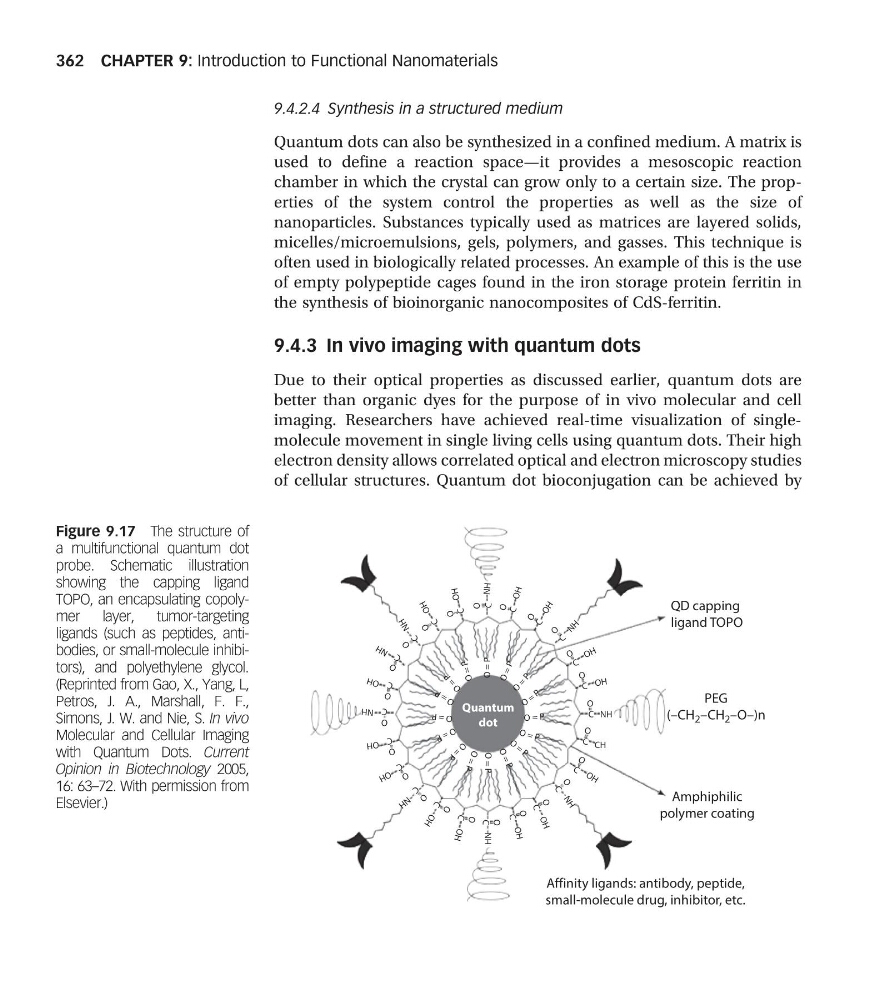
Figure 9.17 The structure of
a multifunctional quantum dot
probe. Schematic illustration
showing the capping ligand
TOPO, an encapsulating copolymer
layer,
tumor-targeting
ligands (such as peptides, antibodies, or small-molecule inhibitors), and polyethylene glycol.
(Reprinted from Gao, X., Yang, L,
Petros, J. A., Marshall, F. F.,
Simons, J. W. and Nie, S. In vivo
Molecular and Cellular Imaging
with Quantum Dots. Current
Opinion in Biotechnology 2005,
16: 63–72. With permission from
Elsevier.)
CHAPTER 9: Introduction to Functional Nanomaterials
362
Quantum dots can also be synthesized in a confined medium. A matrix is
used to define a reaction space—it provides a mesoscopic reaction
chamber in which the crystal can grow only to a certain size. The properties of the system control the properties as well as the size of
nanoparticles. Substances typically used as matrices are layered solids,
micelles/microemulsions, gels, polymers, and gasses. This technique is
often used in biologically related processes. An example of this is the use
of empty polypeptide cages found in the iron storage protein ferritin in
the synthesis of bioinorganic nanocomposites of CdS-ferritin.
9.4.3 In vivo imaging with quantum dots
Due to their optical properties as discussed earlier, quantum dots are
better than organic dyes for the purpose of in vivo molecular and cell
imaging. Researchers have achieved real-time visualization of singlemolecule movement in single living cells using quantum dots. Their high
electron density allows correlated optical and electron microscopy studies
of cellular structures. Quantum dot bioconjugation can be achieved by
QD capping
ligand TOPO
Amphiphilic
polymer coating
Quantum
dot
O = P
O
=
P
O
=
P
O
=
P
O
=
P
O = P
O
=
P
O
= P
O = P
O = P
O = P
O
=
P
O
=
P
O
=
P
O
=
P
O
=
P
Affinity ligands: antibody, peptide,
small-molecule drug, inhibitor, etc.
PEG
(–CH 2 –CH 2 –O–)n
O
C CH
O
C NH
O
C
N H
O
C OH
O
C
O H
O
C
O H
O
C O H
O
C
NH
O
C
OH
O
C
O
H
O
C
N
H
O
C
N
H
O
C
O
H
O
C
NH
O
C
OH
O
C
O
H
O
C
N
H
O
C
O
H
O
C
O
C
O
H
O
C
OH
O
C
O
H
O
C
N
H
O
C O H
HN
Figure 9.17 The structure of
a multifunctional quantum dot
probe. Schematic illustration
showing the capping ligand
TOPO, an encapsulating copolymer
layer,
tumor-targeting
ligands (such as peptides, antibodies, or small-molecule inhibitors), and polyethylene glycol.
(Reprinted from Gao, X., Yang, L,
Petros, J. A., Marshall, F. F.,
Simons, J. W. and Nie, S. In vivo
Molecular and Cellular Imaging
with Quantum Dots. Current
Opinion in Biotechnology 2005,
16: 63–72. With permission from
Elsevier.)
CHAPTER 9: Introduction to Functional Nanomaterials
362