

300–400 nm, making the quantum dot signal easily recognizable above the
background.
9.4.2 Synthesis of quantum dots
9.4.2.1 Precipitative methods
Precipitative synthesis of quantum dots is similar to colloidal synthesis in
that it involves supersaturation of a solution followed by crystallization.
Like traditional chemical processes, colloidal semiconductor nanocrystals
are synthesized from precursor compounds dissolved in solutions. The
precursors are heated to temperatures high enough to convert them to
monomers. Once the monomers reach a high enough supersaturation
level, the nanocrystal growth starts with a nucleation process. The temperature is a critical factor in determining optimal conditions for crystal
growth—it must be high enough to allow for the rearrangement and
annealing of atoms during the synthesis process while being low enough to
promote crystal growth. Furthermore, the size of the crystal depends on
temperature (i.e., it is larger at higher temperatures). Another critical factor
is the monomer concentration. At high monomer concentrations, the
critical size of the crystal is relatively small, resulting in the growth of nearly
all particles and thus facilitating monodispersity (uniformity of the particle
size in the system). When the monomer concentration is depleted during
growth, the critical size becomes larger than the average size present.
The preparation of CdS quantum dots requires the controlled nucleation
of CdS in dilute aqueous solutions of cadmium sulfate and ammonium
Intensity (a.u.)
(b)
1/e
0
5 0
(a)
t 1
t 2
Time (ns)
(c)
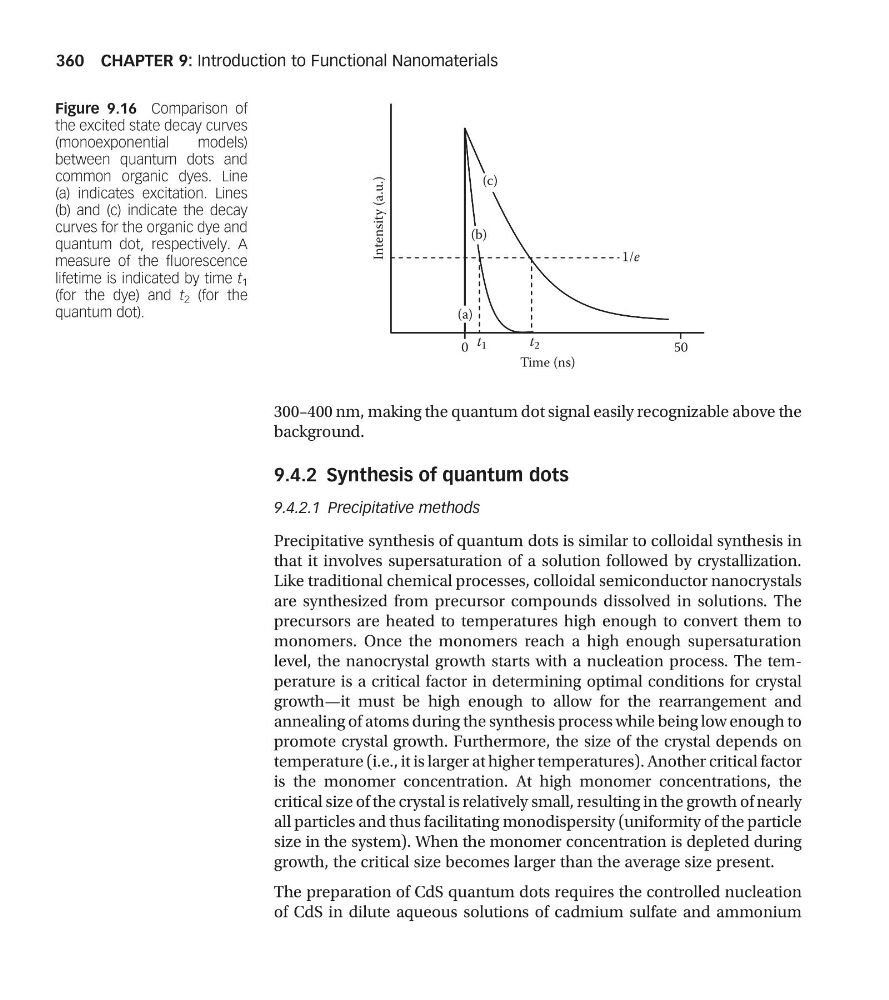
Figure 9.16 Comparison of
the excited state decay curves
(monoexponential
models)
between quantum dots and
common organic dyes. Line
(a) indicates excitation. Lines
(b) and (c) indicate the decay
curves for the organic dye and
quantum dot, respectively. A
measure of the fluorescence
lifetime is indicated by time t 1
(for the dye) and t 2 (for the
quantum dot).
CHAPTER 9: Introduction to Functional Nanomaterials
360
background.
9.4.2 Synthesis of quantum dots
9.4.2.1 Precipitative methods
Precipitative synthesis of quantum dots is similar to colloidal synthesis in
that it involves supersaturation of a solution followed by crystallization.
Like traditional chemical processes, colloidal semiconductor nanocrystals
are synthesized from precursor compounds dissolved in solutions. The
precursors are heated to temperatures high enough to convert them to
monomers. Once the monomers reach a high enough supersaturation
level, the nanocrystal growth starts with a nucleation process. The temperature is a critical factor in determining optimal conditions for crystal
growth—it must be high enough to allow for the rearrangement and
annealing of atoms during the synthesis process while being low enough to
promote crystal growth. Furthermore, the size of the crystal depends on
temperature (i.e., it is larger at higher temperatures). Another critical factor
is the monomer concentration. At high monomer concentrations, the
critical size of the crystal is relatively small, resulting in the growth of nearly
all particles and thus facilitating monodispersity (uniformity of the particle
size in the system). When the monomer concentration is depleted during
growth, the critical size becomes larger than the average size present.
The preparation of CdS quantum dots requires the controlled nucleation
of CdS in dilute aqueous solutions of cadmium sulfate and ammonium
Intensity (a.u.)
(b)
1/e
0
5 0
(a)
t 1
t 2
Time (ns)
(c)
Figure 9.16 Comparison of
the excited state decay curves
(monoexponential
models)
between quantum dots and
common organic dyes. Line
(a) indicates excitation. Lines
(b) and (c) indicate the decay
curves for the organic dye and
quantum dot, respectively. A
measure of the fluorescence
lifetime is indicated by time t 1
(for the dye) and t 2 (for the
quantum dot).
CHAPTER 9: Introduction to Functional Nanomaterials
360